Fall has a way of making us think differently about our homes.
As the days grow shorter and we spend more time indoors, rooms that felt light and breezy all summer can suddenly seem like they need a little more warmth. We bring out throws, add texture, and settle back into the spaces where we will spend much of the season.
Your windows can be part of that transition, too.
One of the most effective ways to add warmth, depth and function to a room is by layering window treatments. Instead of choosing between a shade and drapery, for example, the right solution may be to use both.
It is a technique designers have relied on for years. And while the finished result can look sophisticated, the idea behind it is surprisingly simple.
Each layer has a job to do.
Start with what you need the window to do
Before thinking about fabrics, colors or styles, consider how you use the room.
Do you want plenty of natural light during the day but more privacy in the evening? Does afternoon sun create glare? Do you want a bedroom to feel darker at night? Or does the room feel like it is missing something?
Those answers can help determine whether layering makes sense.
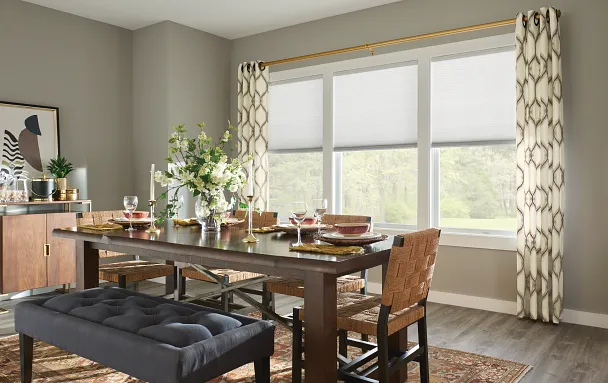
For example, a shade can provide everyday control over light and privacy. Add drapery to introduce softness, texture, and another level of light control, while giving the entire window a more finished appearance.
The result is not simply more decoration. It is more flexibility.
Why shades and drapery work so well together
Think of the shade as the hardworking layer.
Depending on the treatment you choose, it can filter bright sunlight, provide privacy or give you greater control over how much natural light enters the room. It can also offer a clean, tailored look when used on its own.
Drapery brings something different.
Fabric softens the architectural lines of a room and introduces color, pattern or texture. It can also visually frame a window, draw the eye upward, and help the window feel more proportional to the room around it.
Put the two together and you get the strengths of both.
During the day, you might use the shade to soften sunlight while leaving the drapery open. In the evening, closing the drapery can create a warmer, more private atmosphere.
And when both treatments are open? The window still feels intentionally designed.
Layering can make a room feel more complete
There are some rooms where you cannot immediately identify what is missing.
The furniture is right. The rug works. The artwork is hung. The lighting is beautiful.
Still, the room feels a little unfinished.
Look at the windows.
Bare windows or treatments that feel too small for the space can sometimes make the rest of the room feel disconnected. Adding drapery around an existing shade can introduce the softness and scale needed to bring everything together.
This can be particularly effective in living rooms, dining rooms and bedrooms where you want the space to feel comfortable and polished without becoming formal.
The goal is not to make the windows the loudest element in the room. It is to help them feel like they belong.
Does layering make a room feel heavy?
It does not have to.
Layered window treatments can be light, tailored, and understated. Much depends on the fabric, color, treatment style, and how everything is installed.
A room with clean-lined shades and simple neutral drapery can feel completely different from one with richer fabrics and more dramatic color.
That is the beauty of custom treatments. You are not trying to fit your room into a predetermined look. The treatments can be designed around the architecture, furnishings, and overall feeling you want to create.
In some spaces, that might mean barely-there softness. In others, a little more drama may be exactly what the room needs.
And sometimes, one layer is enough
Layering is not the answer for every window.
A beautiful shade may be all a kitchen needs. Shutters may provide the architectural character and privacy a particular room calls for. A streamlined space may look best with a single, thoughtfully selected treatment.
More is not automatically better.
The question is whether another layer improves the way the room looks or functions.
If it does not, you probably do not need it.
You do not have to know what goes together
This may be the most important part.
You do not need to walk into a consultation knowing whether you want a Roman shade with drapery panels, shutters on their own or another combination entirely.
Start with the room.
How do you want it to feel? What bothers you about the windows now? How much privacy do you need? What happens when the afternoon sun comes through? Are there colors, textures, or furnishings you already love?
Those details provide a much better starting point than a product name.
From there, an experienced window treatment professional can help narrow the possibilities and recommend combinations that make sense for your home.
Because good design is not about adding more for the sake of more.
It is about choosing the right elements, giving each one a purpose and bringing them together in a way that feels natural.
And sometimes, the layer that finishes the room has been waiting at the window all along.
Sponsored by VanGogh Window Fashions
Not sure whether your windows need one treatment or a layered look? VanGogh Window Fashions can help you explore custom shades, shutters, and drapery designed around your home and the way you live.