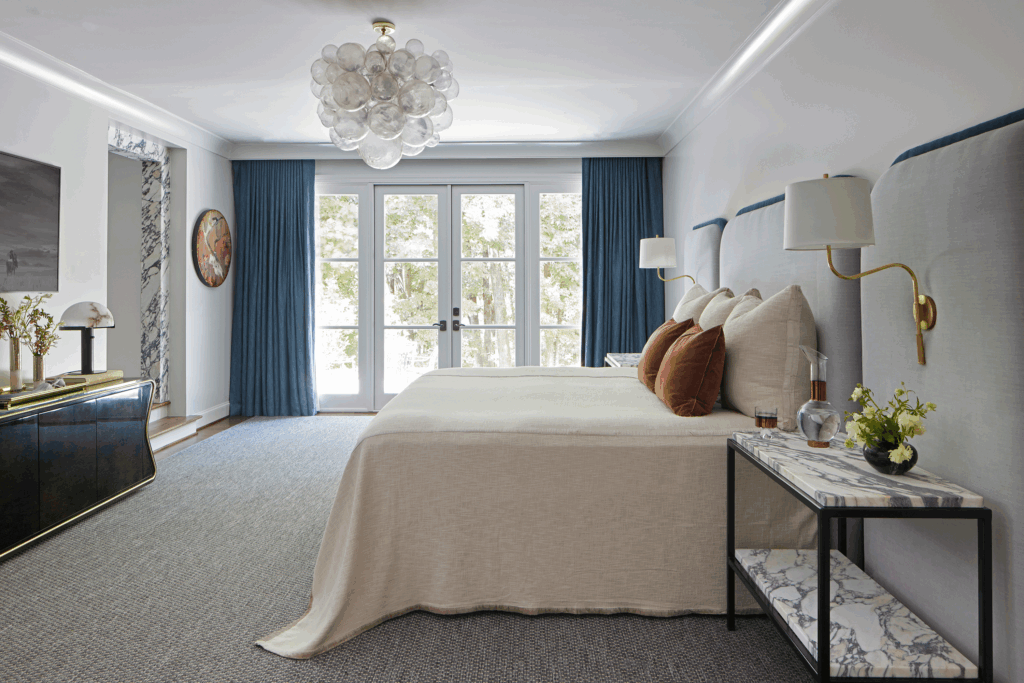
In the bedroom, a custom paneled Mark Jordan bed upholstered in two shades of teal-colored velvet and custom iron-and-marble side tables (also in Calacatta Viola) strike a grand silhouette against a neutral background. A high gloss black vellum credenza, trimmed in textured brass to show its curves, grounds the opposite wall. Windows are dressed in Kravet framing the wooded view beyond. // Photos by Jean Allsopp, Styling by Morgan Stephenson
My clients wanted a hotel-like atmosphere and serene ambiance in their primary suite. The result is an elevated, functional, and highly indulgent space with all the amenities.”
—designer Mary Coley Stevens
A Hotel‑Inspired Retreat at Home
A luxury hotel suite is the stuff of pure indulgence. It’s the kind of place that is instantly transportive, a place where you can close the door and escape the everyday. It’s vacation at its finest, and a feeling that Mary Coley Stevens wanted to recreate for clients in their Tuscaloosa home. “They had a clear vision of what they wanted, and this bed and bath feels like it’s own little world,” Mary Coley says.
A Refined, Modern Color Palette
To achieve that away-from-it-all feeling and harmonize the spaces, Mary Coley worked with her clients to choose modern- leaning pieces in a refined color palette.
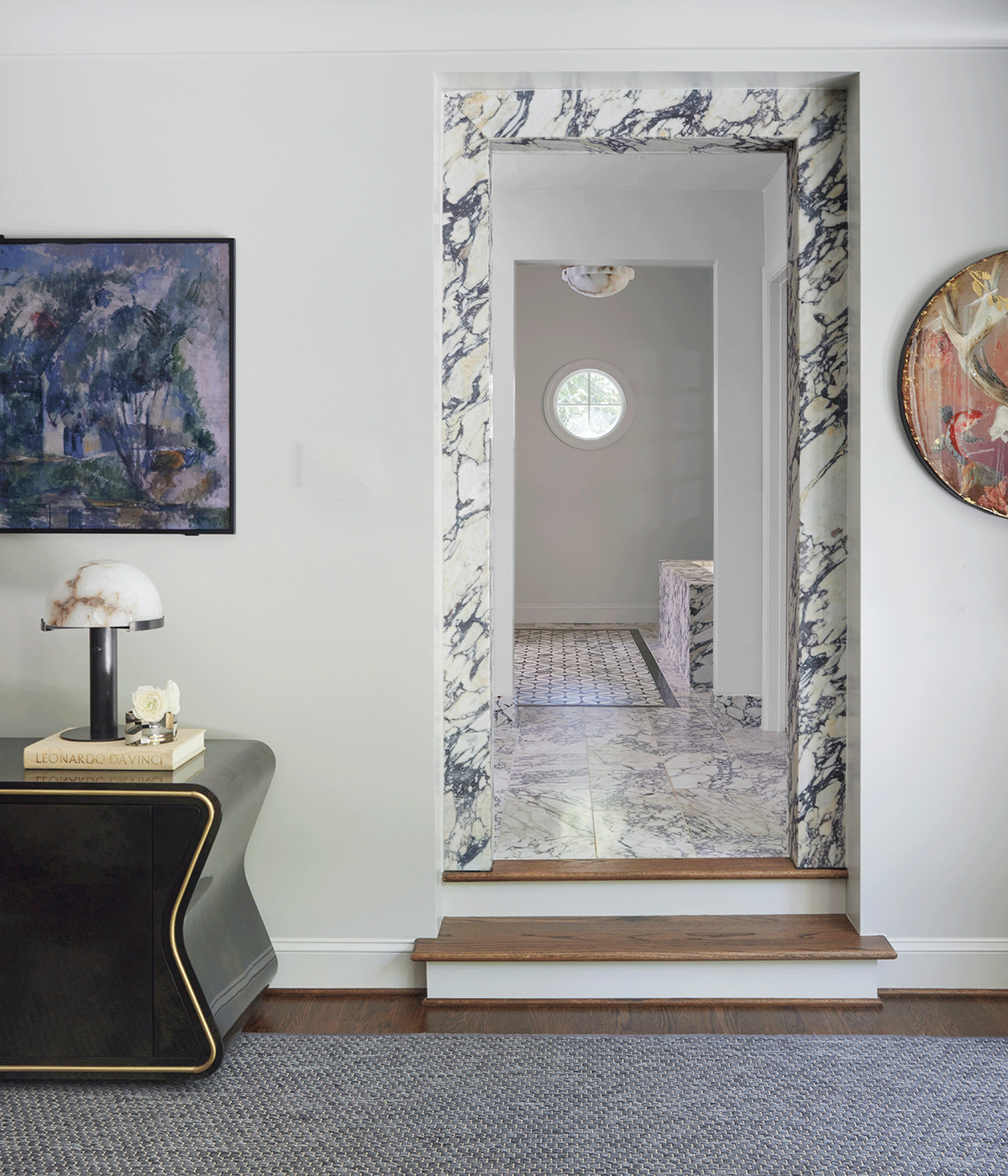
The threshold for the adjacent bath is distinctive with its marble cased opening. It is framed in the same marble as the bathtub to connect the transition between spaces. An ocular window draws the eye across the room.
It all started with the moody veining in a slab of Calacatta Viola marble. “The deep plum tones and creamy background provides great interest while holding a natural, timeless look,” Mary Coley says. To complement those hues, she incorporated black, gold, teal blues, and copper-colored accents for mature color pairings. Fixtures and finishes display gold and brass accents adding to the warmth.
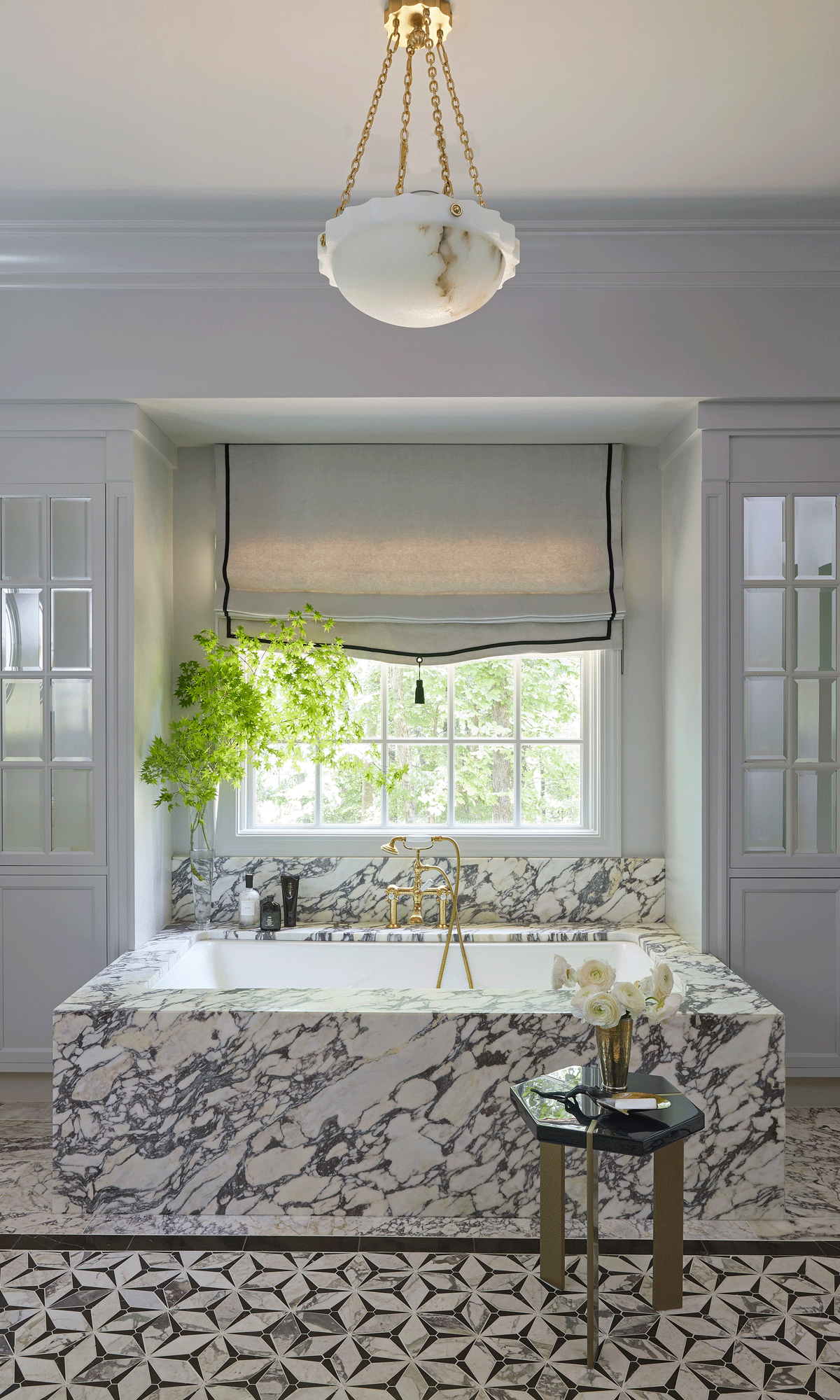
An ulacquered brass fixture gleams against the Calacatta Viola marble framing the Kallista tub. “My clients wanted a large tub with a jet system, so we used the marble to hide the plumbing,” Mary Coley says.
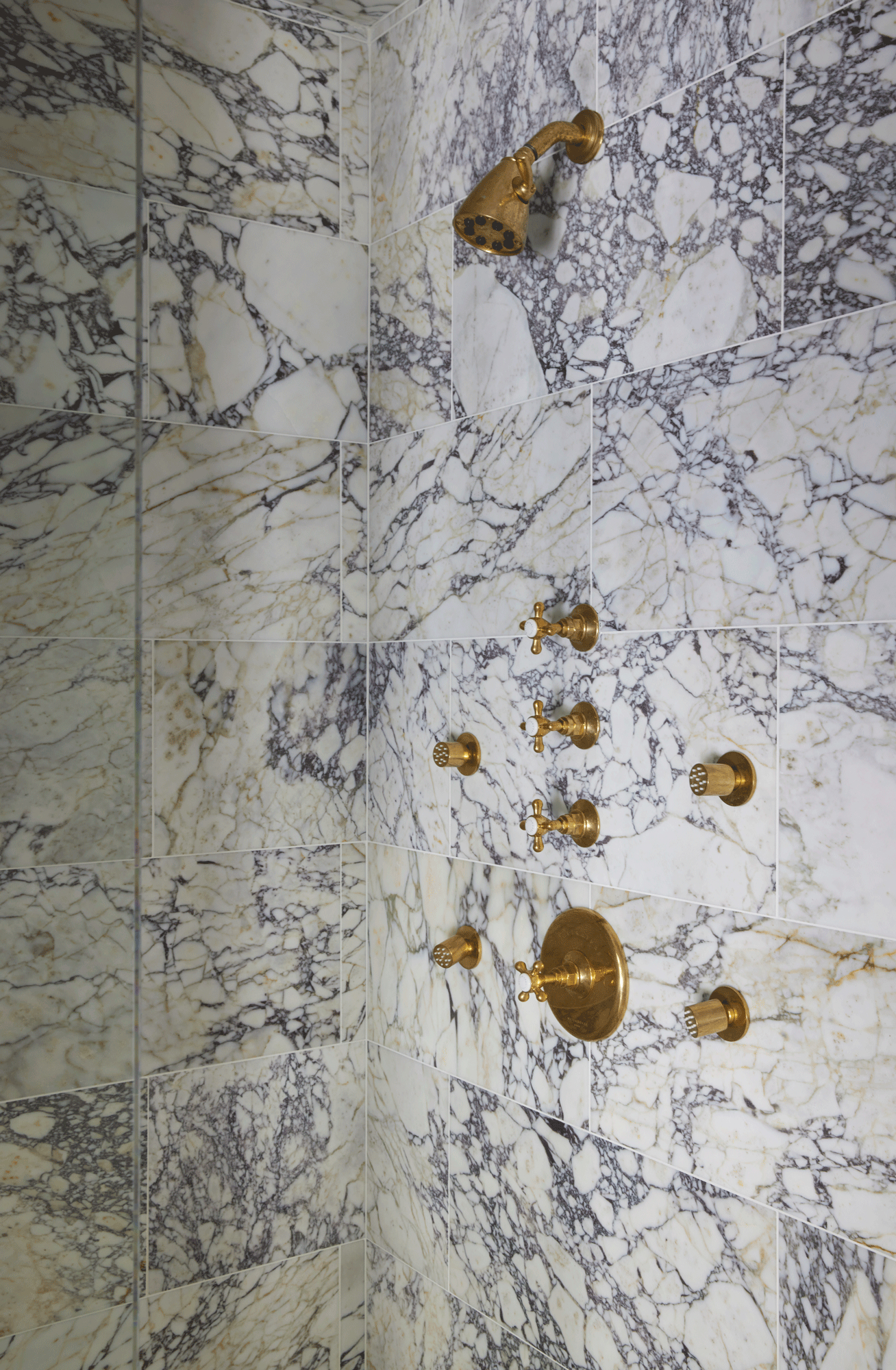
This high-contrast stone provides a vivid, painterly backdrop that transforms the bathroom into a private gallery.
Why This Suite Feels Truly Five‑Star
A truly private sanctuary with considerate design choices and ample amenites, this suite more than meets the standard for style, comfort, and luxury.
A high‑gloss obsidian‑black table with subtle gold flecks and bold brass legs is topped with a whimsical bronze lizard sculpture, while a custom mosaic of Calacatta Viola and Nero Marquina marble adds striking contrast underfoot.
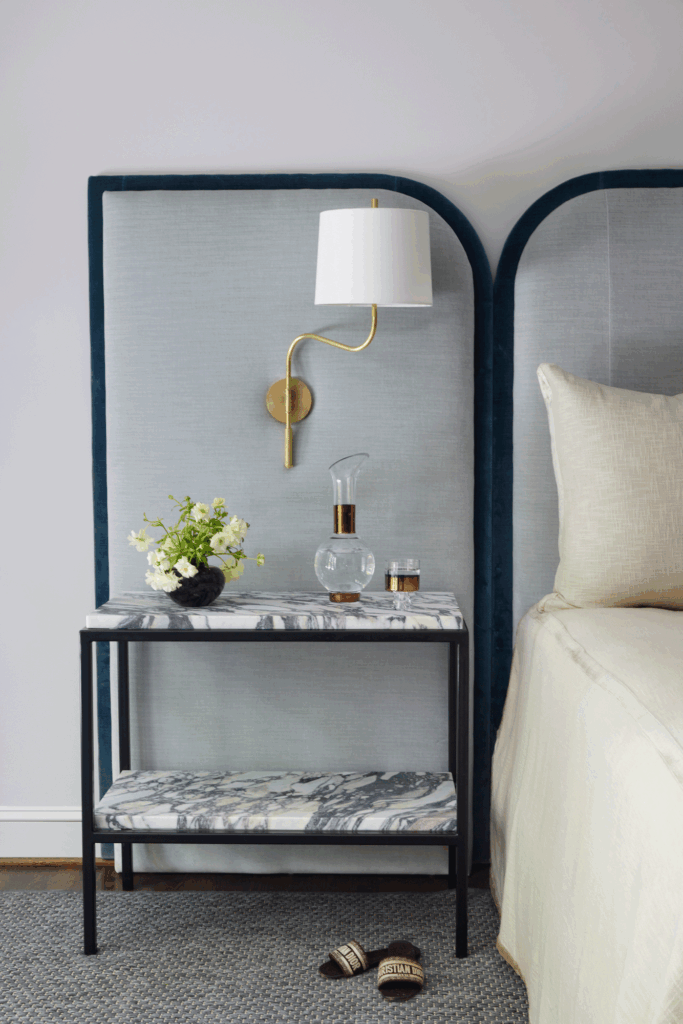
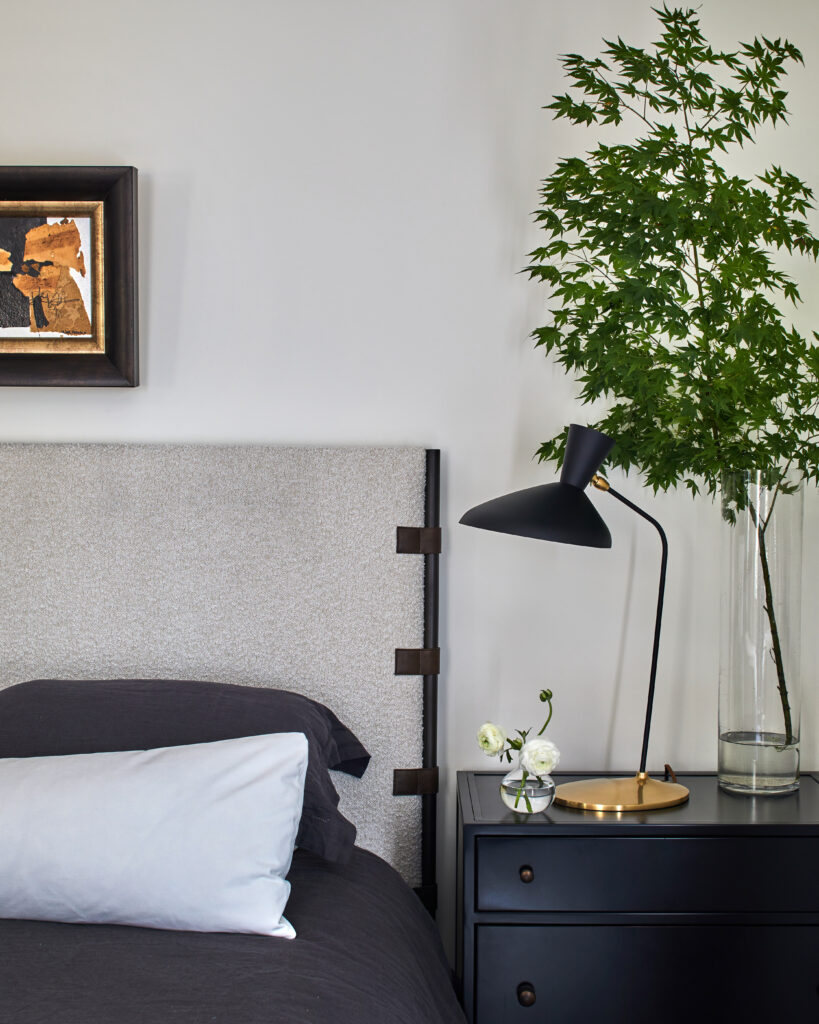
Architectural headboard panels anchor the bedroom vignette, while a minimalist black steel nightstand frames two tiers of Calacatta Viola marble for a crisp, modern contrast.
Studio MC knows that the most memorable interiors reflect the people who live in them. Here’s how the studio blends timeless elegance with playful personality to elevate everyday living across the homes it designs.
Layered lighting. Consider lighting from all angles, pairing overhead fixtures with ambient lighting to create a mood. Dimmable sconces that work for both bedside accent and task lighting are especially useful.
One hero material. Choose a single standout material to repeat throughout the space. Use it in key locations—such as bath surfaces, thresholds, and bedside tables—so it quietly links the rooms, and echo its finish in smaller accessories like trays or picture frames.
Custom window treatments. Opt for tailored window treatments that support both function and mood. Motorized blackout drapes deliver true hotel‑level darkness and ease, while a decorative shade over a tub or window adds softness and polish.
Thoughtfully chosen linens. Invest in sheets and towels you truly enjoy using every day. Decide between crisp percale or softer sateen, lighter or heavier layers for the bed, and bath linens with the right weight, size, and special details such as colored piping or monogramming.
Renovation builder: William Blakeney Building Co., Tuscaloosa, AL Tile/Slabs: Triton Stone; Fixtures: Waterworks; Bathtub: Kallista tub, Ceiling fixture and sconces: Visual Comfort, Art disc: Sarah Helser through Hidell Brooks Gallery Rug: Hiltz Lauber; Linens: Christopher Collection; Motorized drapery: Southern Drapery
Leigh Misso is the co-owner and lead designer of River Brook, a Birmingham-based design-build firm she runs alongside her husband, Kevin Misso. With a foundation in building science, she brings an architecturally grounded, detail-driven approach to interiors that balance bold, unexpected moments with quiet refinement. Known for layered compositions and purposeful drama, her work feels timeless and effortlessly intentional. In this exclusive follow-up to our River Brook feature, Misso shares five ways to master texture, light, and proportion.
“I love creating tension by mixing bold architectural gestures with quieter details.”
A high ceiling paired with low, intimate furniture, or an oversized pendant in a tailored space, instantly creates drama.
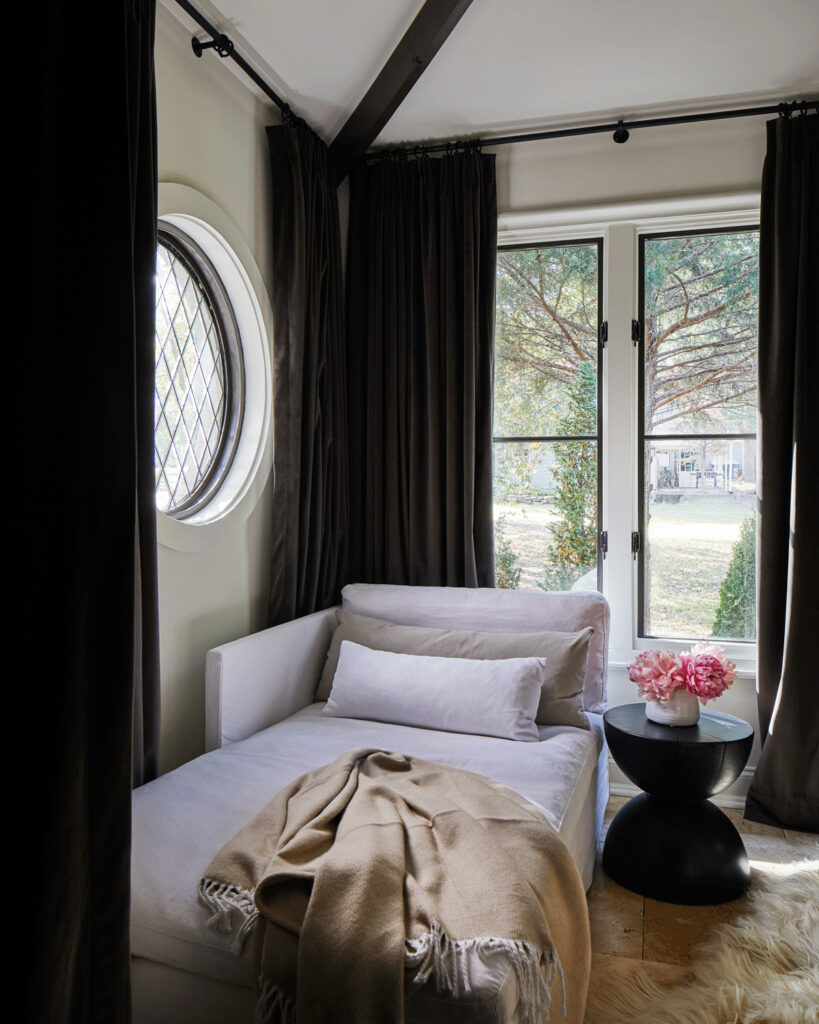
Tucked just off the primary suite, this sitting nook is outfitted for daily quiet moments. A plush chaise from River Brook Interiors invites lingering with a book or morning coffee, while custom drapery softens the light and lends a cocooning feel to the corner. // Photography byLaurey Glenn
Tip #2
Layer Finishes Thoughtfully
Contrast isn’t only about color—it can come from a finish. Matte limewash walls next to lacquered cabinets or polished stone alongside aged wood give the eye something to discover.
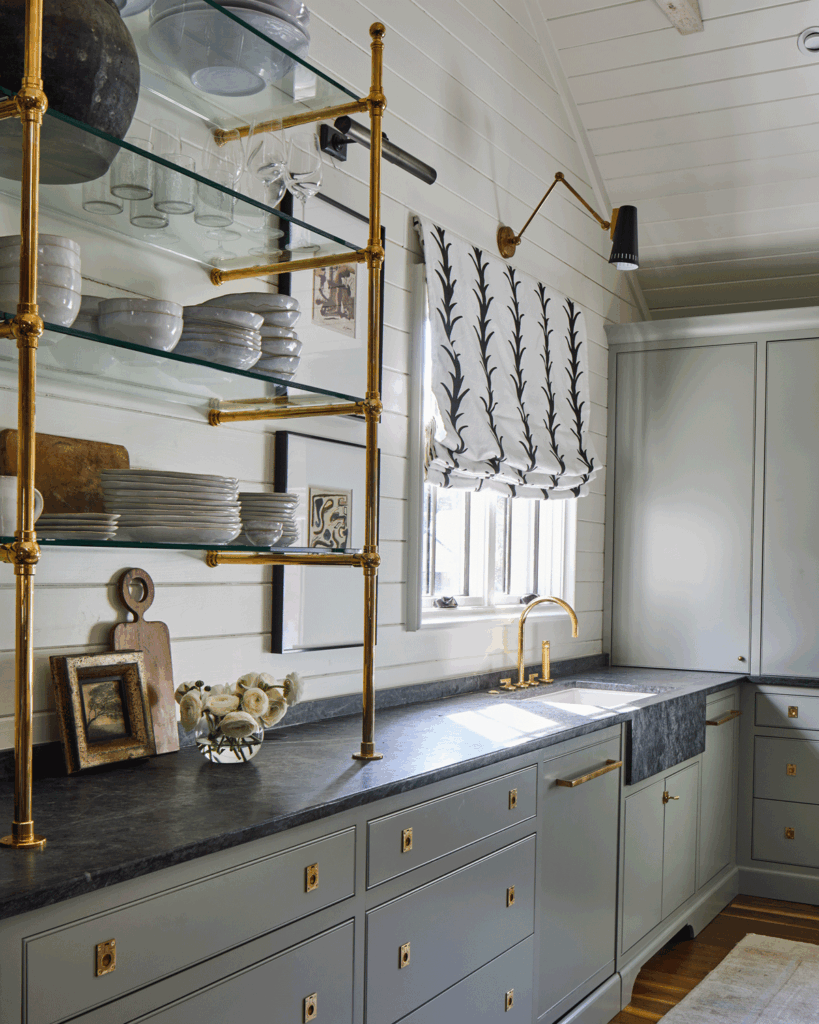
Unlacquered brass-and-glass shelving provides storage while visually balancing the off-center elevation. Schumacher shades, a sculptural task light, and an unlacquered brass faucet from Fixtures & Finishes layer warmth, while soapstone countertops from Surface One and a picture-lit Joe Turner artwork create a refined, centered moment beneath the vaulted ceiling.
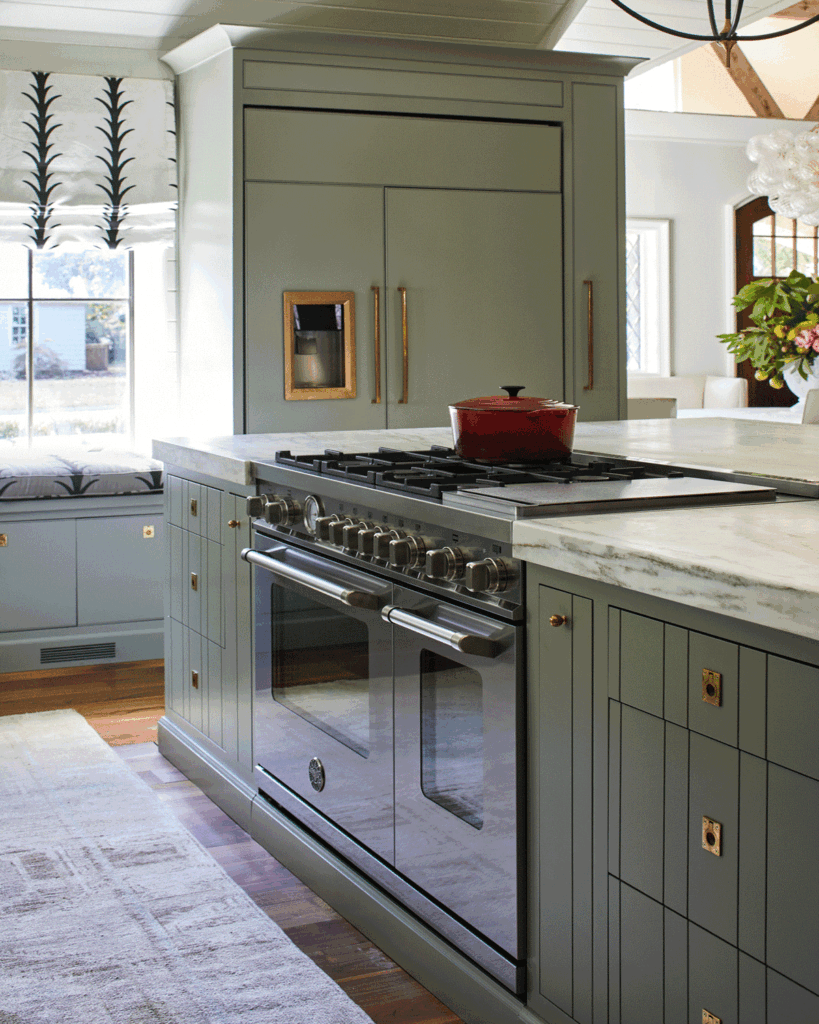
Custom cabinetry from Refinery grounds the room, while the island’s vertical kerf detailing adds a refined modern edge. Topped with Danby marble from Surface One and accented with Brandino Brass hardware, the island serves as both a functional workspace and a sculptural anchor. Panel-ready appliances from AllSouth integrate seamlessly, maintaining the kitchen’s balanced, polished look.
Tip #3
Use Lighting as Punctuation
“Lighting is one of the easiest ways to bring contrast.”
A sculptural fixture can modernize a room and add energy to a classic foundation.
Positioned along the only workable wall, the bed sets the tone for the room’s updated, masculine look. A metal frame wrapped in boucle and a River Brook Interiors headboard give the space a tailored presence, accented by a Visual Comfort lamp and a bedside table also from River Brook Interiors. Artwork by Joe Adams adds subtle graphic weight without overwhelming the small footprint, while walls in White Dove keep the room fresh and serene.
Tip #4
Balance Masculine and Feminine Elements
Mixing strength with softness is key. A grounded, moody palette offset by tactile or romantic details—like velvet or plaster—brings harmony to a space.
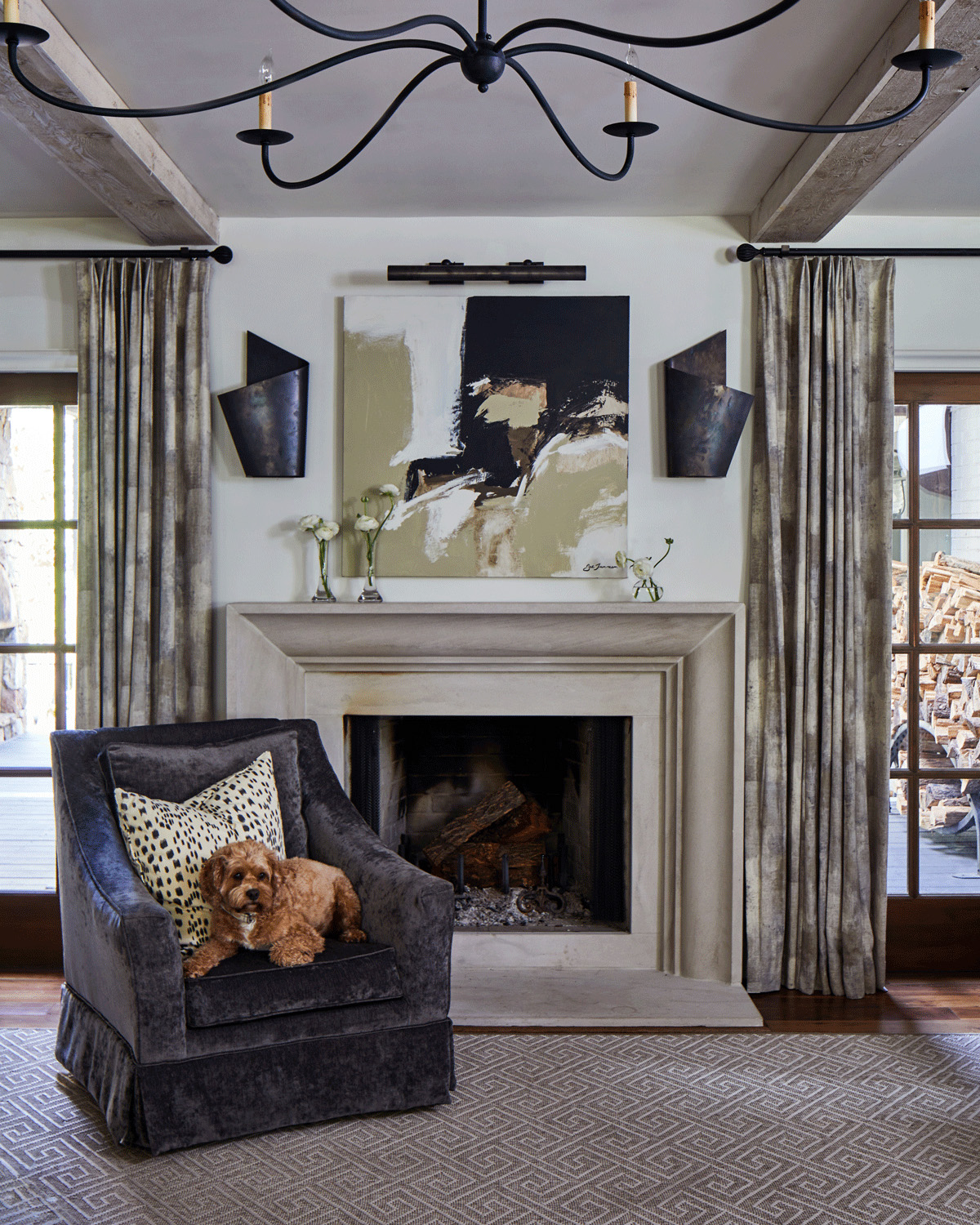
A nearly wall-to-wall custom rug from Billy Brown Rug visually expands the footprint of the living room. “A large rug makes the room feel larger,” Leigh shares. Black and iron accents, from the Currey & Co. chandelier to the Visual Comfort wall sconces, introduce a strong, contemporary edge, while artwork by Joe Turner echoes the room’s black-and-neutral palette, tying the layered, sophisticated space together.
Tip #5
Let Restraint be Part of the Story
True contrast comes as much from editing as from adding. Allowing the eye to rest makes the dramatic moments even more powerful.
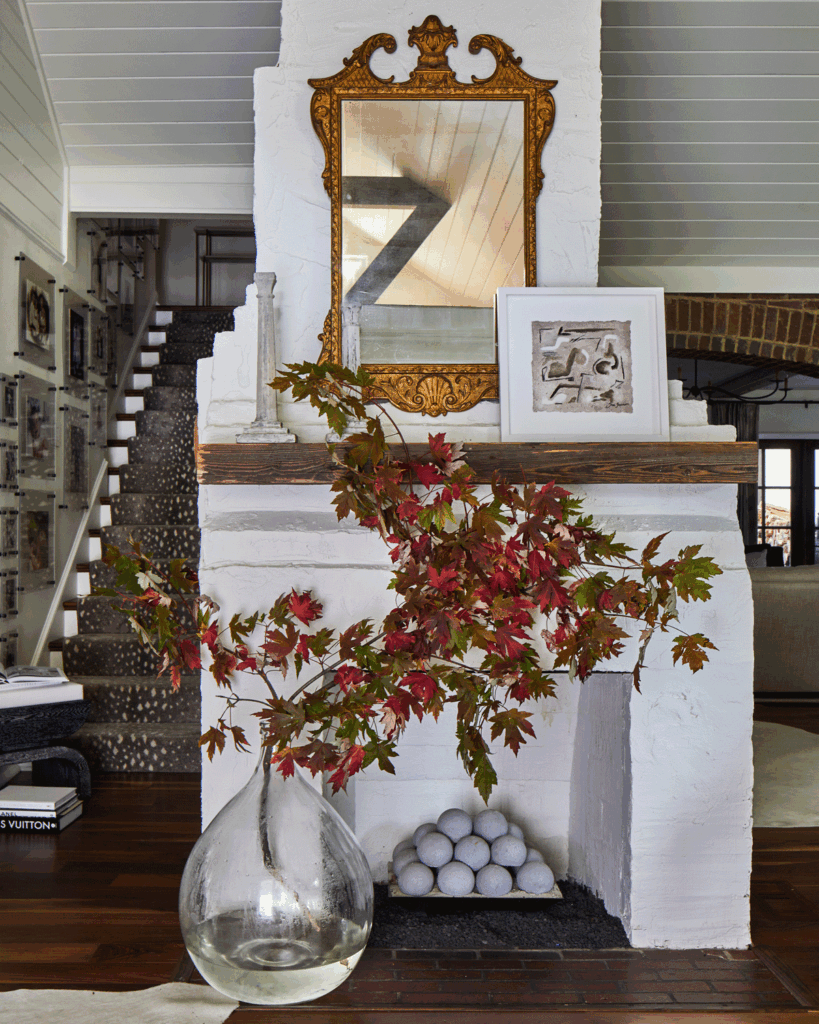
The home’s original fireplace anchors the downstairs living area. Leigh refreshed it with contemporary touches, such as a sculptural mirror from River Brook Interiors, Joe Turner artwork, and modern gas fireballs that lend a clean, updated edge. Just behind the hearth, the stairs leading upstairs peek into view, dressed in the custom antelope runner that echoes the master bedroom’s pattern—subtly connecting the upstairs and downstairs spaces.
Resources
Designer: Leigh Misso Firm: River Brook Design + Build (Birmingham-based) BEDROOM NOOK: Window Treatments: Custom drapery Furniture: River Brook Interiors KITCHEN: Countertops: Soapstone from Surface One Countertops: Danby Marble from Surface One Cabinetry: Custom-built units by Refinery Hardware: Brandino Brass Appliances: AllSouth Plumbing: Fixtures & Finishes Lighting: A sculptural task light and Schumacher shades Art: Joe Turner BEDROOM: Headboard & Nightstand: River Brook Interiors Lighting: Visual Comfort Art: Joe Adams Paint: Benjamin Moore White Dove LIVING ROOM:Rug: Billy Brown Rug Lighting: A Currey & Co. chandelier paired with Visual Comfort wall sconces FIREPLACE: Mirror: River Brook Interiors Art: Joe Turner
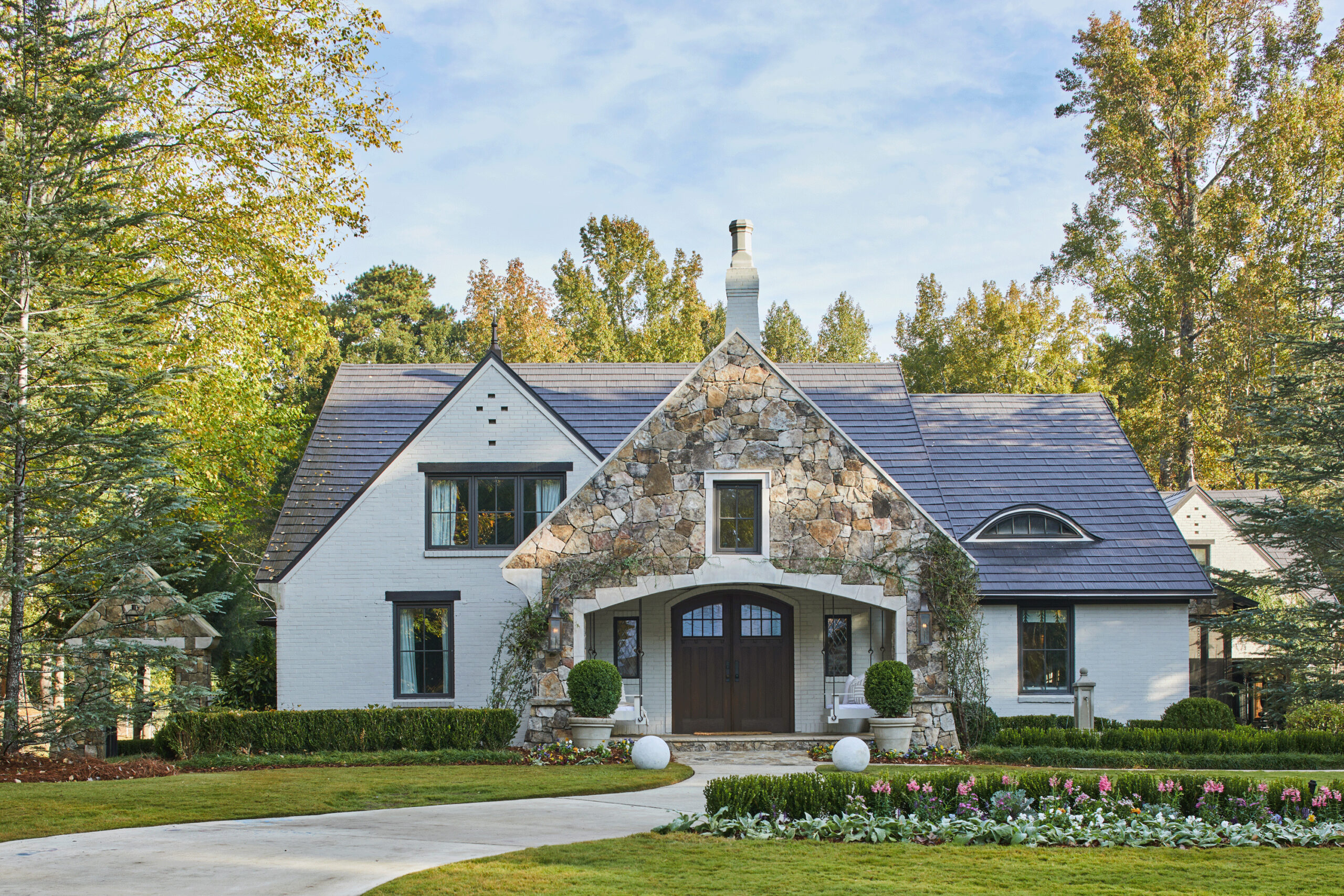
A mix of materials and subtle texture defines the home’s exterior in Trussville’s historic district—a quiet hint at the layered contrasts Leigh carried indoors. // Photography byLaurey Glenn
The owners of this historic Trussville residence loved the character and charm of their home. But over the years, the interiors had become a patchwork of collected pieces, leaving the space feeling rather disconnected. That’s when Leigh Misso of River Brook Construction was brought in to create a more connected, thoughtfully edited flow.
Honoring the Bones
Leigh approached the project with deep respect for the home’s history. Rather than reinventing, she refined, thoughtfully transforming it from a muddled mix into a cohesive, elegant retreat for the family of five. “It was less about restructuring and more about refining,” Leigh explains.
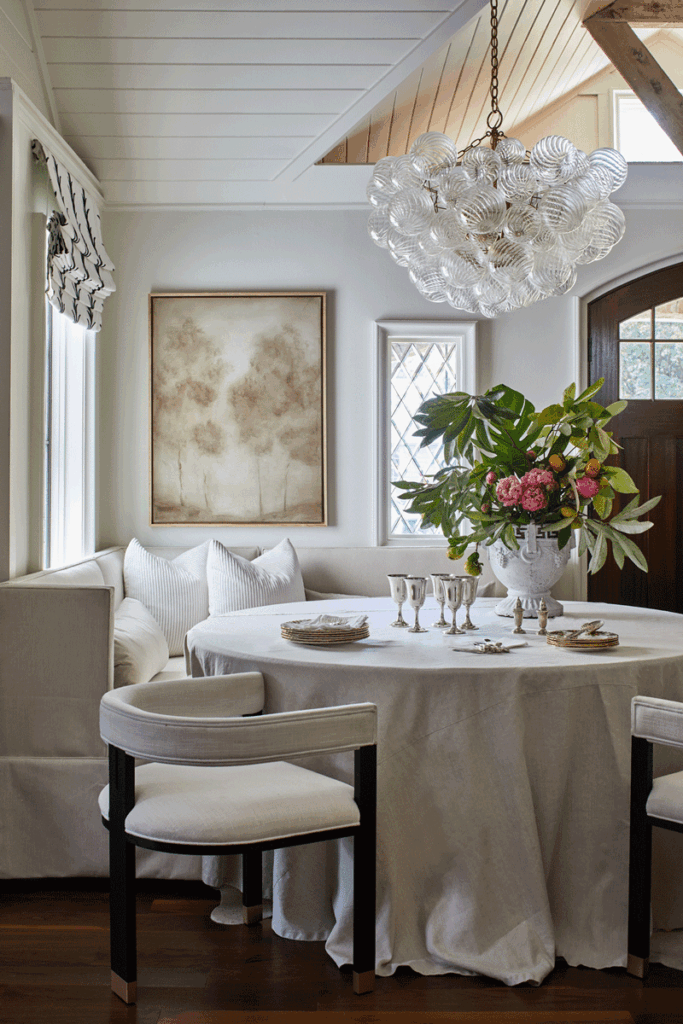
A custom banquette turns a once-tricky corner into a welcoming dining nook. The neutral upholstered seating frames the couple’s beloved table—a gift when they got married—while black-and-white Schumacher shades and a Mackenzie Dove painting add pattern and personality. A sculptural Visual Comfort chandelier crowns the space.
A bar wall with Refinery custom cabinetry, Brandino Brass hardware, and fixtures from Fixtures & Finishes creates a polished moment, while a concealed mudroom wall keeps everyday storage neatly out of sight—grounded by a bold, checkered painted floor.
“The goal was to honor the bones while giving the interiors a fresh, modernized look.”
— Leigh Misso
A Study in Light and Shadow
Her strategy hinged on creating a rhythm of light and shadow throughout the home, allowing its traditional architecture to take center stage while giving each room a renewed sense of identity. Leigh began the transformation by painting the walls Benjamin Moore’s White Dove, a soft shade that offered the perfect backdrop for layering in the contrast and texture that would ultimately bring cohesion to the interiors. She then sought to introduce contrast, not just in color—such as dark cabinetry that punctuates lighter walls and moody blues softened by natural neutrals—but also in materials: polished finishes play against raw textures, adding depth and dimension without overwhelming the historic structure. “It really came down to layering light and shadow, playing with scale, and balancing texture,” Leigh explains. “We used contrast as a unifying element.”
A Curated Retreat
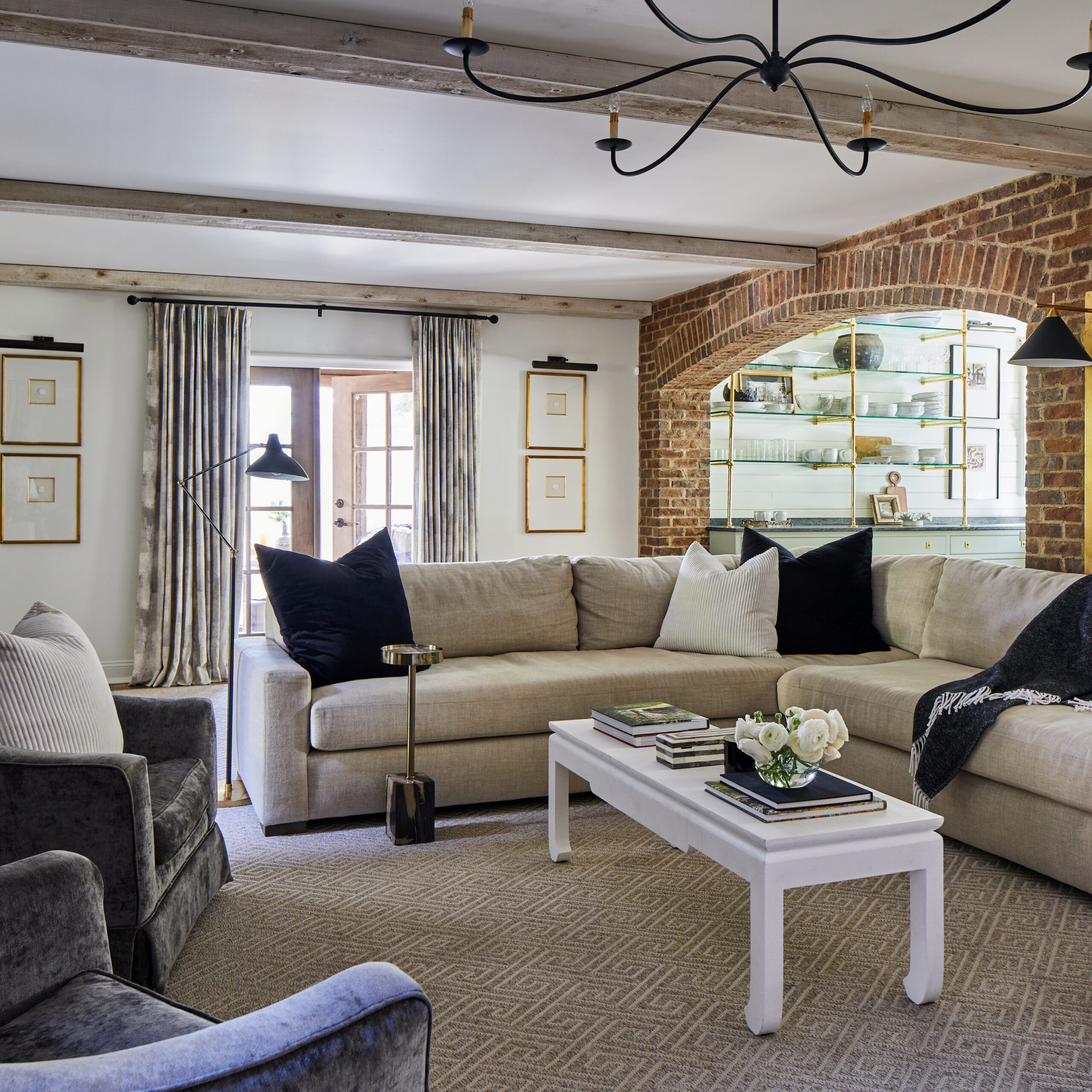
In the living room, she brought in a deep, oversized sectional from Restoration Hardware that anchors the room without overwhelming it—and makes it easier for the family to entertain—and offset it with a duo of blue velvet chairs that add a rich note of color beside the newly renovated limestone mantle from Tracery. A mix of modern lighting from Visual Comfort, such as the wall sconces, chandelier, and floor lamp, introduces a contemporary counterpoint that keeps the space feeling fresh. “It creates that subtle juxtaposition between old and new,” she adds.
A gallery-style arrangement of artwork, softly illuminated by picture lights, creates a curated focal point, while a crisp white coffee table from River Brook Interiors offsets the rich black tones throughout the space, balancing the warmth and contrast.
Kitchen & Craft
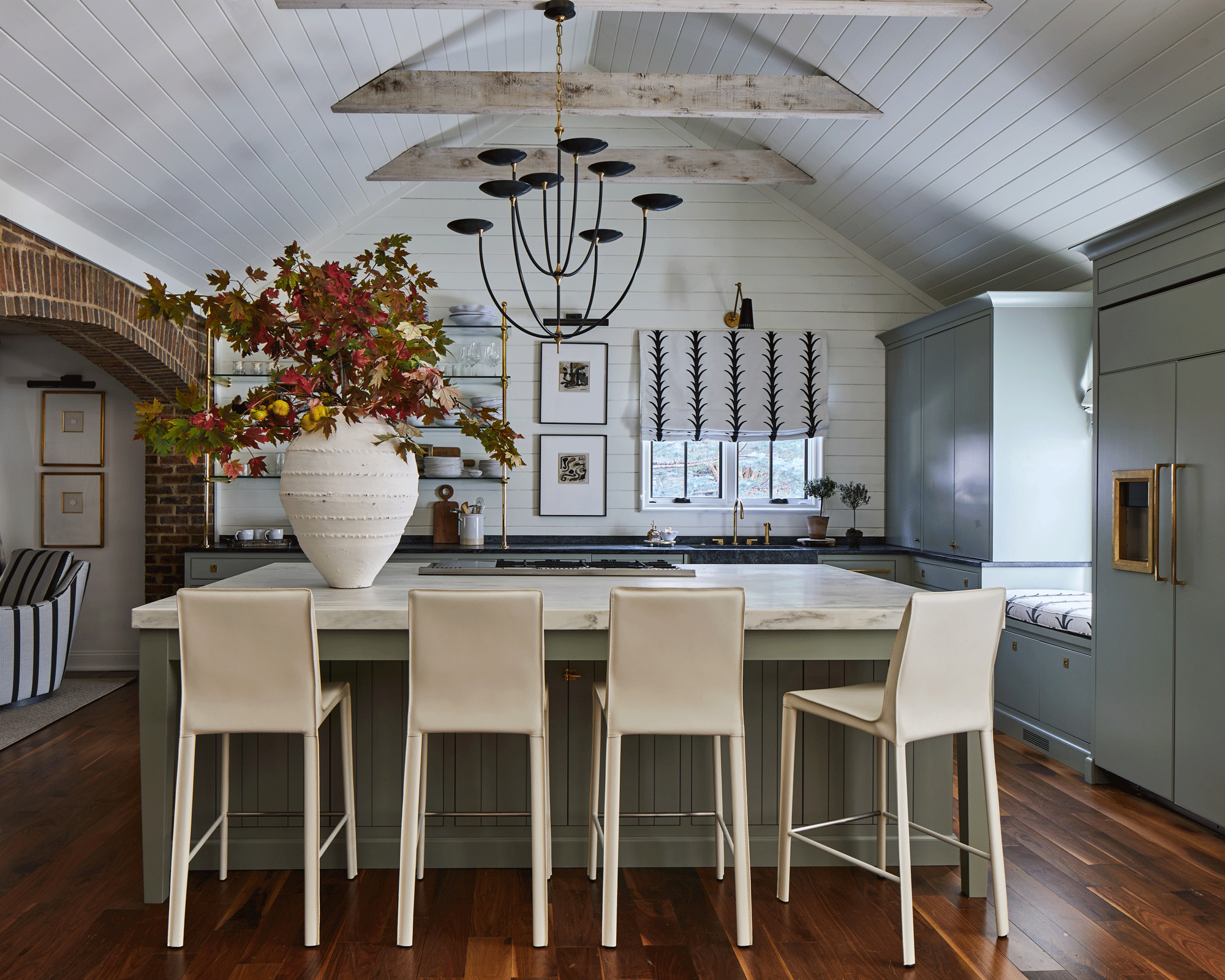
Working beneath the sweep of the original tongue-and-groove ceiling and the drama of the brick archway, Leigh thoughtfully rebalanced the kitchen’s footprint to give the room a clearer sense of order. She streamlined circulation and introduced purposeful storage to feel more intentional. Moody custom cabinetry painted in Pigeon by Farrow & Ball grounds the space, while a contemporary chandelier and slender brass-and-glass shelving layer in a modern edge without overpowering the home’s historic feel. “It’s those shifts in tone, texture, and light that make a space feel layered, intentional, and alive,” Leigh says.
The kitchen was the one space Leigh fully reimagined, beginning with a layout that felt visually lopsided—upper cabinets crowded one side of the window, leaving the vaulted ceiling without a true focal point. By relocating appliances, adding a built-in pantry, and carving out a nook underneath an existing window, she restored balance to the room’s architecture.
“Contrast isn’t just about color—it’s about texture, scale, and material, and how each element interacts to create drama without losing comfort.”
– Leigh Misso
The Private Quarters
Beyond the main living spaces, the same thoughtful tension between old and new continue. In the office, Leigh removed dated built-ins to open the footprint, replacing them with a modern desk and a gallery wall that blends family memories with curated artwork—“a way to make it feel personal but not cluttered,” she notes. The powder bath gained personality through wallpaper and unexpected hardwired table lamps. And in the primary suite, where several existing elements had to remain, Leigh shifted the visual weight with an off-black limewash applied to walls and ceiling—giving it movement and depth—a massive chandelier that capitalizes on the vaulted height, and layers of natural texture. The result is a home that feels unified, refreshed, and gracefully connected to its past. “It’s all about creating rhythm and flow while letting each room have its own personality,” Leigh says.
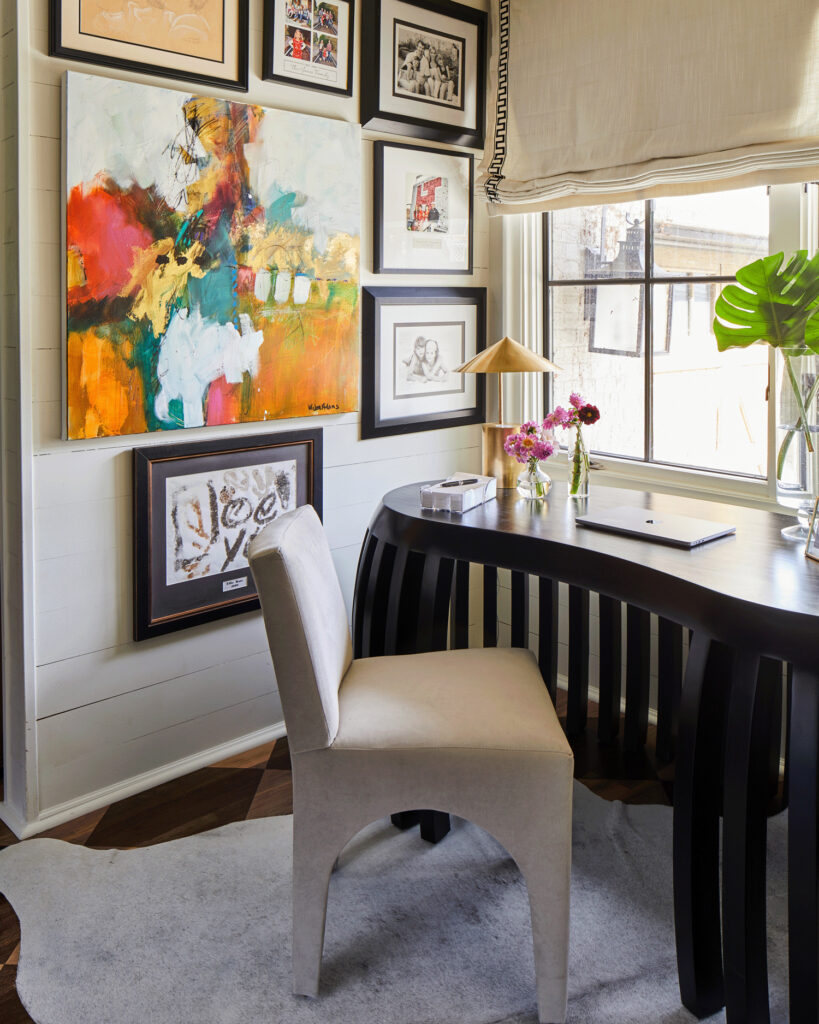
Leigh swapped dated built-ins for a streamlined Noir desk and sculptural Coley Home chair, opening up the space. A curated gallery wall and cowhide rug from River Brook Interiors add warmth and character, creating a workspace that’s both functional and beautifully lived-in.
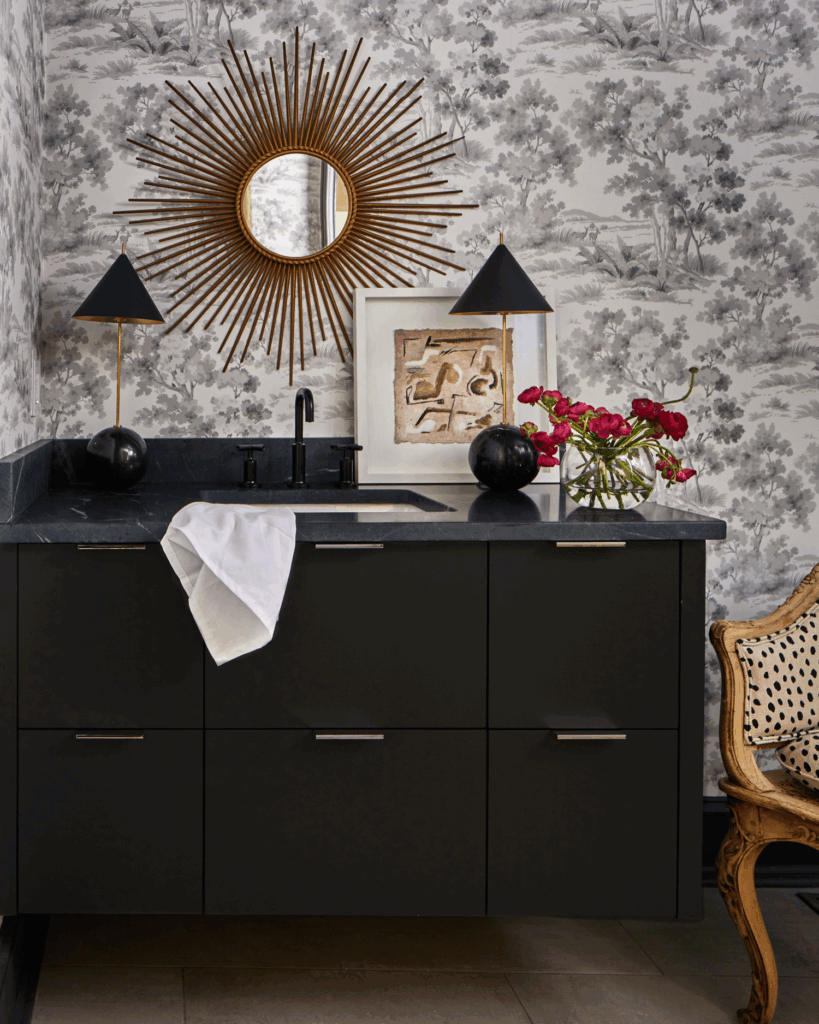
A Refinery custom vanity with soapstone and Brandino Brass hardware replaces dated built-ins. Patterned wallpaper, a starburst mirror from Charish, and hardwired Visual Comfort lamps add drama, while a cheetah-print chair and Joe Turner artwork complete the jewel-box moment.
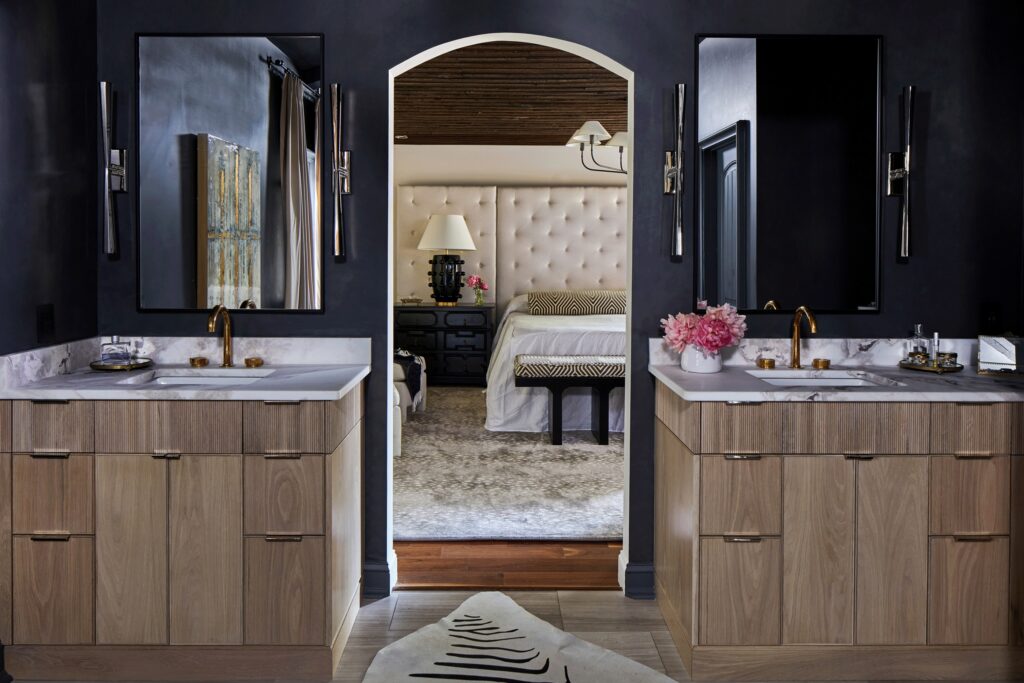
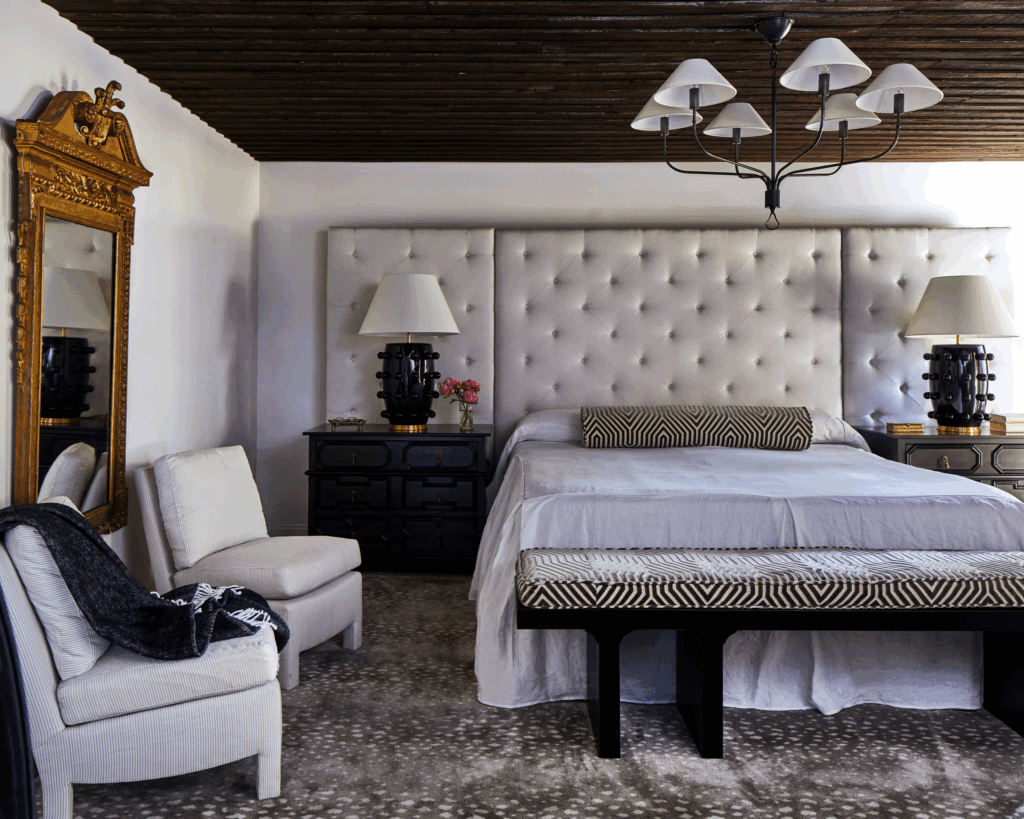
Along the vanity wall, newly installed white oak cabinetry from Refinery replaces the original ’90s built-ins, grounding the bath by adding warmth through the natural grain. Visual Comfort sconces flank River Brook Interiors mirrors, offering soft, flattering light above Waterworks plumbing fixtures from Fixtures & Finishes.The primary bedroom centers on a tufted River Brook Interiors bed with a paneled headboard focal wall. Warm wood ceilings, symmetrical bedside tables with Visual Comfort lamps, and Schumacher-upholstered accents are balanced by Coley Home slipper chairs, an antique giltwood mirror, and a custom antelope-pattern rug.
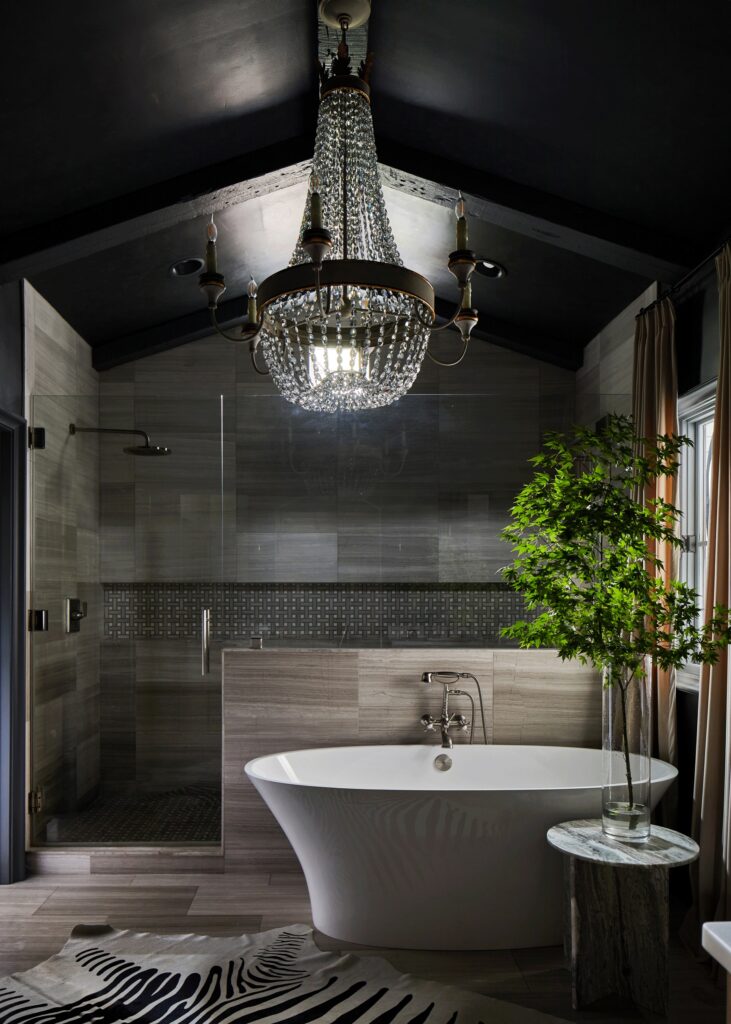
Once a dated, white-on-gray space devoid of character, the primary bath now feels layered, moody, and intentional. Leigh preserved the existing tile but transformed the room’s atmosphere entirely with an off-black Farrow & Ball limewash she had applied to the walls and the vaulted ceiling so its subtle strokes and movement introduce an artisanal texture. A dramatic Visual Comfort chandelier takes full advantage of the ceiling height, redirecting the eye and establishing a new focal point beyond the tile. A zebra cowhide from River Brook Interiors and a marble side table bring pattern and softness around the existing tub, while custom drapery completes the room’s elevated, retreat-like feel.
Leigh Misso| River Brook Design + Build
Leigh Misso is the co-owner and lead designer of River Brook, a Birmingham-based design-build firm she leads alongside her husband, Kevin Misso. With a background in building science, Leigh brings an architecturally grounded, detail-driven approach to interiors that balance bold, unexpected moments with quiet refinement. Her work is defined by layered compositions, purposeful drama, and a timeless, effortlessly intentional sensibility.
Resources
Interior Design & Construction: Leigh Misso, River Brook Design & ConstructionHome Furnishings Store:River Brook InteriorsGeneral Interior Walls:White Dove by Benjamin Moore Kitchen Cabinetry:Pigeon by Farrow & Ball Primary Suite Walls & Ceiling: Off-black Limewash by Farrow & Ball Fireplace Mantle: Custom limestone by Tracery Mudroom Floor: Custom painted checkered pattern Living Room Sectional:Restoration HardwareUpholstery: Custom bed, mirrors, and coffee table by River Brook Interiors Office Furniture: Desk by Noir; Chair by Coley HomePrimary Suite Seating: Slipper chairs by Coley Home Fabrics & Window Treatments:Schumacher (shades and upholstery) Rugs: Zebra cowhide and custom antelope-pattern rug via River Brook Interiors Art: Original works by Mackenzie Dove and Joe Turner Vintage Finds: Starburst mirror from Chairish; Antique giltwood mirror Hardware:Brandino BrassPlumbing Fixtures:Waterworks via Fixtures & FinishesCountertops: Soapstone (Powder Bath) and White Oak (Primary Bath vanity)
“Some people worry that they will tire of color and pattern. But a bolder room creates more interest, which lends itself to longevity.”
Choose saturated color—not necessarily dark, but saturated. Color can be soft and dramatic. Layer a variety of tones or variations of the same hue. As the designers put it, “All blues are friends.”
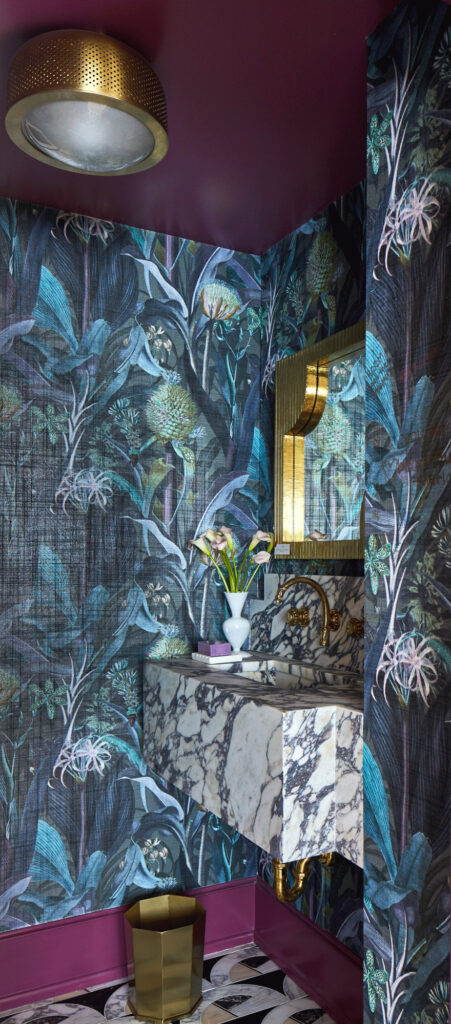
The main level powder room is “very small, but so much fun!” Cole says. The room is wrapped in printed grasscloth by Arte. A custom marble vanity has a faucet shaped like a dragon head. // Photography byLaurey Glenn
MAKE IT PERSONAL
“It’s not just using tons of stuff. Find pieces that represent your interests.”
The designers can’t overstate the importance of layers. It’s not about adding more, but adding meaning. Always include at least one unexpected element, because drama comes from pairing the unexpected.
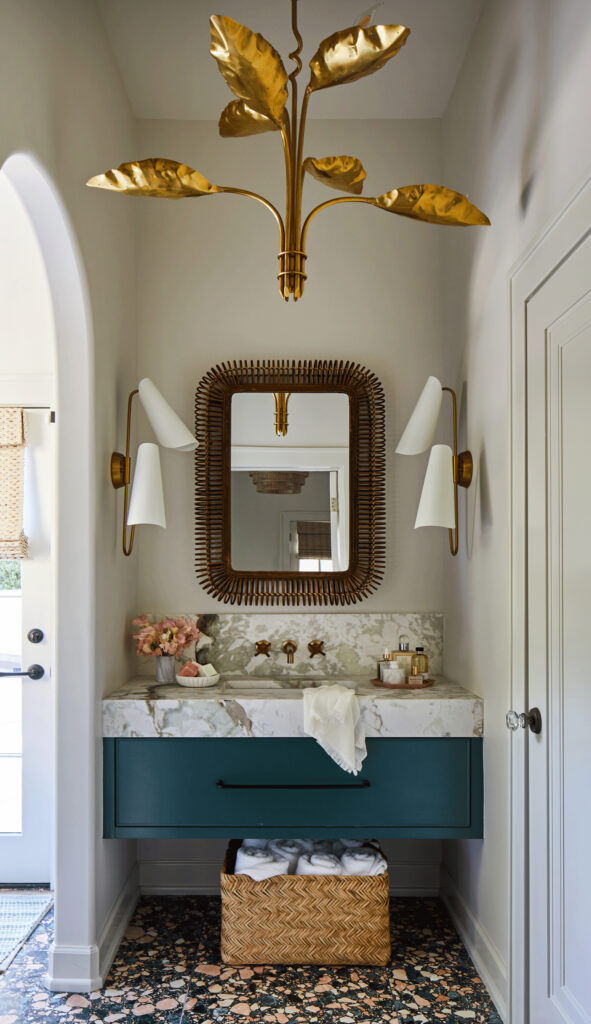
Even the pool house bath doesn’t skimp on color, pattern, and lighting. Terrazzo flooring and countertops from Triton Stone. Chandelier and sconces from Visual Comfort.
MIX, DON’T MATCH
“It is so much more fun to see what the person is actually reading versus books on the shelves that were purchased because of their spine color.”
Designer Marianne Strong believes a room loses its appeal when everything matches. It begins to feel like a showroom rather than a true reflection of the people who live there. Her goal is to walk into a space and immediately imagine the story of who calls it home.
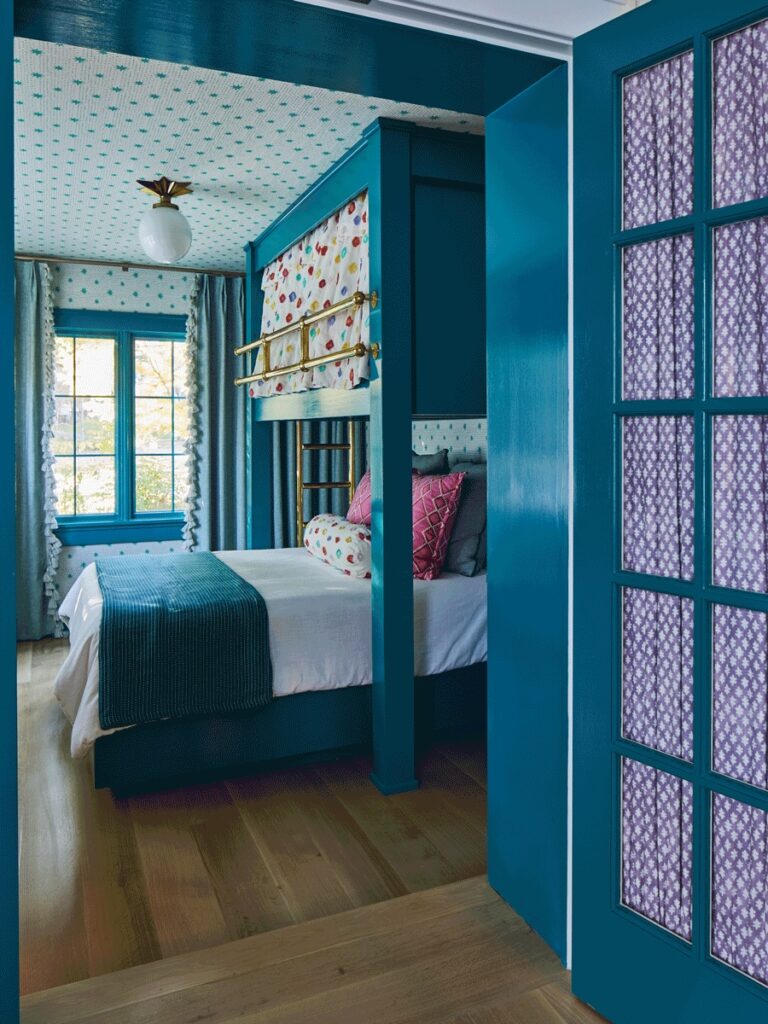
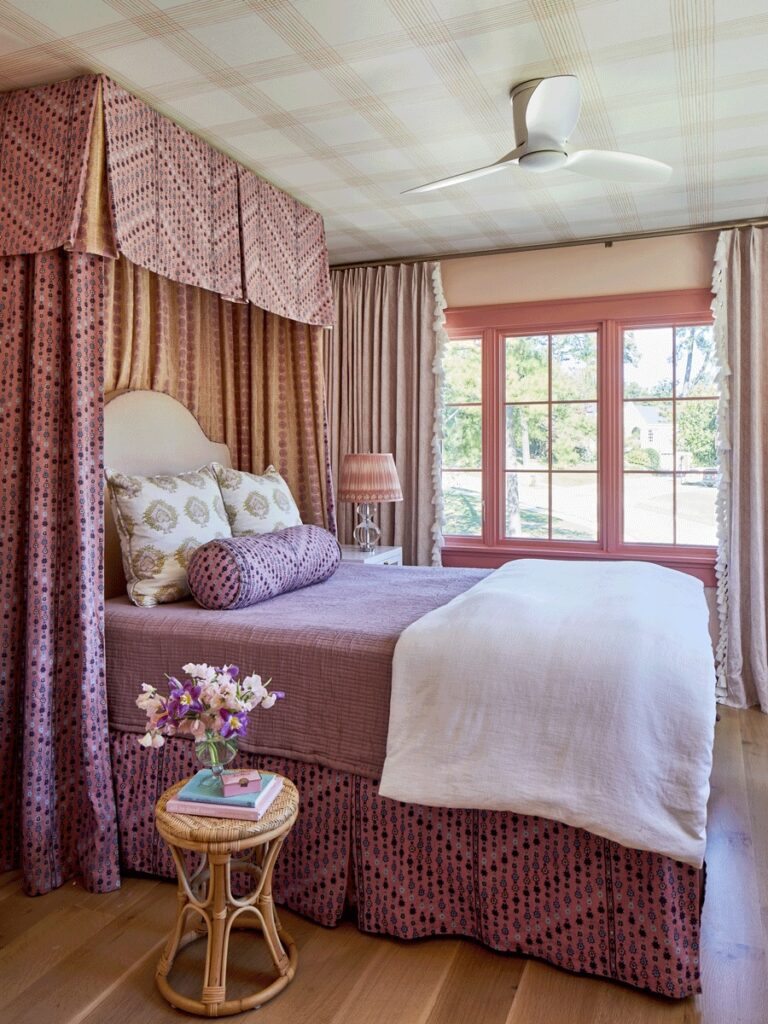
Two of the family’s children are twin girls. Strong adds that the twins have very different personalities. “One loves feeling cozy and cocooned, so we gave her bunks. The other loves fashion, and we leaned into ‘more is more.’”
Strong explains that in both spaces, “we wallpapered everything,” layering mixed patterns across walls, ceilings, window drapes, bed drapes, and throw pillows. “Both rooms are jewel boxes,” she says, “and we were able to give each her own hideaway.”
BE PATIENT
“We don’t want to create a room that feels like the dramatic, attention-seeking person at the party. Instead, what feels like the good storyteller—timeless, collected, not trendy.”
Any good room takes time. While lacquered walls, wallpaper, and upholstery can be installed quickly, art, books, and collected details need months to come together. If everything is forced at once, it shows.
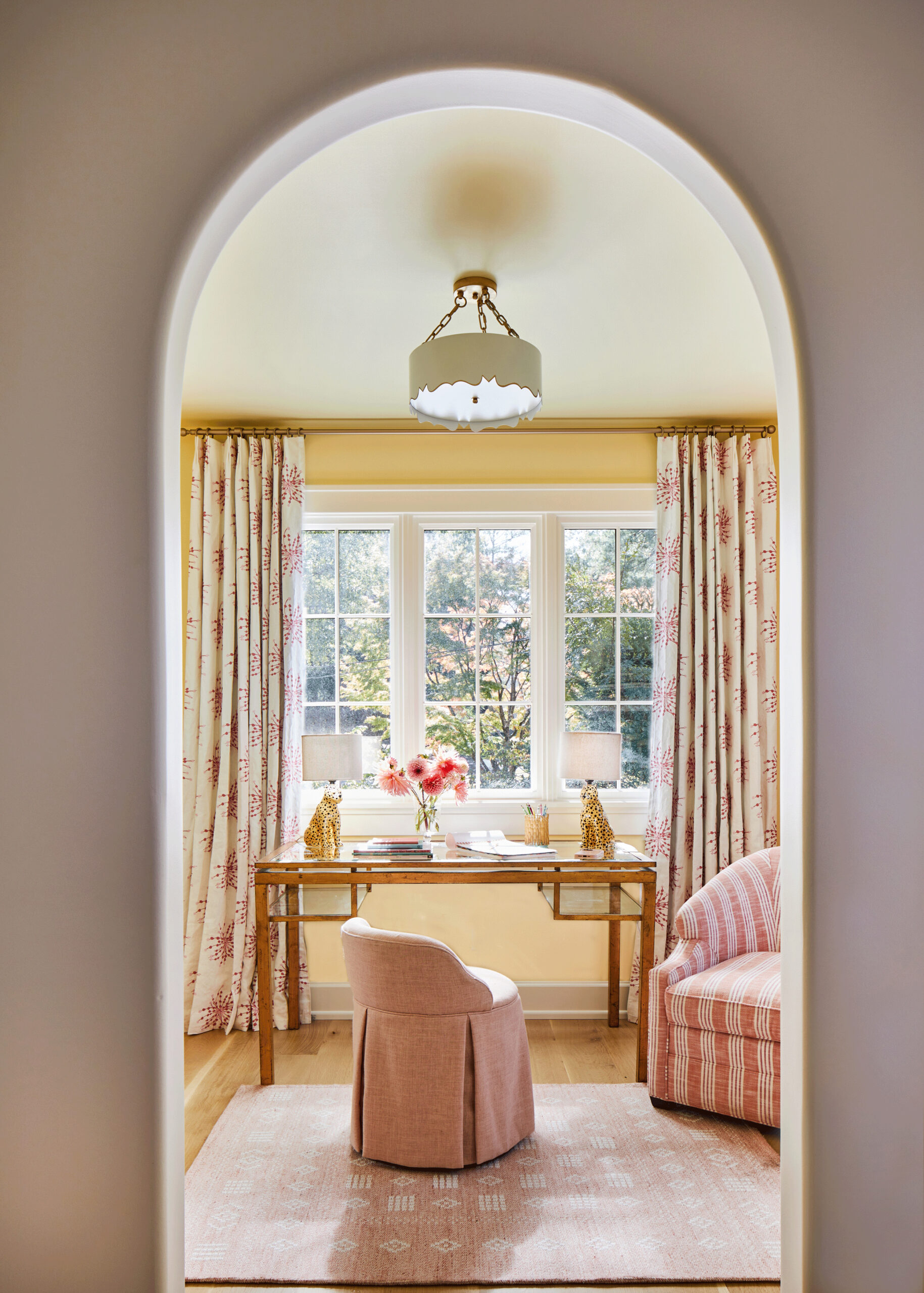
Patterned drapery, warm wood, and blush upholstery turn this softly layered study into a quiet jewel box. Traditional details are balanced with playful accents, giving the space a collected, personal feel that’s both polished and inviting.
START SMALL
“Successful dramatic rooms are ones you want to hang out in. They are inviting, not jarring, and feel like a hug.”
If you’re drama-shy, small spaces are easier and less of a commitment. Try going bold in a powder room, hallway, or home office first.
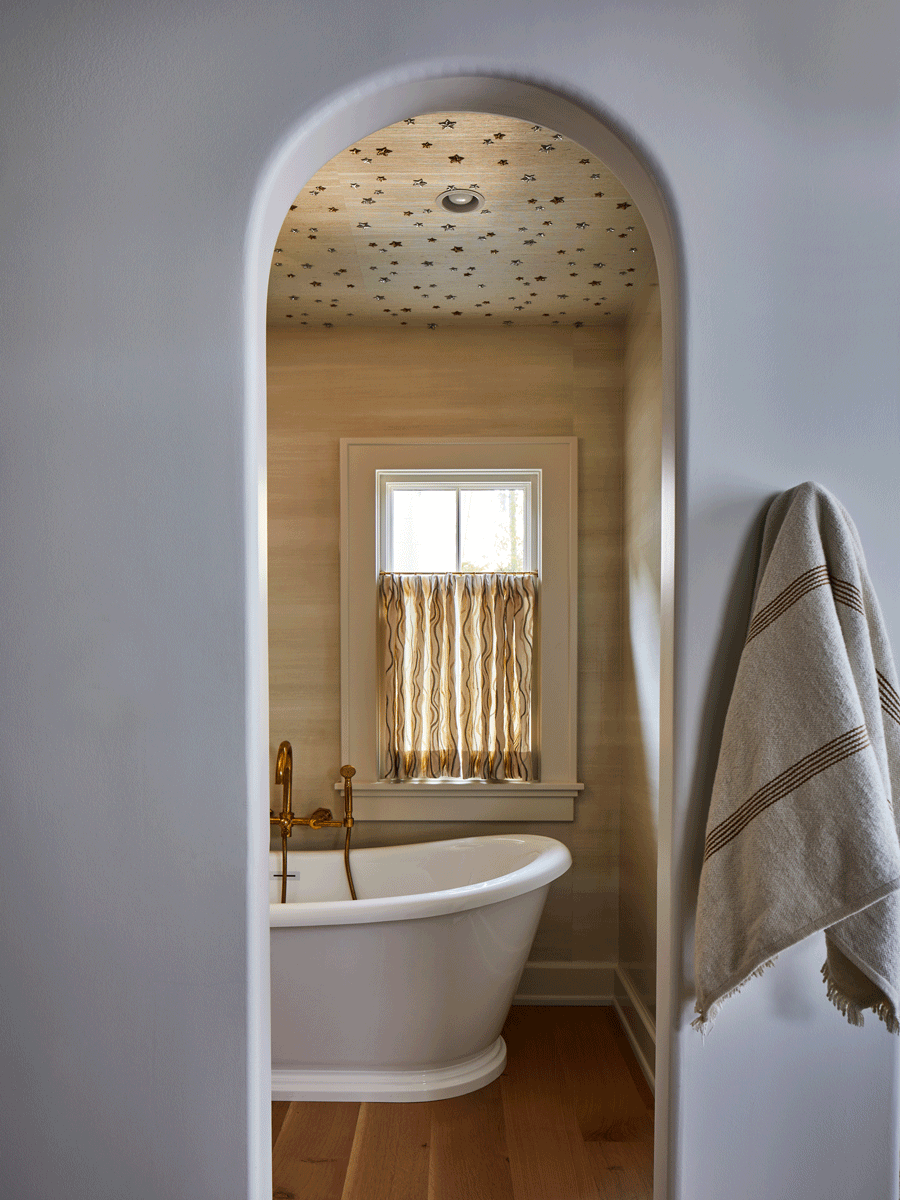
The tub room of the primary bath is wrapped with a lacquer wallpaper in a stripe pattern from Zinc Textiles. The ceiling sports Cowtan & Tout ‘s Galaxy wallpaper with hand-applied sequined stars on a grasscloth base.
FIND BALANCE
“In design, the boundary between an eclectic, well-edited ‘more is more’ mix and a chaotic hodge-podge is remarkably delicate.”
Balance bold, layered moments with calm, serene spaces. Those quieter areas are what keep an eclectic interior from tipping into chaos.
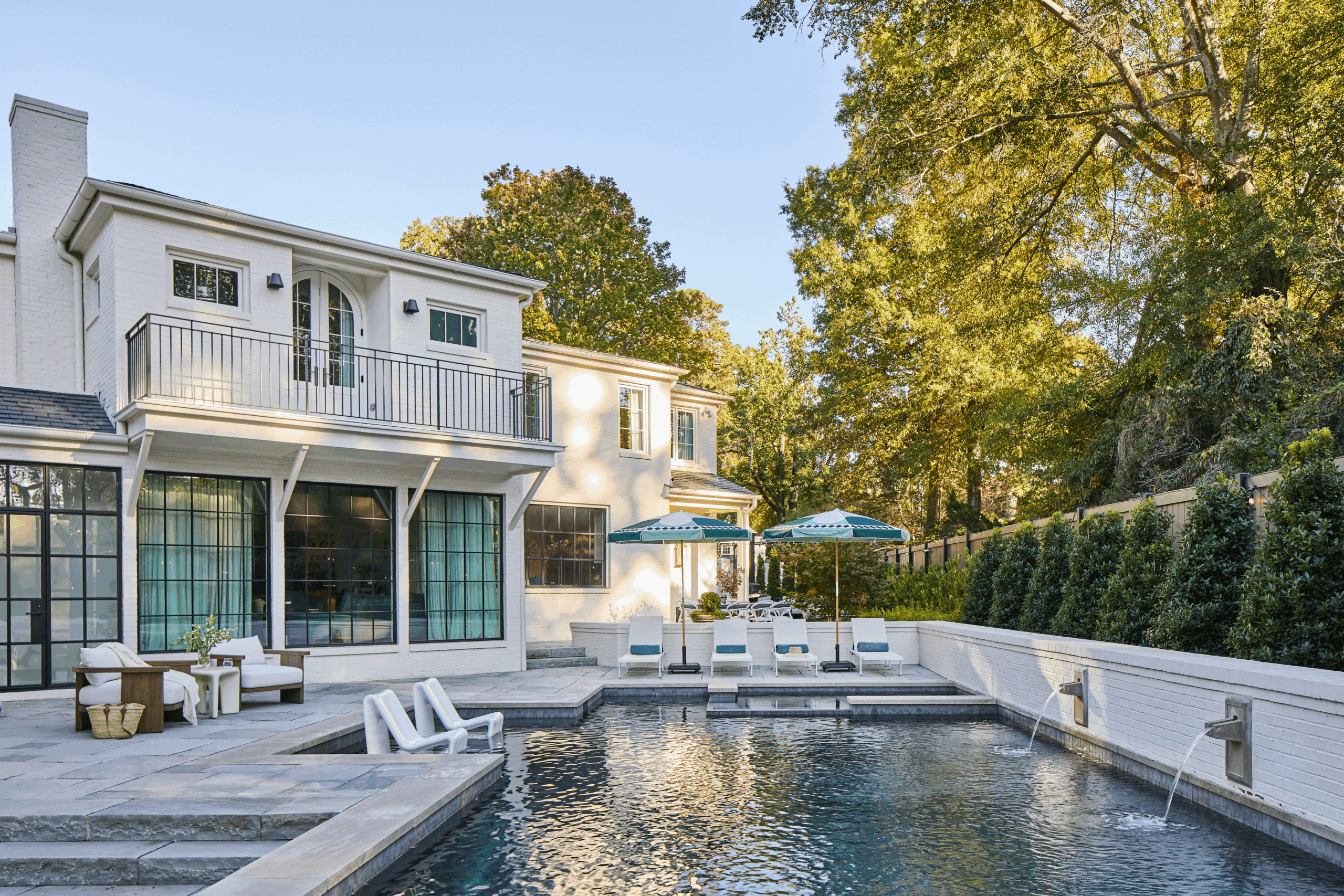
The backyard’s new pool is a dreamy installation by landscape design firm Dave Eyrich & Associates. “The pool’s interior is dark, so its ethereal,” says Cole.
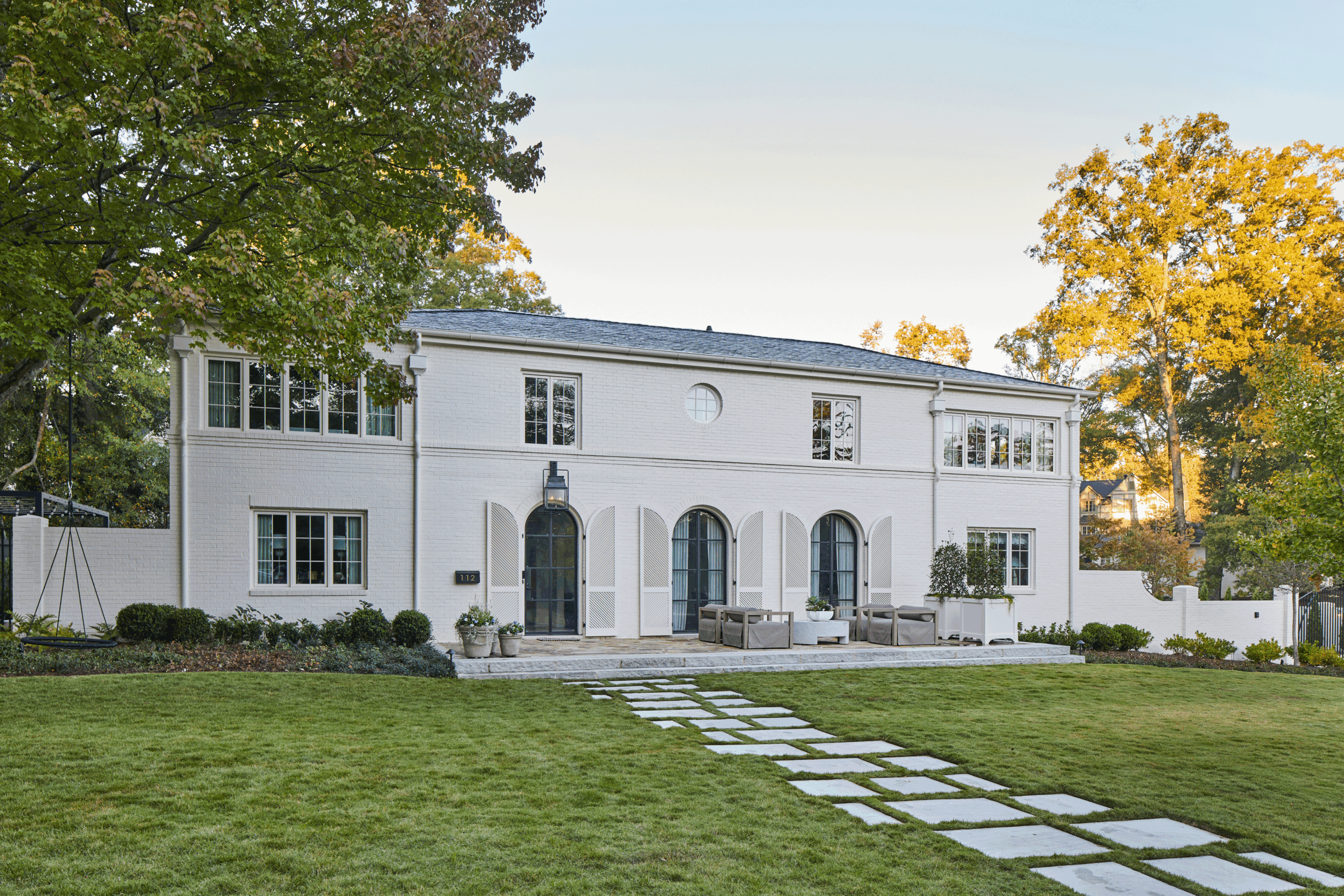
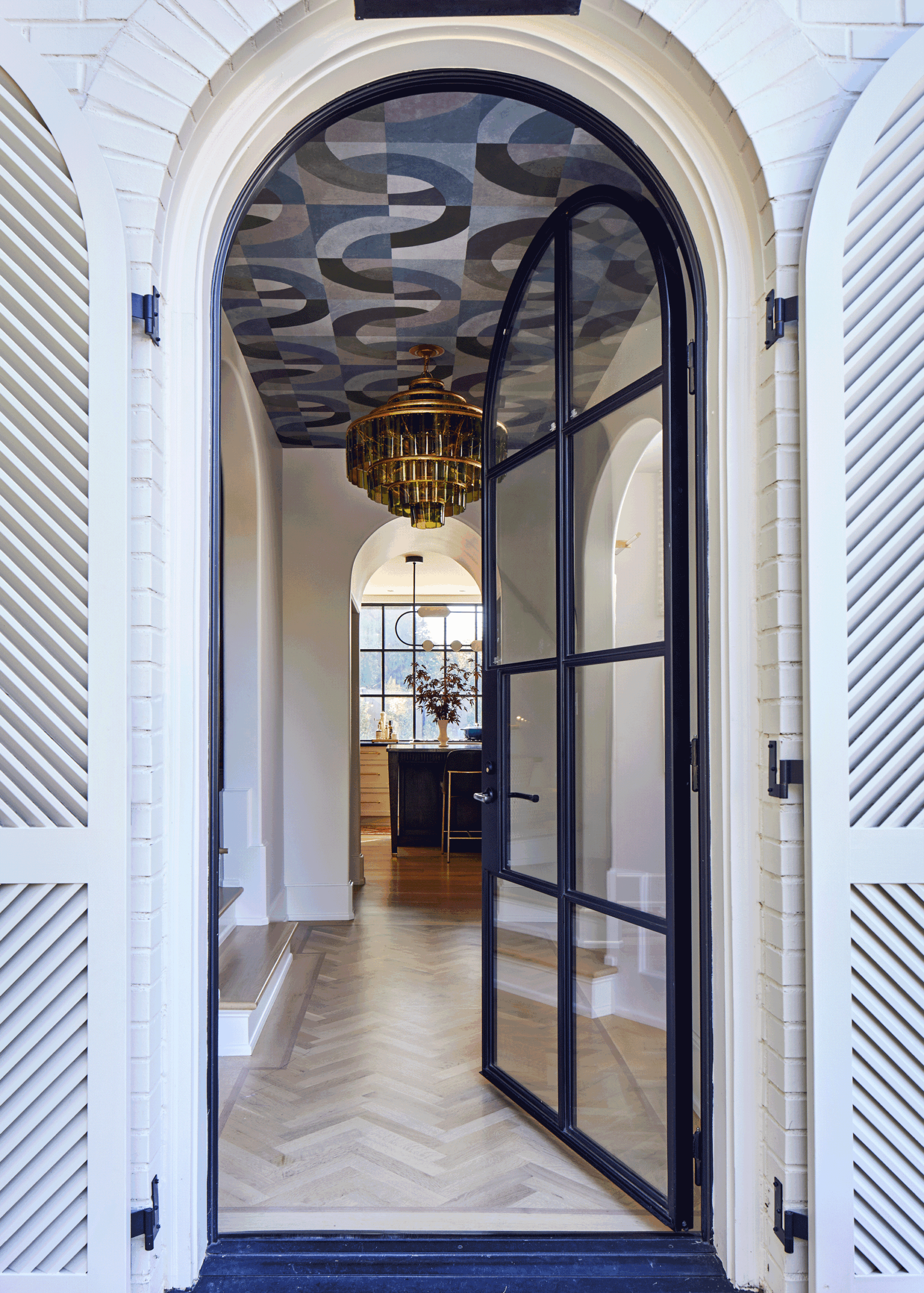
Subtle changes to the front façade update the 90-year-old home. On the main floor, custom shutters flank new iron-and-glass arched-top doors by Bessemer Glass that fill the original door frames. // Photography byLaurey Glenn
A Beloved Homewood Landmark
“What’s going on with the Bonita house?” That question was one designers Marianne Strong and Teresa Cole were asked almost every day while they worked on the renovation of the home at the junction of Bonita Drive and Ventura Avenue. “Homewood residents were so curious and had a vested interest,” Strong says. “Everyone was grateful it wasn’t torn down.” Built in 1935, the Hollywood home “is very much a beloved part of the neighborhood.”
In the entry, the designers wanted to hint at the color and pattern that appear beyond the formal, neutral front rooms.
When the pair’s long-time clients bought the home, “the only construction planned was a bump out of the kitchen, just a small renovation,” Cole explains. “That quickly escalated.” Every wall McGuire Construction’s crew opened revealed a new set of challenges and soon the team realized that the entire home needed to be taken down to the studs.
That change of scope allowed the designers to really lean into the charm of the home’s original architecture—replacing square doors with custom arched French doors on the front façade, adding a laundry room, and reorganizing bedroom suites upstairs. “The house looks architecturally very similar to the way it did originally. That was important to all of us,” Strong says. “We improved it with subtle changes.”
Interior Drama and Modern Charm
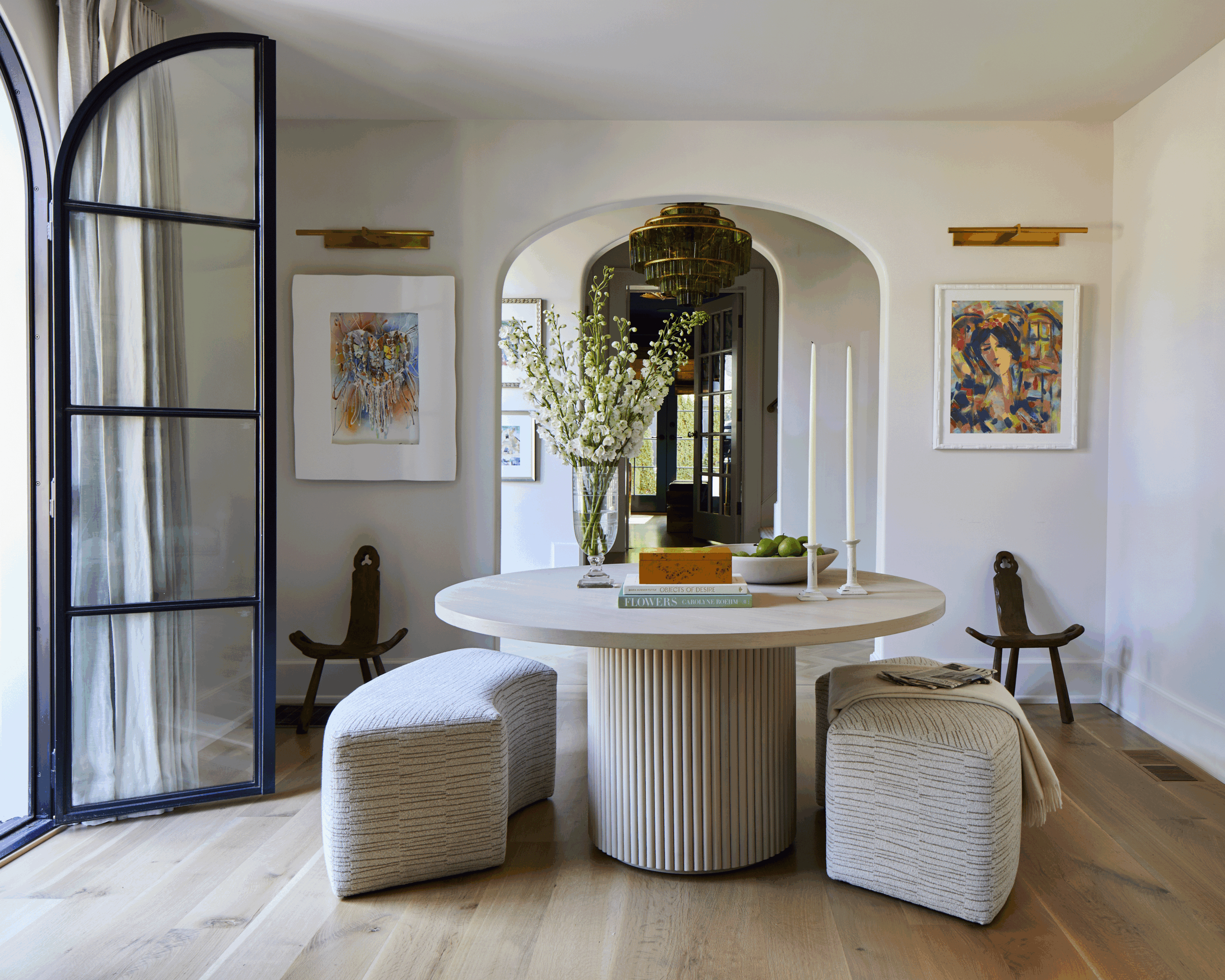
An upscale drop zone close to the front entry acts as a game table or overflow when entertaining.
Cole & Sons’ Woods wallpaper is beloved by the homeowner and was originally planned for the kitchen. “It sets an earthy and moody tone,” Strong says.
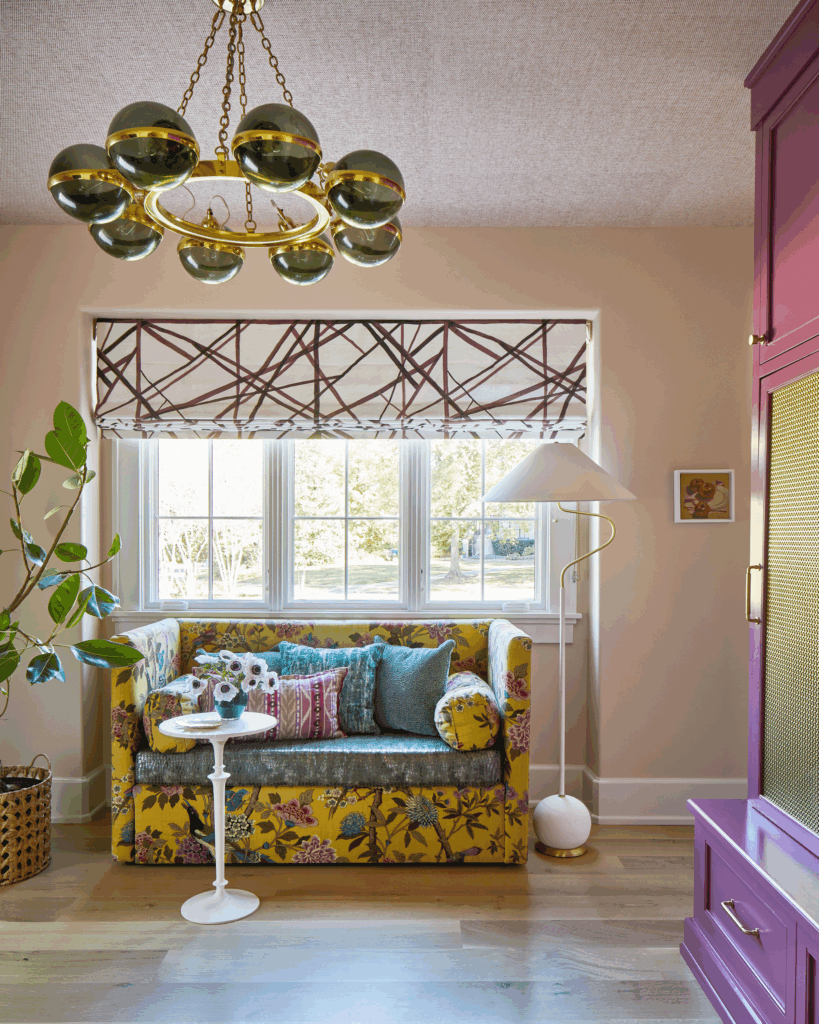
The mudroom greets the family from the garage with a joyful mix of color. Seagrass on the ceiling; a green-glass-and-brass light fixture; a with a metallic crocodile on the seat cushion; and a bright magenta set of lockers.
While the changes to the architecture may have been subtle, the interior design updates are anything but! At both the front door and the garage entry, color and pattern come to the fore, and nod at what’s to come deeper inside. While some rooms are steeped in vibrancy and others are a calming balm, every space has at least a touch of color and pattern. “There are lots of fun spaces mixed with calmer, more restful rooms throughout the house,” Cole says. “At one time the couple lived in California so you can feel that eclectic West Coast vibe woven into the design.”
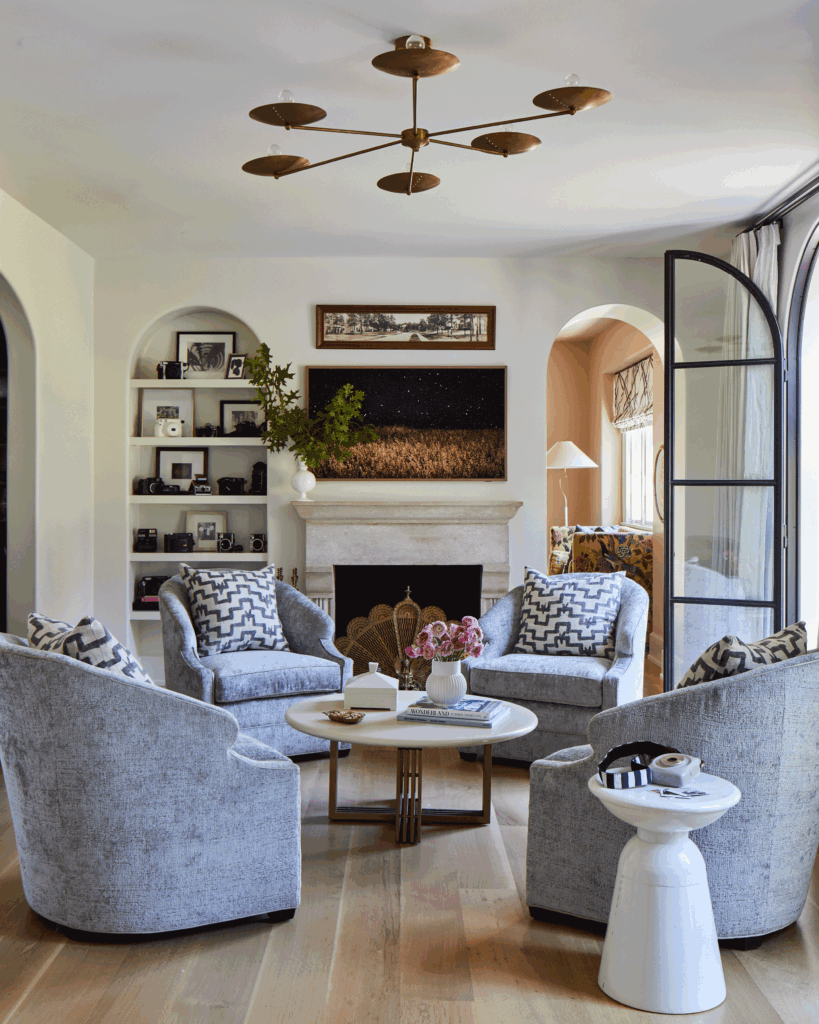
The formal living room, a long, narrow space with two sets of French doors that open to the front patio, has a calm, California vibe. “The homeowners are art collectors and she’s a photographer who’s traveled the world,” Strong says, noting the cameras displayed on built-in shelves.
One way the designers brought that collected, personal feel to rooms was with lighting choices. Sculptural pendants and linear chandeliers span the style spectrum from traditional to modern, all with the goal of feeling unique. A custom six-armed fixture from Italy hugs the ceiling of the formal living room while twin Arteriors fixtures that recall the shape of an abacus light the kitchen island. In the dining room, a stack of graduated gold discs give off soft light, and in the library, marble bases add interest to sconces. “Our client is adventurous and we wanted each selection to feel unique to her,” Strong says.
The location of the planned update, the kitchen’s window wall was pushed out about five feet and the laundry room (behind the refrigerator/freezer wall) was added. The Arteriors light fixtures give the room a unique twist. “It’s important to us and our client that her home not look like every other house,” Strong says. “When I saw those fixtures, I knew they were the ones.”
The project, really a meaningful preservation effort, Strong says, “is a special one.” Not just because of the home’s 90-year history as a beloved part of Homewood’s architectural narrative, but also because of the long-standing relationship between the clients and the design team. “They are so much fun, they love color and pattern, and they gave us complete creative license throughout this project,” the designer says. “It’s that level of trust that allows the magic to happen.”
“The table and chairs are indoor/outdoor which is great for this young family of five who gather here for meals,” Cole says. The tiered brass chandelier gives off a soft ambient light—perfect for eating.
“In this house, color, texture, wallpaper, and lighting make it special.”
– Designer Marianne Strong
A bar flanked by built-in arched hutches makes one wall of the dining room a storage and entertaining boon. “The Brandino Brass cabinet hardware and the bar sink from Fixtures & Finishes really elevate the space,” Strong says.
Custom cabinets and a furniture-like island by Dan Brogan at Birmingham Woodworks with pulls from Brandino Brass hardware anchor the workspace in traditional style.
“This is the wife’s getaway,” Cole says of the bookshelf-wrapped library. The sofa’s small-dot upholstery, textured flame-stitch drapery, and floral wallpaper coordinate with lacquered walls. “The last pieces to go in were the chairs and they just happened to go with everything in the room—a fun find,” Cole says.
Resources
INTERIORS: Marianne Strong InteriorsBUILDER:McGuire ConstructionLANDSCAPE ARCHITECT: Dave Eyrich STYLING: Lindsey Ellis BeattyENTRYWAY: Kelly Werstler for Lee Jofa wallpaper LAUNDRY ROOM: Floors and countertops: Triton StoneMUDROOM: Custom settee upholsteree: GP&J Baker floralKITCHEN: Custom cabinets and island: Dan Brogan at Birmingham Woodworks, Pulls: Brandino BrassBAR: Wallpaper: Romo’s Black Edition collection, Cabinetry paint: Sherwin Williams LIBRARY: Wallpaper: Floral wallpaper by Maxwell Fabrics, Paint: Lacquered walls in Benjamin Moore – Everard Blue (CW-575)
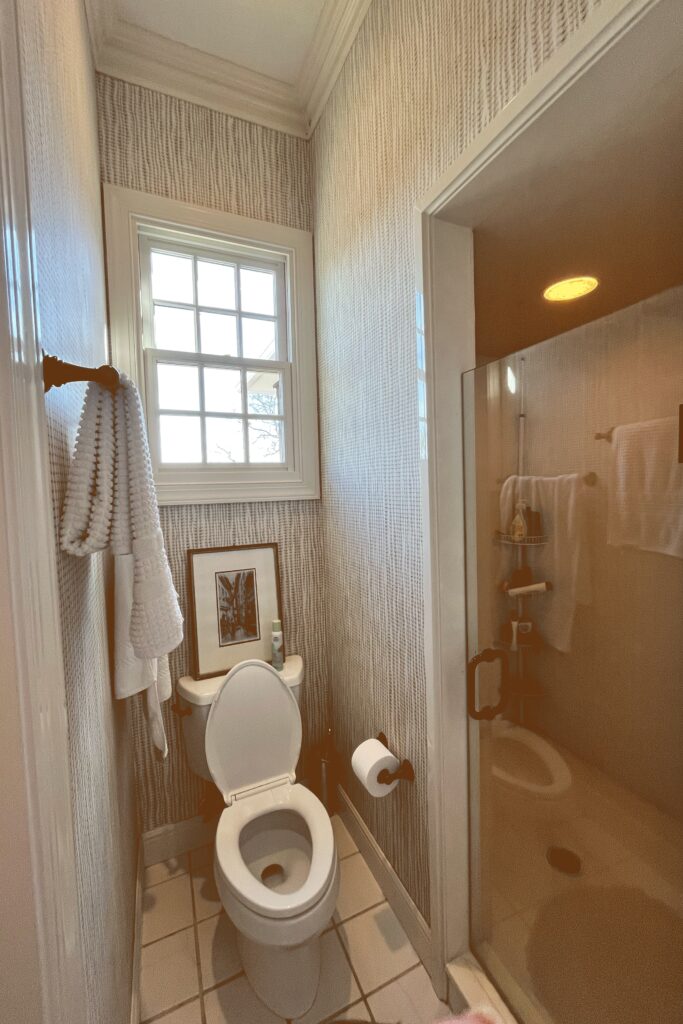
BEFORE: Heavy drapery and dark, textured wallcovering overwhelm the room, muting natural light and making the bathroom feel smaller than it is.
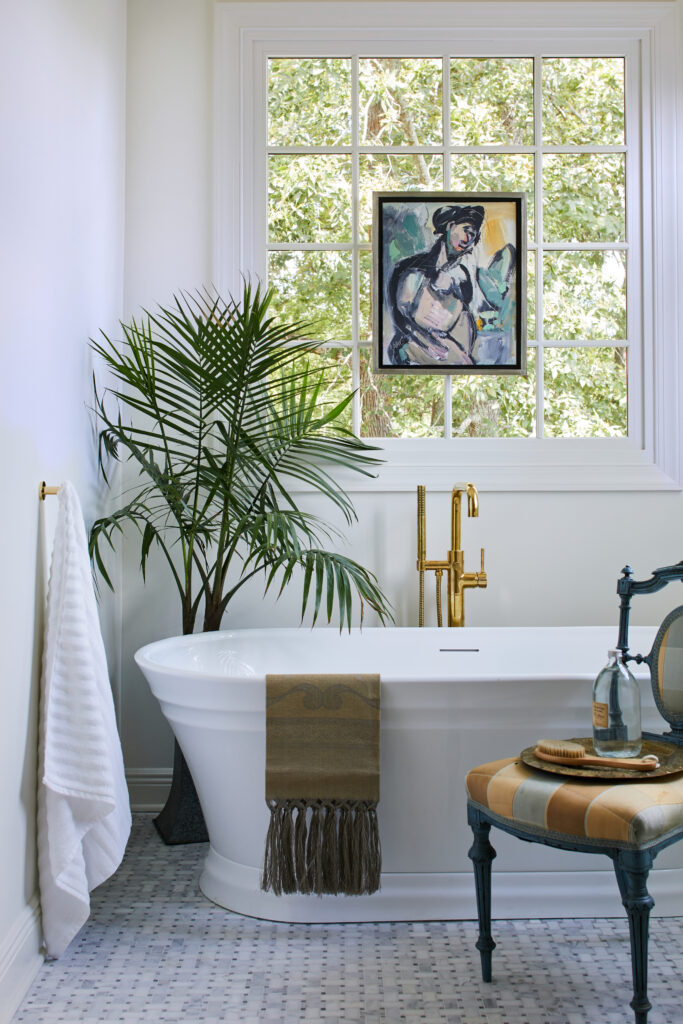
AFTER: A sculptural freestanding tub anchors this bright, nature-facing bath. Brass fixtures add just enough warmth to elevate the palette. // Photos by Laurey Glenn, Styling by Kathleen Varner
How to Make a Small Bathroom Look Bigger
Sometimes a few small tweaks can make all the difference. For this primary bath renovation, designer Amanda Hickam of Harper Harris Design made simple but strategic design moves to maximize space and provide a better flow.
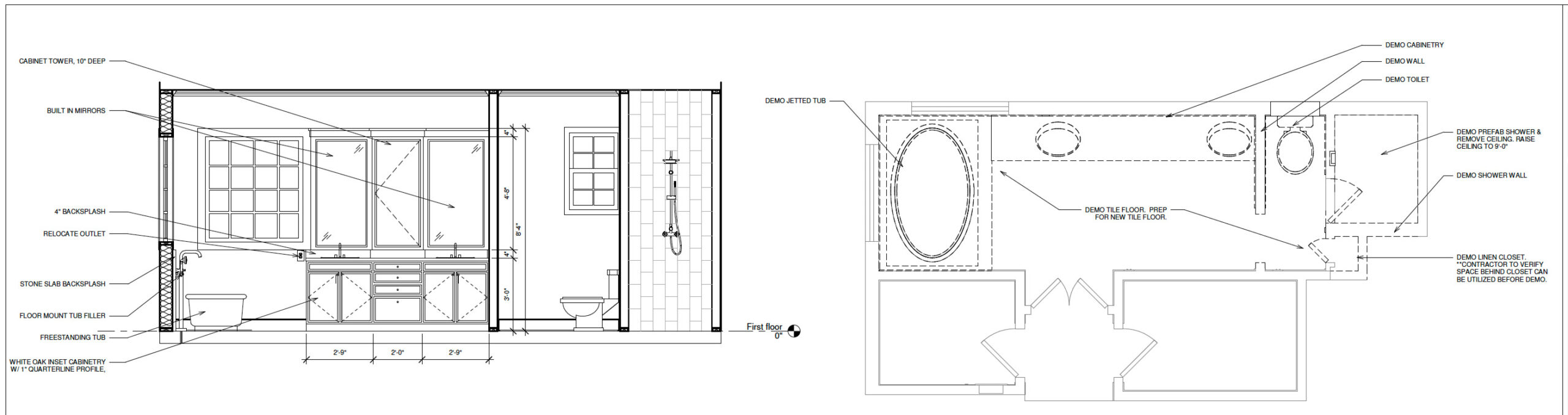
Floor plan changes by Harper Harris Design.
Trouble spots included a much-too-long vanity that took up floor space and butted against a built-in tub surround. The pre-fab shower was past its prime and way too low and cramped, and the water closet much too visible.
“White marble counters, crisp white cabinetry, classic mosaic floors, and unlacquered brass accents are timeless materials that still feel effortlessly modern.”
– Designer Amanda Hickam
BEFORE: The cramped footprint made every design choice feel cluttered, while the dated shower enclosure and awkward layout only emphasized the room’s poor flow.
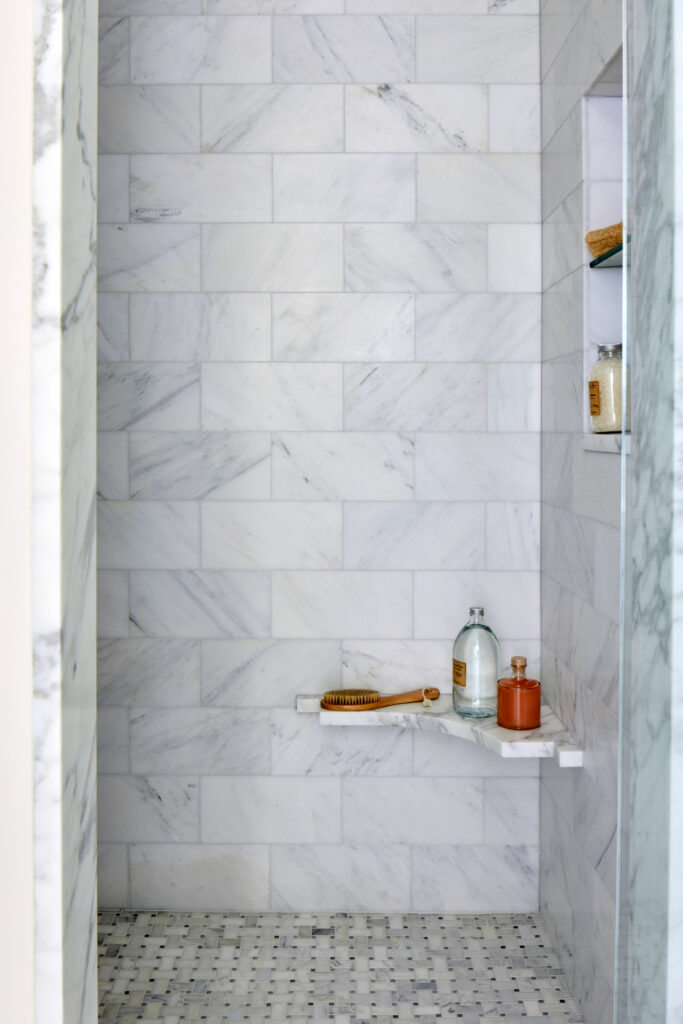
AFTER: Clean-lined marble tile instantly elevates the shower. The restrained palette and thoughtful detailing allow the materials to speak for themselves.
Small Bathroom, Big Upgrade
Her solutions? Replace the clunky tub with a freestanding style and shorten the vanity and add a storage tower between the sinks to make up for lost cabinet space. She also rotated the toilet and portioned off the water closet on its own. “We now have a clear visual line all the way through the entire length of the bathroom,” Amanda says.
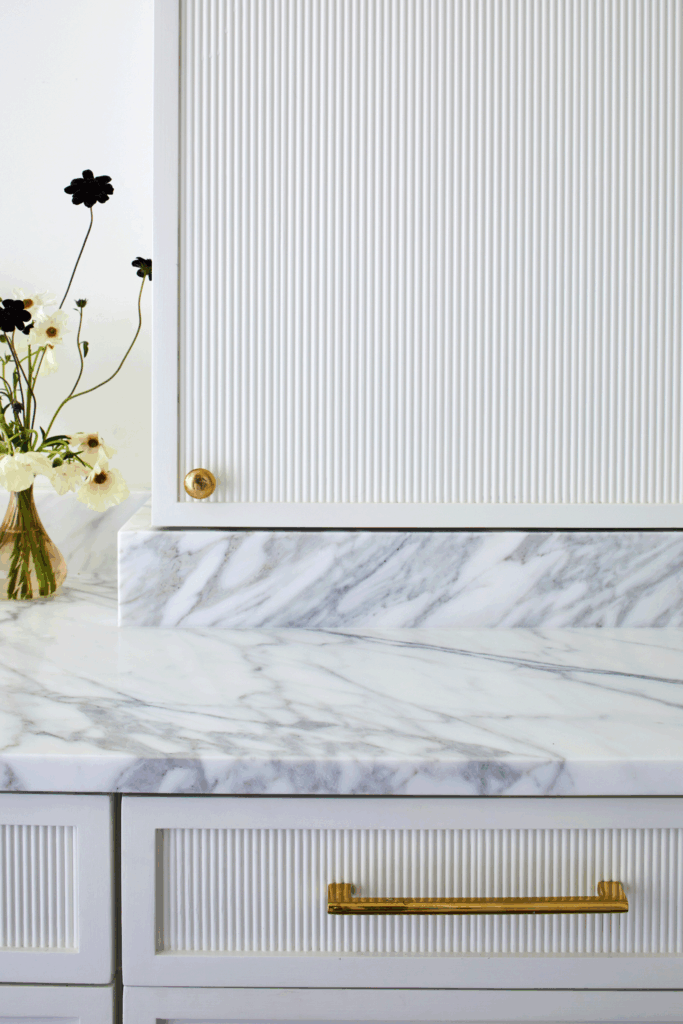
The storage tower resides on a marble plinth that joins the backsplash band for a clean, continuous look.
Calacatta marble steals the show here, contrasted with soft neutrals and brass accents for a luxe, timeless look that keeps the stone’s veining front and center.
Amanda Hickam | Harper Harris Design
IG: @harperharrisdesign
Amanda’s Top 5 Must-Haves for a Winning Bath
Make storage glamorous. Ample, well-organized cabinetry and drawers keep every beauty and skin-care product at arm’s reach—and off the counters—for a polished, clutter-free look.
Protect prime-time routines. A separate water closet and a roomy double vanity let two people get ready at once, safeguarding both storage space and marital harmony.
Linger a little longer. A deep, comfortable bathtub invites long soaks, quiet moments, and the feeling of a private spa at home.
Insist on hardworking hardware. Beautiful plumbing fixtures should double as jewelry for the room while delivering reliable, powerful water pressure.
Straighten every line. Perfectly placed, level tile and crisp grout lines keep the eye at ease, so nothing distracts from a calm, relaxing shower.
Winter and cold weather bring on a garden’s dormancy but that doesn’t mean there isn’t work to be done. What you do throughout the cold season can make all the difference for your garden and plants come spring. Here are some ways to support and improve your plants and soil quality, as well as protect pollinators, throughout the winter.
Cleaning up your garden is an important part of getting it ready for winter and the next growing season to come. Just like the rest of the year, you want to make sure you remove dead and rotting material and weed out invasive plants. However, for this time of year it’s best to leave any fully dried leaves and stems on your plants, as they provide shelter for local insects and pollinators throughout winter. This plant material will most often be hollow stems of perennials and fully dried leaves and flowers on your trees and shrubs. Weeding now can be even more important than weeding throughout the growing season—most weed seeds can overwinter in your soil and garden beds and get a head start on taking over in the spring.
Another task that is synonymous with this time of year is dealing with leaf litter. Whether you rake, blow or vacuum, the best thing is to directly mow leaves into your lawn or add to your planting areas. Leaf litter breaks down and adds organic material and nutrients to your garden as well as acting as an insulator.
Soil Care
Moth orchid (Phalaenopsis) Photo courtesy of Alisha Julia
Once you’ve tidied up your garden, you can focus on soil health and weather preparation. Adding mulch, compost or leaf litter as insulation can improve plants’ survival rates through harsh cold temperatures. Additionally, amending your soil with additives now gives them time to break down and become active components of your soil by spring. While soil amendments can help retain heat during cold drops, that’s not the only weather-related threat for your garden.
Winter Weather Preparation
Primrose (Primula) Photo courtesy of Kagab4
Watch out for sudden drops and spikes in temperatures throughout winter. Steady temperatures below freezing can be dangerous for your garden, but large and quick changes are more worrisome. If changes in temperature are expected with rain, this could reduce the risk of frost damage to plants. Dry conditions can be just as damaging as cold temperatures and can worsen the impact of harsh weather on plants. Watering your plants before freezes can keep the roots at a higher temperature and prevent cold damage beneath the soil. Moist soil holds heat which can act as a protective bubble around your plants root system during dangerously cold weather. Watching the weather forecasts can tell you when to prepare and how to best protect your plants.
Now you know how important winter garden tasks are and that there is plenty to do. What you do now will build the blooms, harvests, and beauty of your garden in the coming seasons. So don’t wait for spring—start nurturing now. Your garden will thank you.
The 1929 home in Redmont Park features original clinker brick, which provides a depth of color to the façade. The limestone surround of the front door nods to Tudor influences. // Photography by Laurey Glenn. // Styling by Lindsay Beatty Ellis.
Restoring a Classic With Restraint
Not every potential home buyer would thrill to the prospect of a historic home that had not been touched in many decades, but architect Laura Bartlett was an exception. “For me, it was kind of a dream; there had been a few kitchen updates but really everything was so intact and had not been renovated,” says Laura. “It was nice to have a blank slate from a preservation standpoint and also to be able to make it ours without inheriting someone else’s updates.”
The architect and her husband Taylor set about bringing the 1929 Redmont Park house back to its prominence by capitalizing on its original limestone fireplaces, hardwood floors, and abundant wavy glass windows. “Optimistically, except for the kitchen, I thought it just needed a layer of freshening,” explains Laura. “But as I well know, in renovations, things tend to snowball! A beam that needed to be added to the revamped kitchen affected an upstairs bathroom, so the bathroom needed to be updated, etc.”
The changes to the kitchen went well beyond structural—it was enlarged by incorporating several small pantries and a side porch that Laura was told was once used for the delivery of eggs and milk. “We wanted a more spacious kitchen, but also wanted it to open up to the dining room, so we created a generous cased opening between the two.”
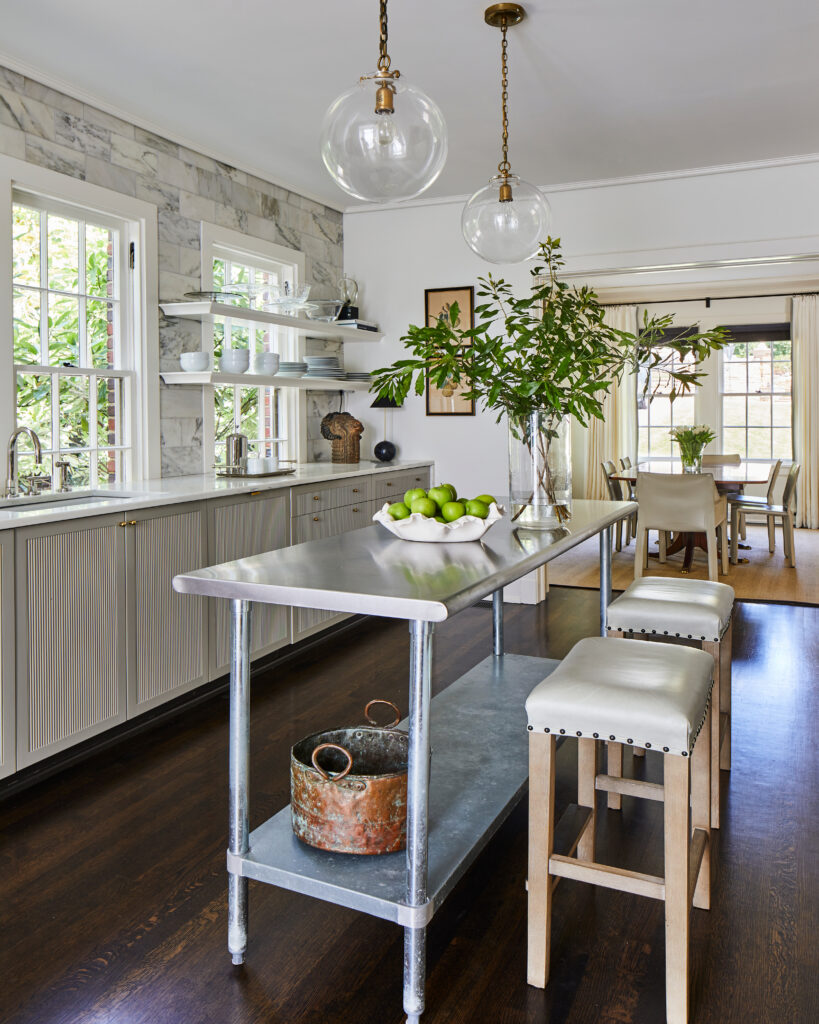
The kitchen renovation involved incorporating the former breakfast room and ancillary spaces into a bright sizeable room with a large cased opening to the existing dining room.
To keep the airy feeling in the space, the couple settled on a floating stainless-steel island with open shelves instead of a traditional one with cabinetry; it is topped with classic glass globe lanterns that reflect an old-fashioned appeal.
A Quiet Palette for a Character-Rich Home
As far as the interiors, given the home’s Tudor leanings, it had dark wood trim throughout which caused a bit of a dilemma. “We really struggled with whether to paint it or not; we wanted to respect the original materials and tried not to go all in and dip the house in white paint,” says Laura. “We started slow with the window trim and then went from there.”
An original half shelf was reimagined as a mirrored bar tucked behind pocket doors.
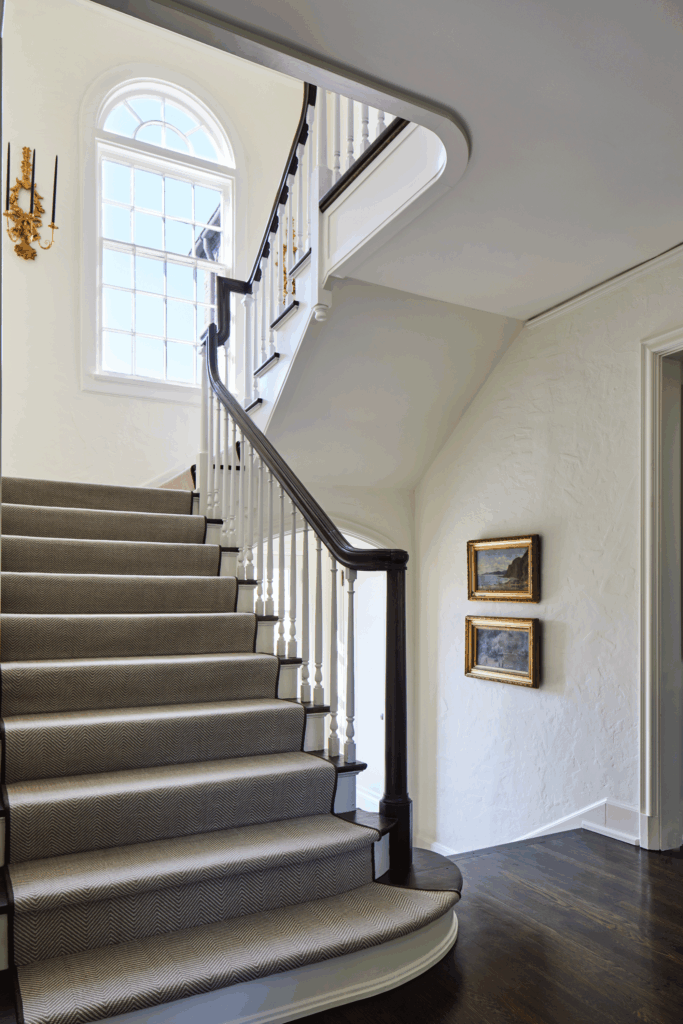
“We debated whether to paint some of the dark trim throughout the house because there was a lot of it. So, we did it in stages such as painting the trim around the stairs first, then trying the pickets before committing to the white,” says Laura.
When they did paint anywhere in the house, it was a shade of white as the architect explains: “I’m not necessarily a neutral person, but I think it was what this house wanted to be. There is a lot of variation in color on the outside with the combination of red and clinker brick; and we balanced that busyness with a quiet interior palette. It just felt right.”
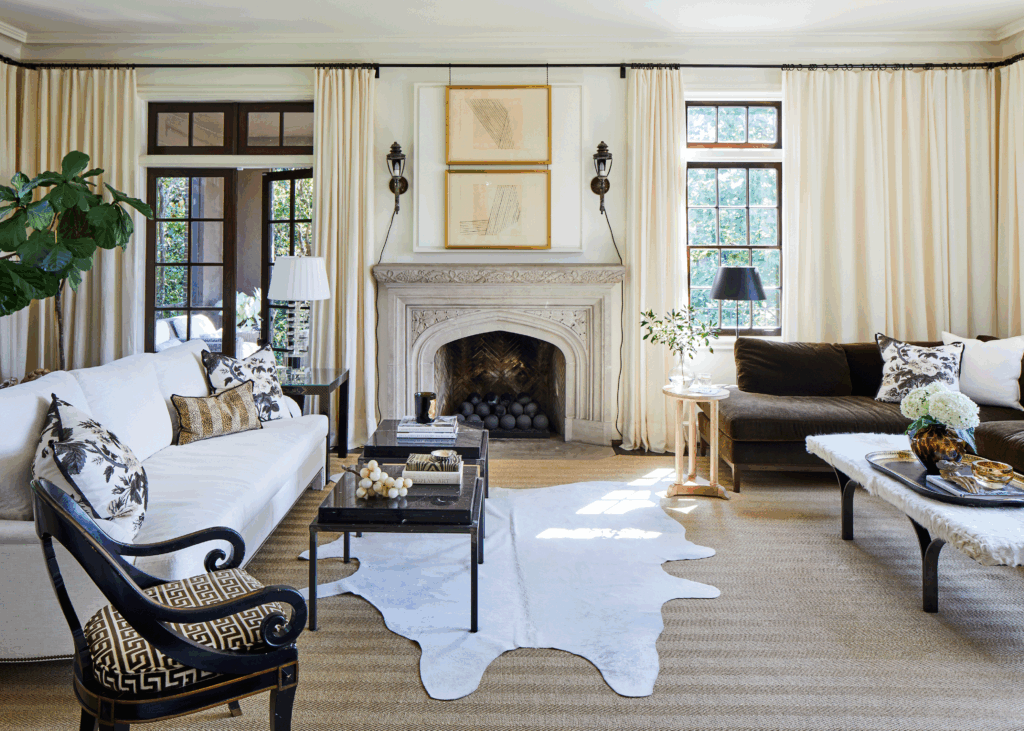
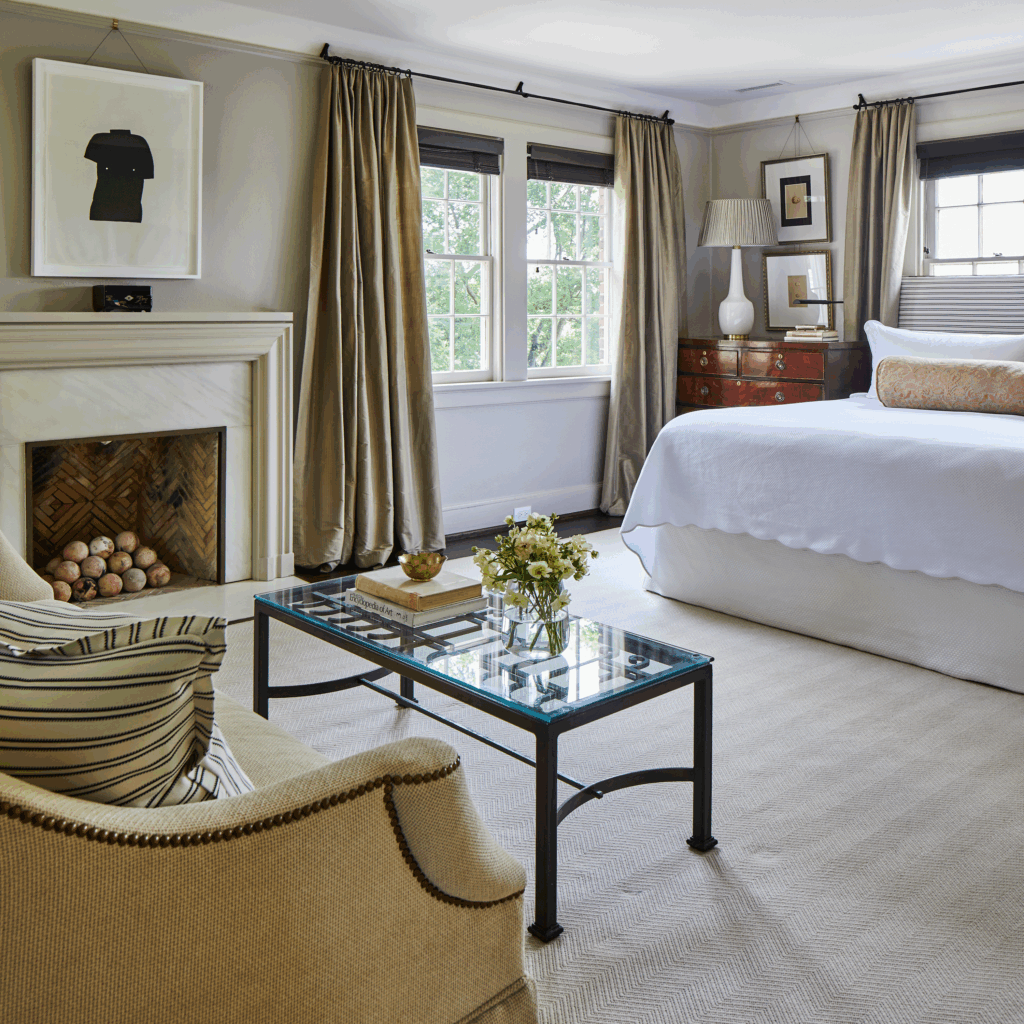
The edited décor for the living room allows the original architectural details such as the limestone fireplace to shine through with a graceful blend of antiques and current pieces in neutral tones. A brown mohair Lee Industries sectional hugs a corner of the living room joined by a custom hide ottoman atop a chevron sisal rug.
Home, Community, and a Lasting Affection for Birmingham
That thinking extended to the furnishings and décor where a brown mohair sectional and crisp, classic white sofa join hands in the living room while the entry showcases a dark gray/green velvet table skirt. Laura and Taylor’s personal and inherited antiques, including a marble-topped chest that Laura asked for her 21st birthday, slipped in easily.
“With so many interior architectural details and abundant windows and light, I felt like the house called for quiet colors,” says Laura.
“I have many designer friends, and we had a lot of people weigh in and help us. Even if you have a strong personal compass about your style, every house is different and every house needs something different,” says Laura. “I learned so much professionally working on Carlisle, but more than anything, on a personal level, it cemented my lasting affection for Birmingham and the community that welcomed us back!”
Laura Bartlett on Old House Musings
“I think many historic homes hold drama in their individual history. When given the opportunity to peel back some of the layers of time, modern additions can be the foil that highlights the original architecture, renewing that sense of drama. I try to put on my editing hat, but not overdo it.
The foyer captures a sense of drama and anticipation with the ornate original double door; the front screened door was refitted with glass, and the Tudor style door was refinished to give it new life. Laura added a classic round table draped in a lush green-gray velvet fabric as a welcoming accent to the high ceilings and richly stained floors.
To me, every house seems to want a certain stylistic direction, and especially in a renovation, it is important to respect what you inherit when possible. I try not to take away from what is originally loved about the home—interior architectural details, for example, should be celebrated.
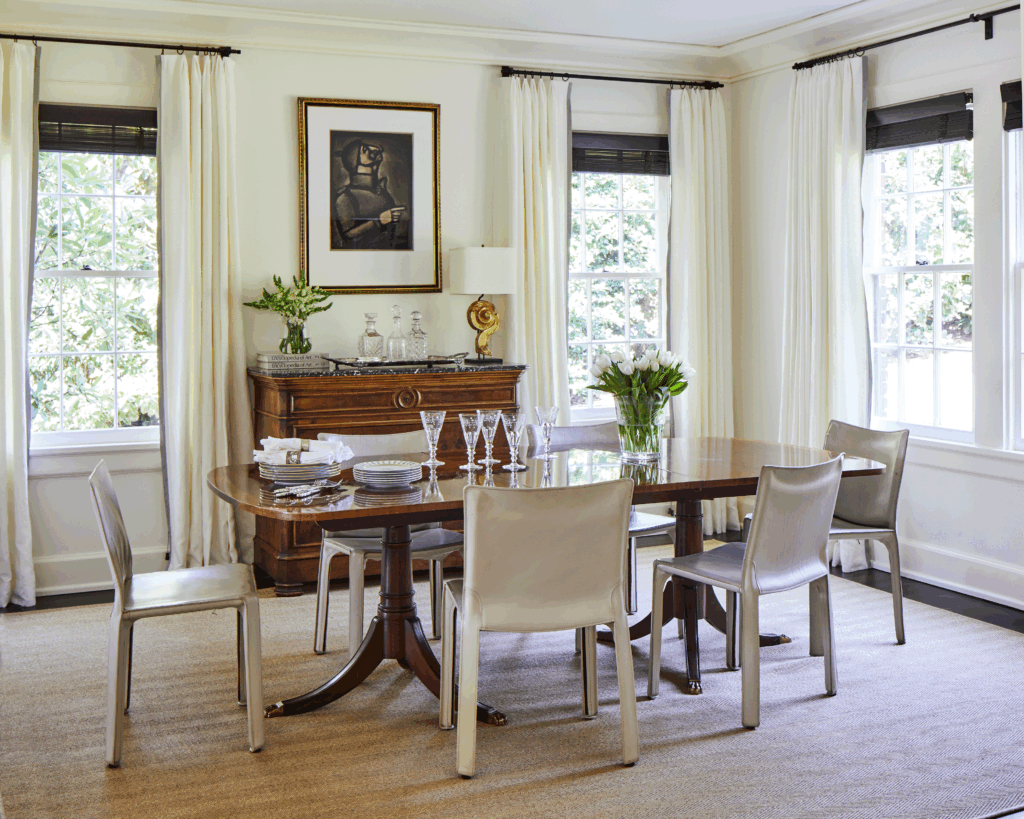
An antique mahogany table from Taylor’s great Aunt holds court with more contemporary dining chairs Laura and Taylor found at Thomas O’Brien’s shop Aero in New York.
“With all the natural light coming into the house, a neutral palette really worked; the rooms felt joyful and alive even without color. I confess to painting the dining room a bolder color only to change it back to white!”
That said, oftentimes older homes were not originally designed for the way we live today. For example, the kitchen might have been closed off from the main living spaces, but in today’s world, the kitchen is the heart of the home. Thinking critically about how to adapt and reuse existing spaces in a way that responds to modern life can bring comfort to an older home. Perhaps the kitchen is opened up to an adjacent space to lend more room for gathering, or the formal dining room becomes a small family snug or built-ins added to make it more functional and comfortable.”
Meet Laura Bartlett
Laura Bartlett was born and raised in Atlanta by parents who loved design and projects. As a young child she lived in homes designed by celebrated classicist architects Philip Schutze and James Means. “I grew up surrounded by blueprints and went to meetings with architects and decorators. We were always going to estate sales and Scott’s. When Taylor and I were renovating Carlisle Road, some of the unexpected things my parents experienced during their projects came up for us too, and it was fun to consult with them—it felt very full circle in a sense.”
Laura moved to Birmingham in 2007 to complete her architectural degree at the Auburn Urban Studio while her husband Taylor Bartlett, a native, attended law school. She started working with the commercial architecture firm Giattina Aycock Architecture Studio. “It was a bit of a jump-into-the-deep-end experience; I worked on some really grand projects like the new Children’s Hospital, Railroad Park, and some multi-family housing, and it was invaluable training.”
“My husband Taylor studied mechanical engineering at Auburn when I was there for architecture, so there is some professional crossover, but he’s a doer and I am a dreamer which is a really great combination.”
A graduate program in London for her husband landed Laura a position on a luxury residential design team secured through a mutual connection to Sam Mockbee and the Auburn Rural Studio. “It was an exciting place to be—it was basically a startup, staffed by people from all over Europe. The firm grew from about 12 to 60 employees during the time I was there from 2010 to 2012.”
A return to Birmingham in 2012 brought her to William Blackstock Architects, where she returned to commercial work primarily on projects for Children’s Hospital, The University of Alabama, and Auburn University, but she longed to get back into the private residential arena. Afterwards, she worked for five years with Paul Bates as her mentor.
In 2019, Laura and a partner began to develop a co-working space, but it fell through in early 2020. “I was very disappointed at first, then later realized we really dodged a bullet because this was right at the start of the pandemic! Fortunately, I was working on a friend’s house at the time, and that project led to referrals, and I officially started my own practice in 2020. I do a lot of historic renovations, so my experience with the Carlisle house has been invaluable. A commercial project has more defined perimeters and timeline, which has its advantages, but for me, it doesn’t compare to the relationship you develop with clients and their homes. Houses, especially old ones, always need something!”
Resources
Architect: Laura Bartlett. laurabartlettarchitect.com Contractor: Homeowners served as general contractor with consulting by Philip Woods. Kitchen: Marble: Will Casey and Susan Vise (formerly Fragment Stone). Island: Bresco. Counter stools: Pottery Barn. Custom cabinets: Cahaba Woodworks. Range: Wolf Dual Fuel. Globe pendant lights: Visual Comfort. New steel door by Bessemer Glass. Bar & Staircase: White paint color: Custom. Sconces: from Laura’s parents. Stair runner: Billy Brown Flooring. Artwork: Hanna Antiques. Black candles: Little Hardware. Living Room: Rug: Billy Brown Flooring. White sofa: Lee Industries through Circa. Sofa pillows: Schumacher Pyne Hollyhock and Colefax and Fowler Malabar. Curtain fabric: Linen from King Cotton. Throw rug: Cowhide from Yerra. Drinks table (left:) Woodworking Dynamics. Sconces: Antique Carriage Lights from Taylor’s Grandmother’s home. Sectional: Lee Industries through Circa. Pair of tables: Black Marble on Custom Metal Bases. Art (over fireplace): George Reed framed by Framed. Bedroom: Rug: Rugko. Curtain fabric: Silk panels from RH. Coffee table: Scott Antique Market. Sofa: Hickory Chair. Striped pillow fabric: Schumacher. Art (over fireplace): Amy Pleasant. Bedside lamp: Custom Shade from The Lamp Shoppe. Bedding: The Linen Ladies with Fortuny Bolster. Fireballs: Brandino Brass. Foyer: Table skirt fabric: Lewis and Sheron. Art: Piranesi Prints from Taylor’s Grandmother. Vase: White Ceramic. Dining Room: Chairs: CAB Chairs by Cassina through Aero. Curtain fabric: Linen from King Cotton. Shades: Smith and Noble. Rug: Billy Brown Flooring. Art: From Taylor’s Grandmother. China and crystal: Table Matters.
Inspired by classical Italianate design, this Mountain Brook garden effortlessly blends peaceful retreats with expansive spaces for entertaining. Architect James Carter, landscape architect Norman K. Johnson, and garden designer Mary Zahl bring this breathtaking property to life.
Jenny Sobera spends much of her day caring for patients at Village Dermatology, but when the lab coat comes off, she turns her attention to another passion project: Gardening.
This iconic Mountain Brook cottage, reimagined by owner and garden designer Troy Rhone with architect Bill Ingram, proves that an iconic home deserves a garden to match.
Tasked with transforming a steep backyard into an entertaining retreat, garden designer Troy Rhone carved a series of terraced outdoor rooms into the hillside.
From asphalt jungle to refined retreat, landscape designer Todd Dorlon reimagines this backyard with distinct spaces for outdoor living and entertaining.
The “Pineapple House” on Canterbury Road in Mountain Brook is a standout landscape project for Todd Dorlon (@tmdlandscapedesigns). The rear courtyard was in rough shape when Todd stepped in to give it a much needed facelift that complements the charm and character of the Cape Cod-style home.
When a Birmingham family sought to build a comfortable year-round retreat at Kennebec on Lake Martin, they called in the dream team: Jessica Prier of Birmingham Design House and Nequette Architecture.
Architect Walker Renneker has worked on many houses – but he says if his wife could trade their personal home for any of the ones he’s designed, this modern farmhouse would be it.