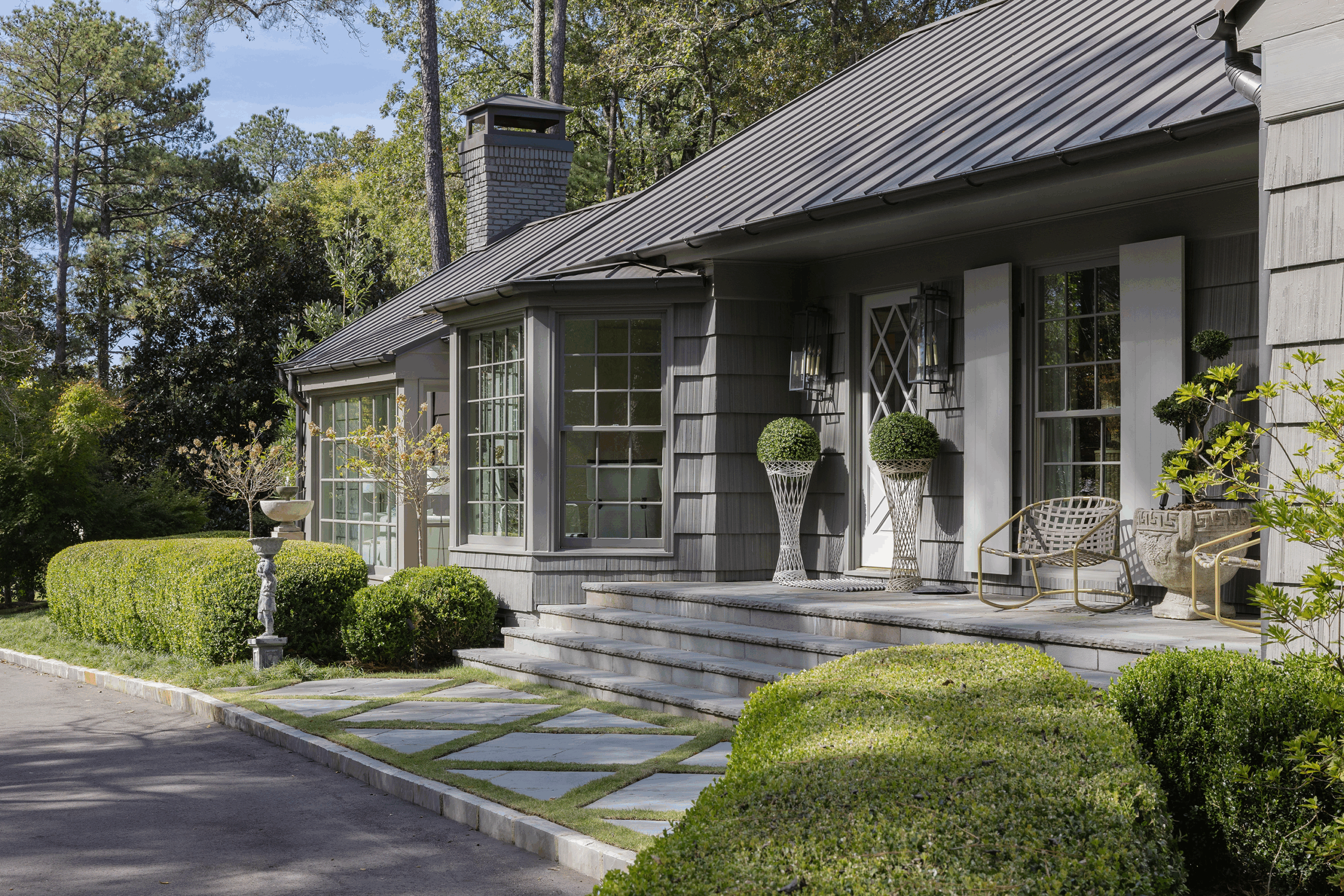
The shingled exterior was updated with Gray Gardens by Benjamin Moore, along with fresh landscaping // Photography by Holly Schumpert // Floral Design by Vicka Hanson // Styling by Margaret Hicks
A Weekend Retreat Tucked Into the Trees
What do young married design professionals and their children do on the weekends? Sometimes, absolutely nothing at all—and that’s just fine by interior designer Ivy Schuster. “Our house does have a bit of a vacation vibe to it,” she says. “A weekend can go by where we never leave, and I hardly even notice. One reason we were attracted to this property was its location tucked away in the woods yet close to everything.”
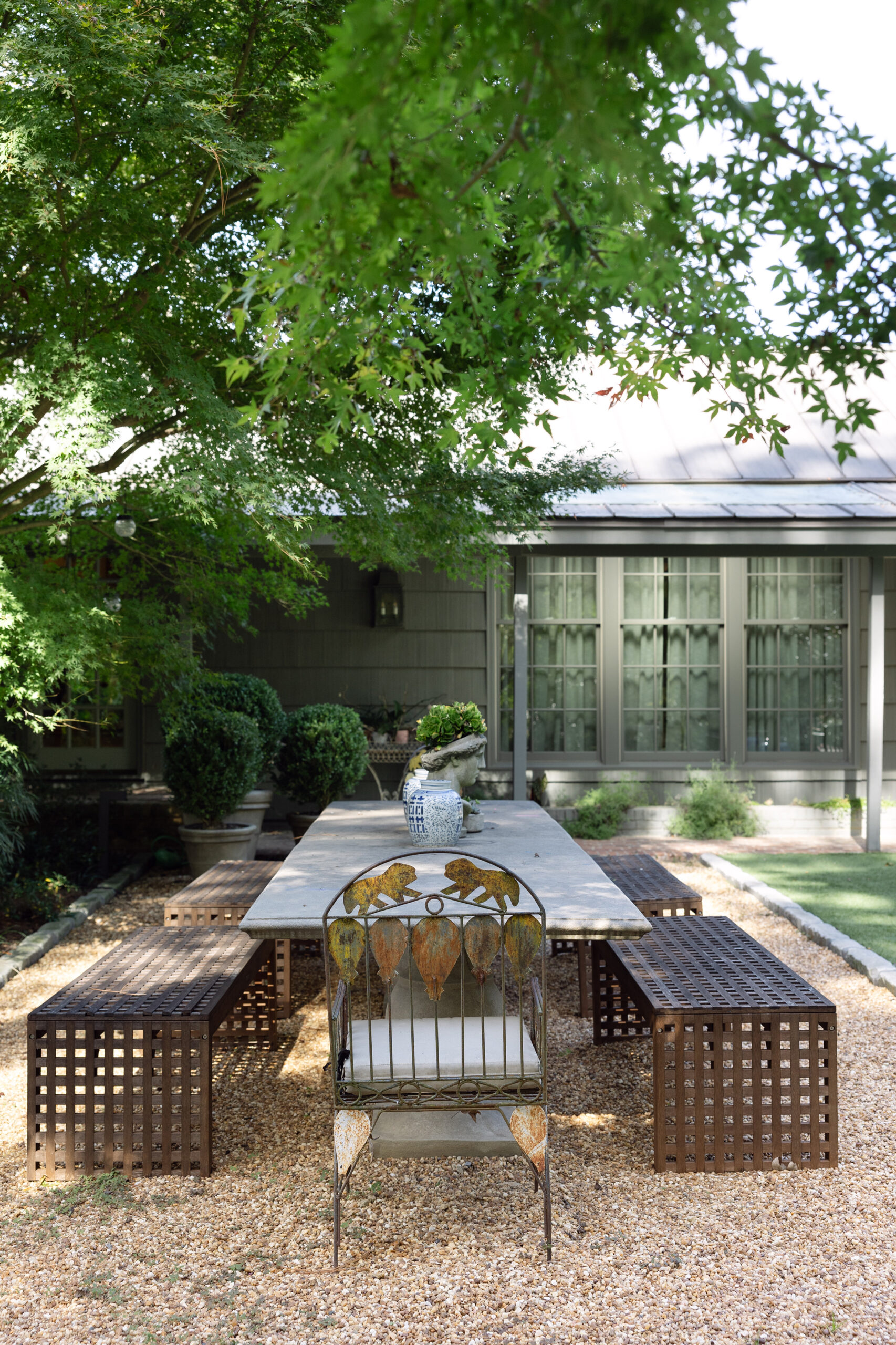
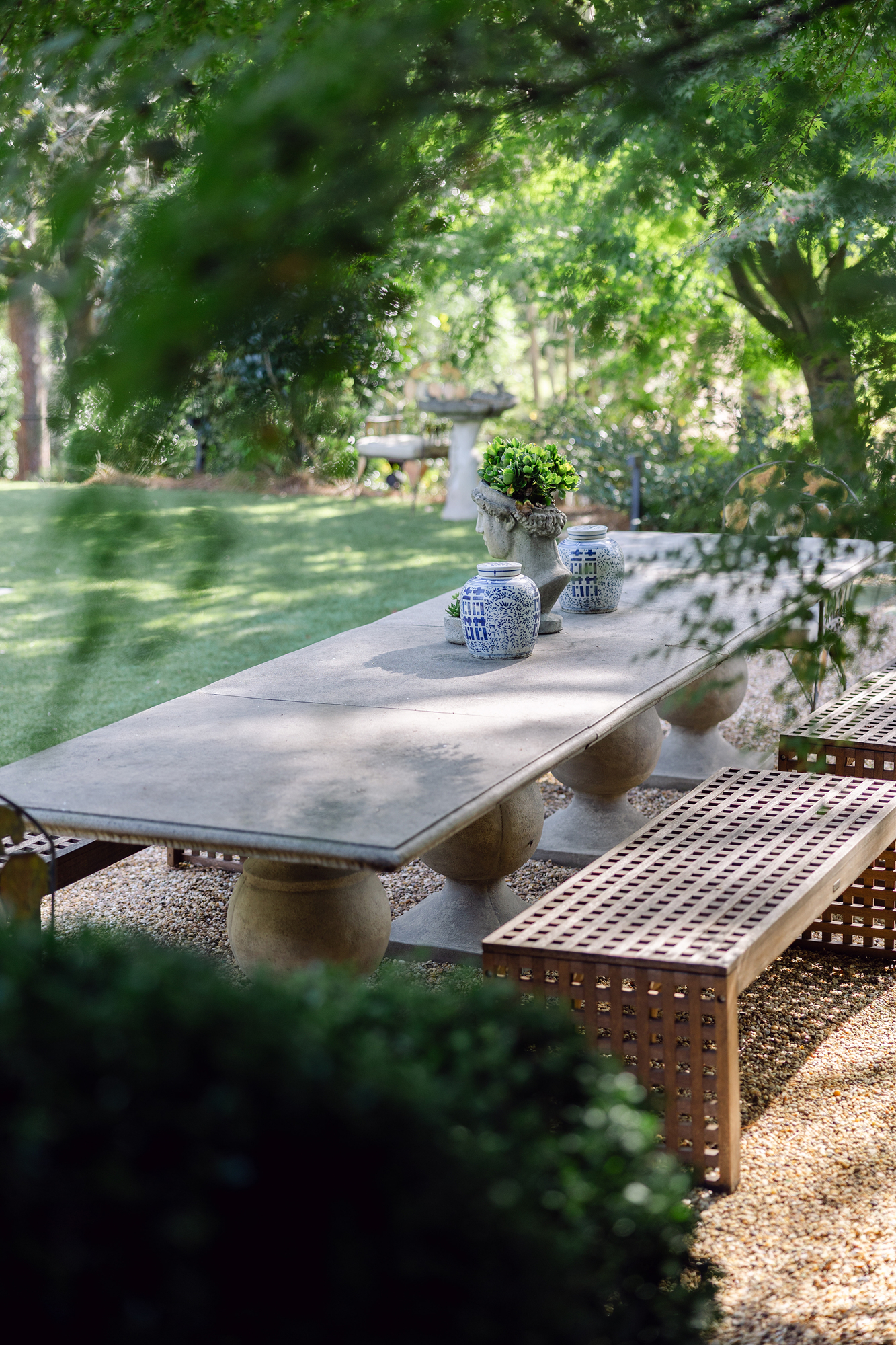
A stone dining terrace provides a serene setting for alfresco meals.
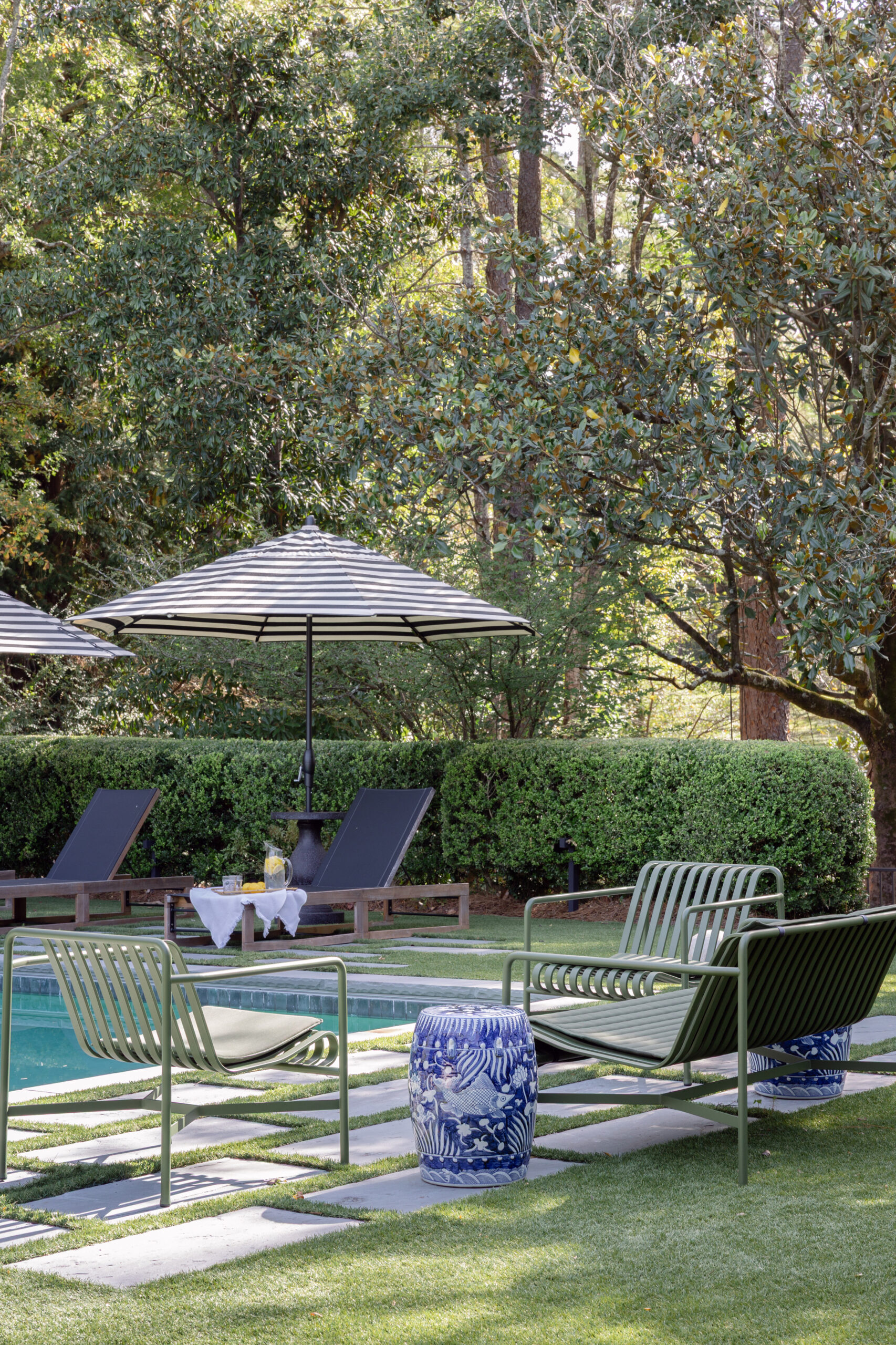
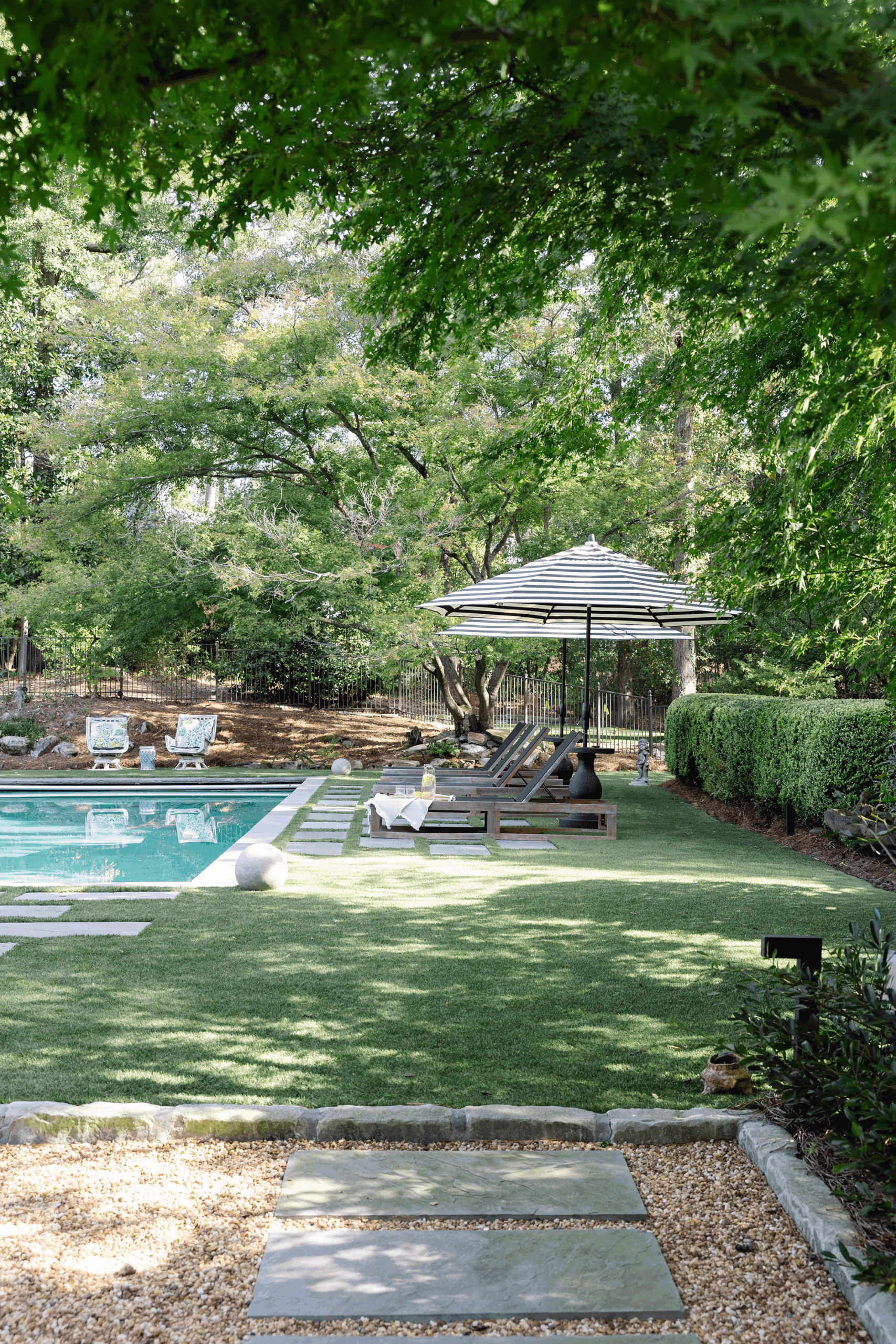
The reworked pool deck makes staying home all the more enticing.
A Mountain Brook Find Worth Waiting For
After renovating what they thought was their forever home in Homewood, Ivy and her husband Josef, a custom cabinetmaker, learned that a property was going on the market in Mountain Brook. Not only was Ivy friends with the owner but she and Josef had worked on the house professionally after a fire.
The couple had always admired the 1950s cedar shake home, so it seemed like kismet when it became available. “We loved the bones, and it was in good shape,” says Ivy. “However, we did end up touching every room in some capacity. Several lifts were more of a decorating exercise, but we also added a wing that feels like it could be original. Before, the house was more of an L-shape; now it’s closer to a U.”
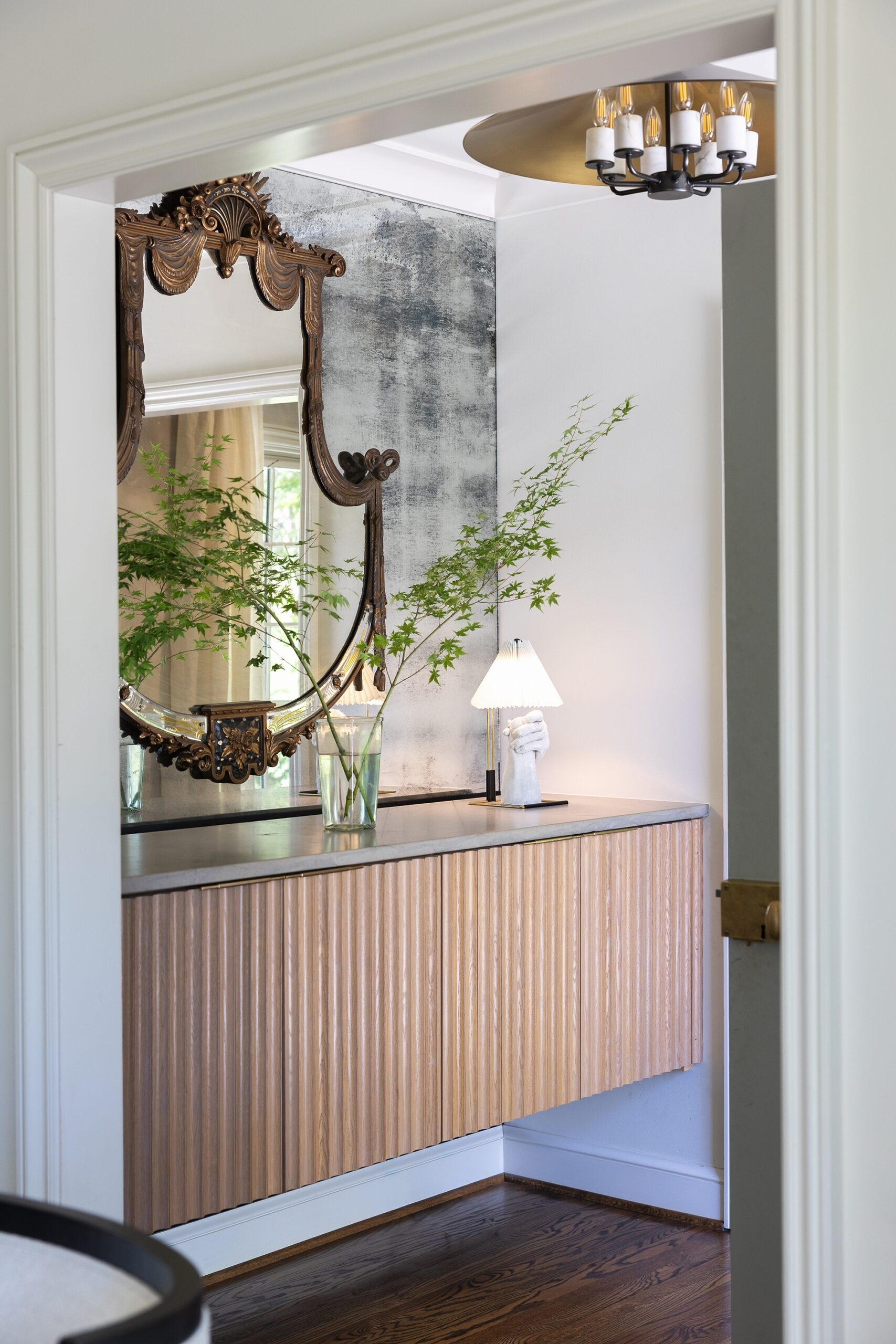
For the tight entry, Josef crafted a floating, fluted console set against an antique mirrored wall topped with an ornate French mirror.
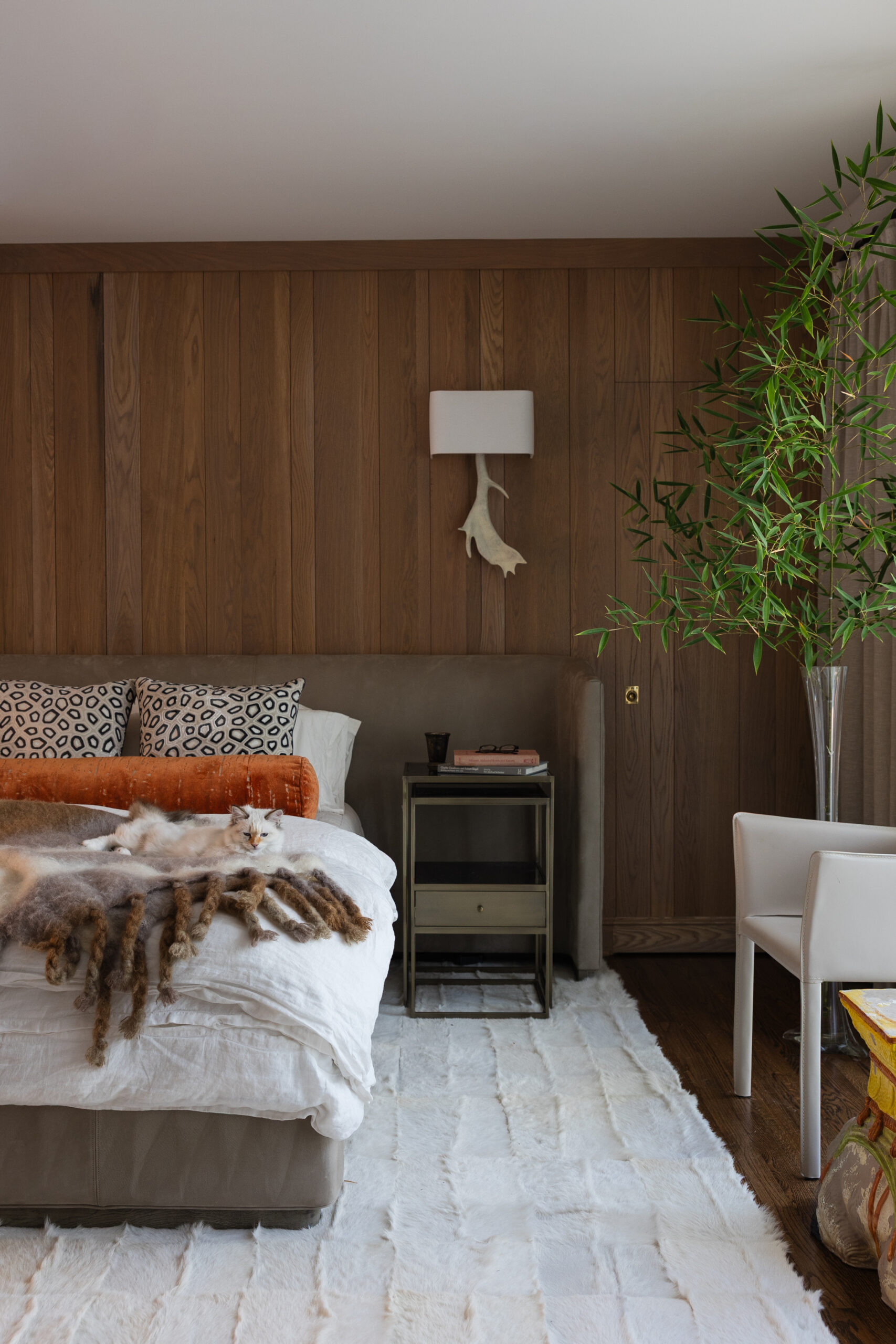
A paneled wall in the primary bedroom provides storage accessed by a pair of jib doors. The posh, tactile room with its animal print and cowhide rug feels plucked from a contemporary hotel.
“One draw to the house is its great layout for hospitality and entertaining which is what makes it unique—there is such good flow between the rooms and the outdoor spaces.” —Ivy Schuster
A Designer’s Eclectic Eye, Led by Art
When it came to the décor, Ivy found herself exploring new territory as the style and one-level layout of the house was very different from her 1920s traditional Homewood stone cottage. However, her signature passions remained the same. “Your home is the only place where you can do exactly what you want, and I would say that my personal style is very eclectic and leans more modern and casual, but I also love to mix in antiques,” she says. “I’m fortunate to have inherited a lot of special pieces, and I’m very influenced by art. I also dove into my file of favorites that I’ve collected when sourcing for clients. I kept going back to some of the ideas over and over again.”
Living Room Details
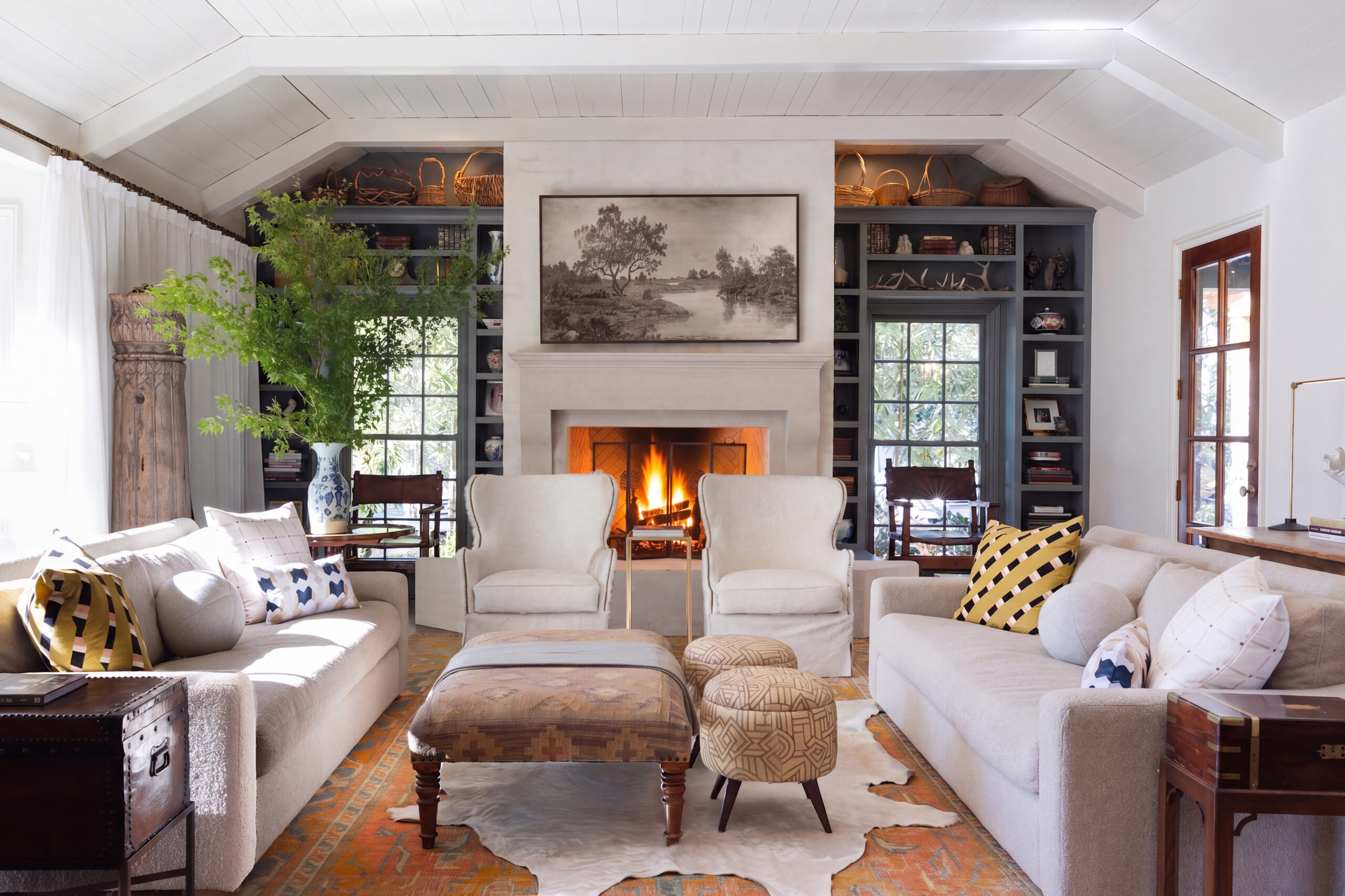
Dashes of color from the orange-hued Oushak rug and yellow Pierre Frey pillow fabric bring spirit to the neutral living room anchored at one end by custom millwork bookcases painted a deep gray green, the same color as the exterior of the house.
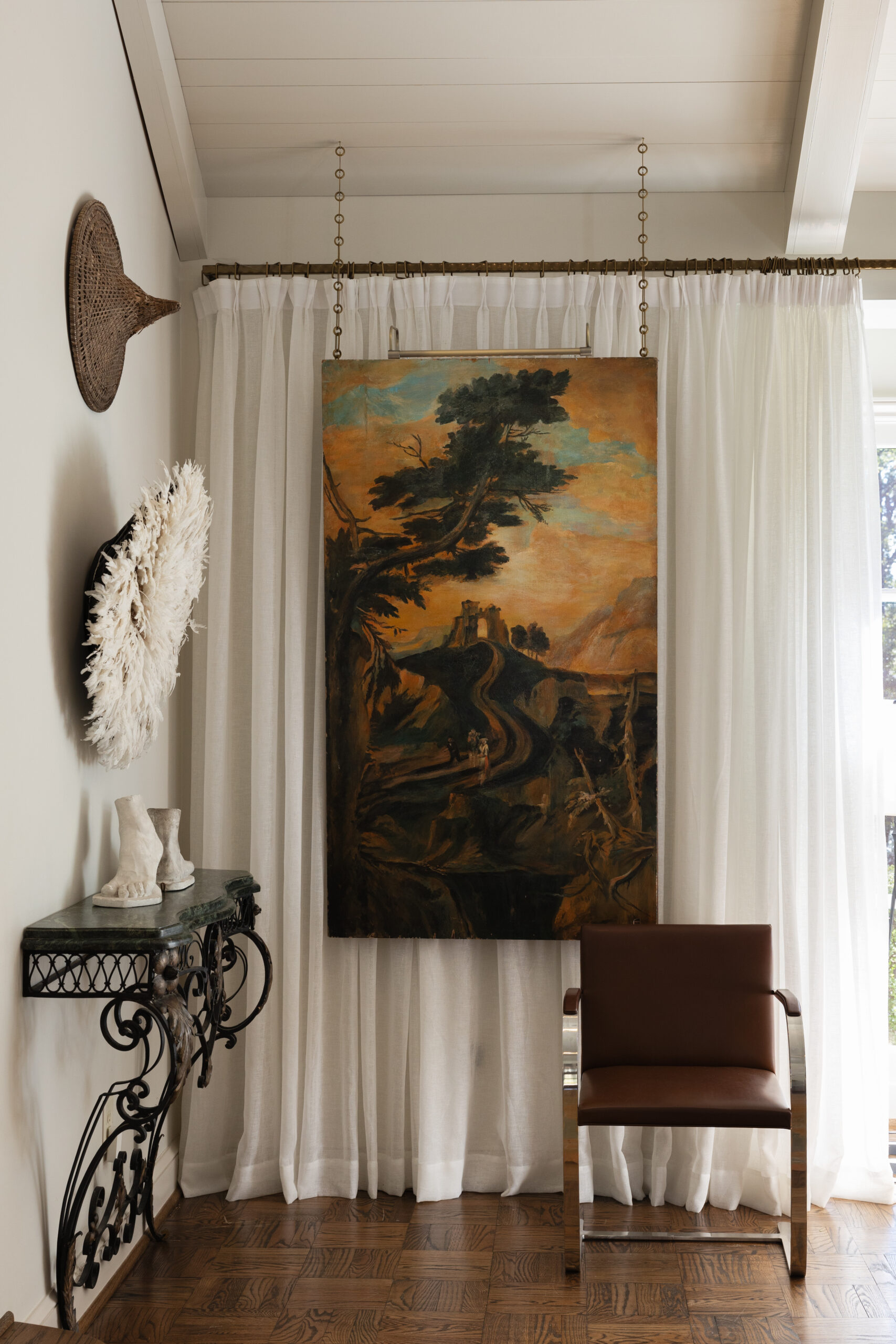
Tip: Bring contrast to neutral walls through painted bookcases, wood paneling, gilded mirrors, sheer fabric panels, and art such as the antique piece from The Nest
The result is rooms that are inviting with subtle panache—a tiered paper lantern over the breakfast room table; a wall covered in sheer drapery panels; a large-scale moody landscape suspended from the ceiling by decorative brass chains; floor-to-ceiling bookcases painted in a chic gray/green; layered cowhide rugs; and antique chests transformed into a kitchen island.
The Gallery Wall
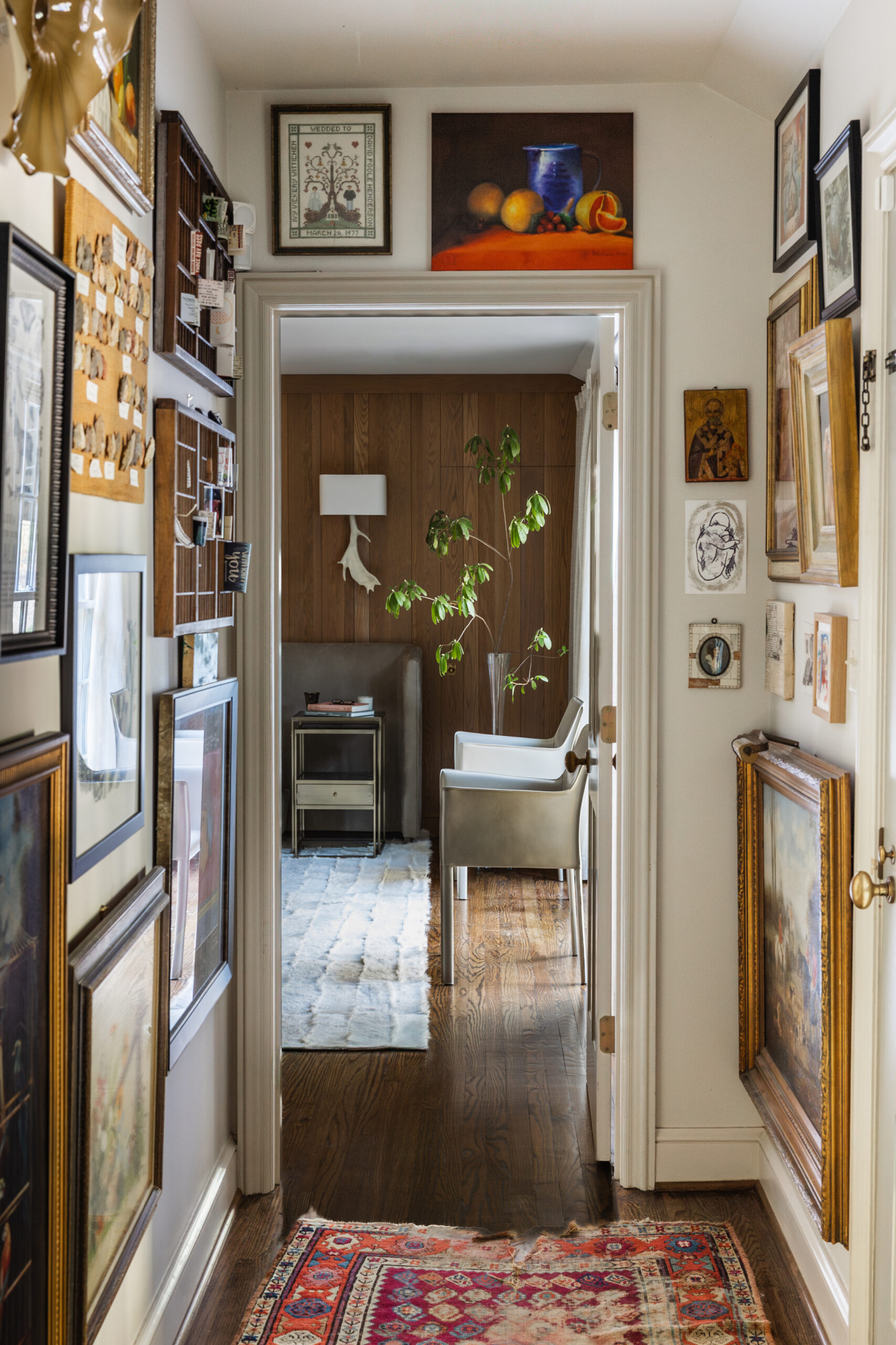
Tip: Create an eclectic gallery wall full of family finds, travel treasures, and other pieces that speak to your personality or tell a story. “I wanted to cover that whole area with art, and I’m constantly adding, tweaking, and messing with it—there is no formula,” says Ivy.
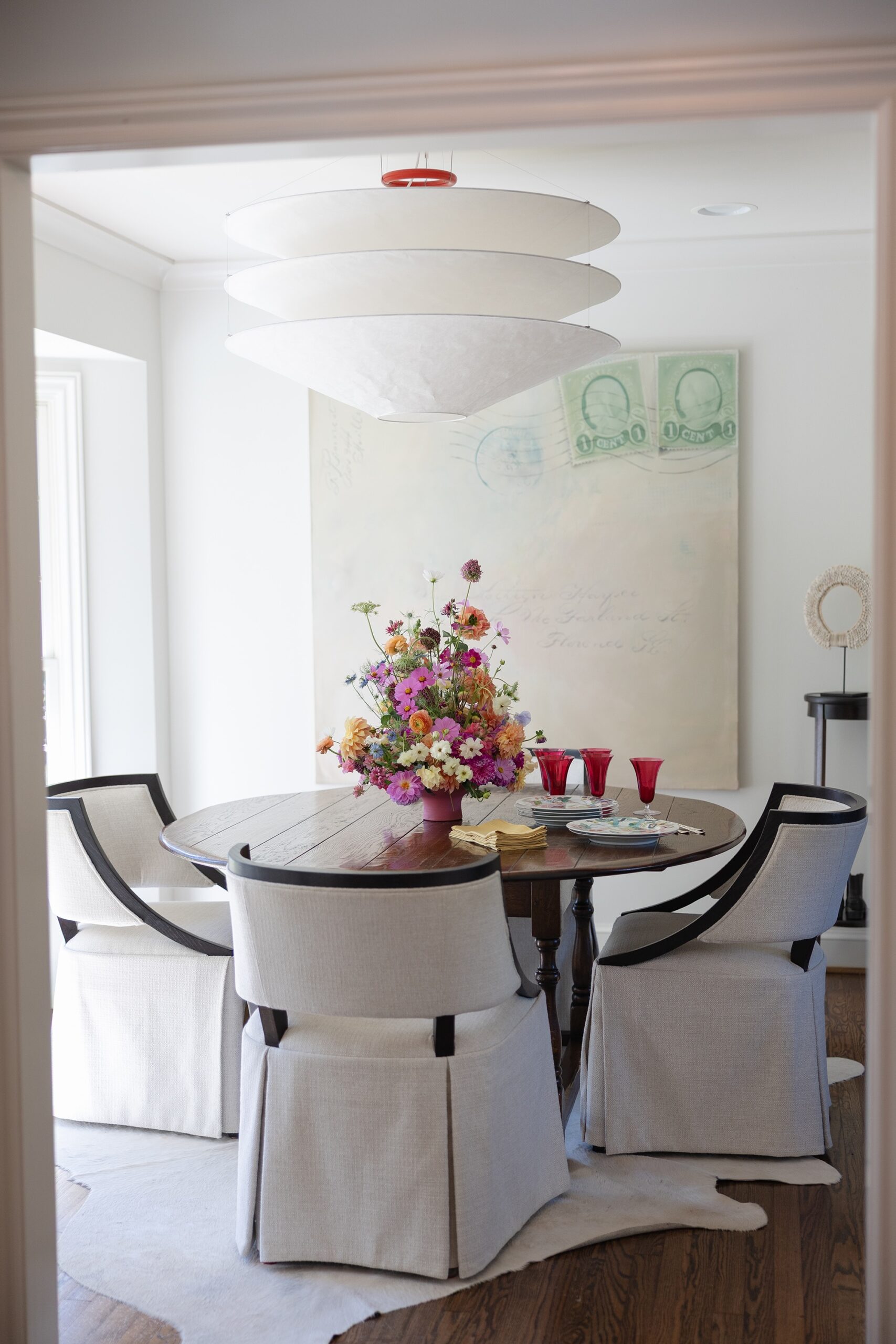
The breakfast room shows off skirted chairs with dark wood detailing surrounding an antique table topped with a paper lantern that Ivy had used in other projects and long admired. “The lantern is a bit whimsical which keeps the space from leaning too serious,” she says. The art is a gift from a friend.
Kitchen, Dining, and Breakfast Room
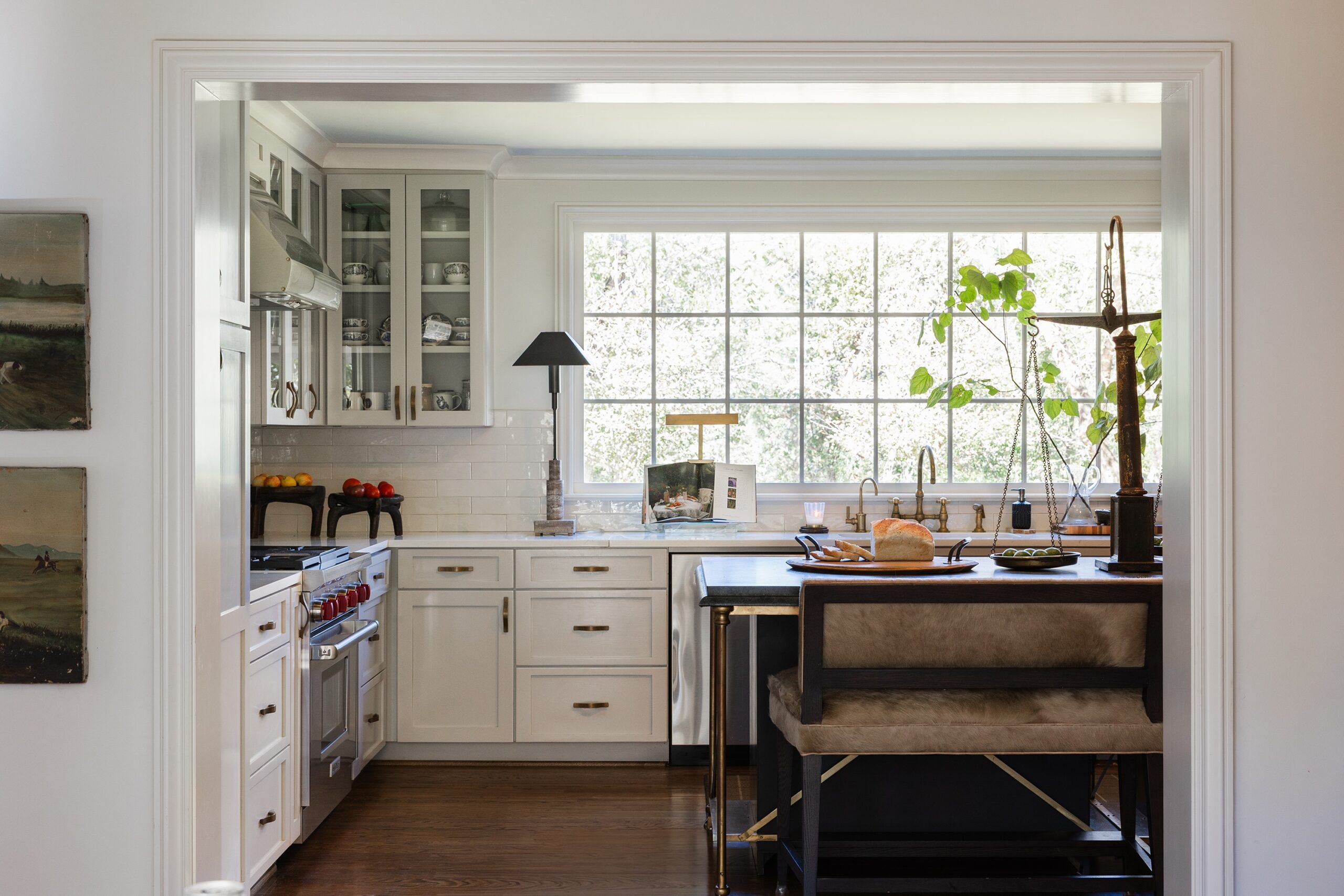
Tip: Animal hides are super durable, family friendly, and add a lot of texture. Ivy used them on kitchen counter stools and armchairs in the living room. Above, a brass-framed kitchen island designed by the couple is the highlight of the creamy kitchen. Ivy paired it with counter stools from Circa Antiques & Interiors, along with vintage finds such as the French pie scales.
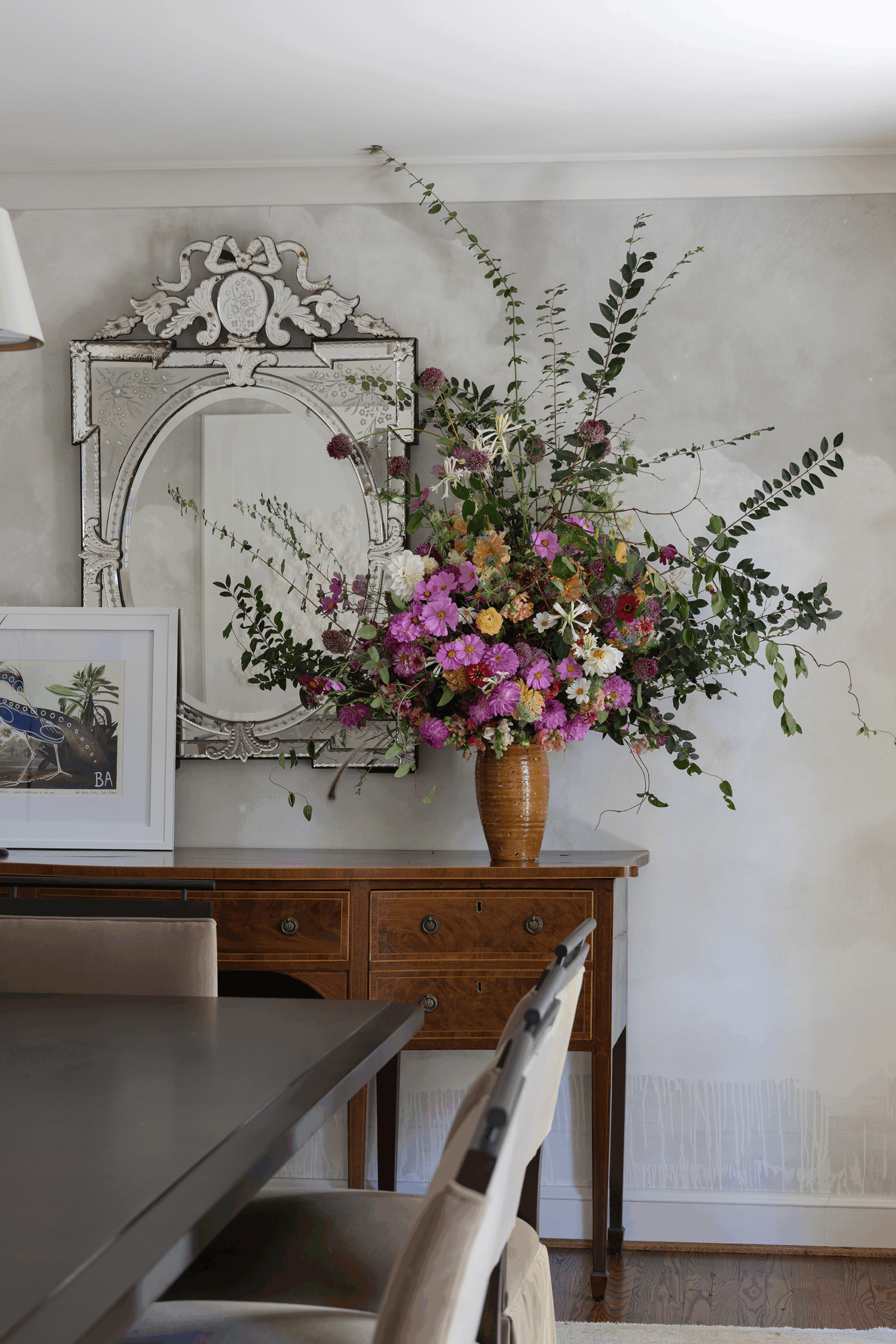
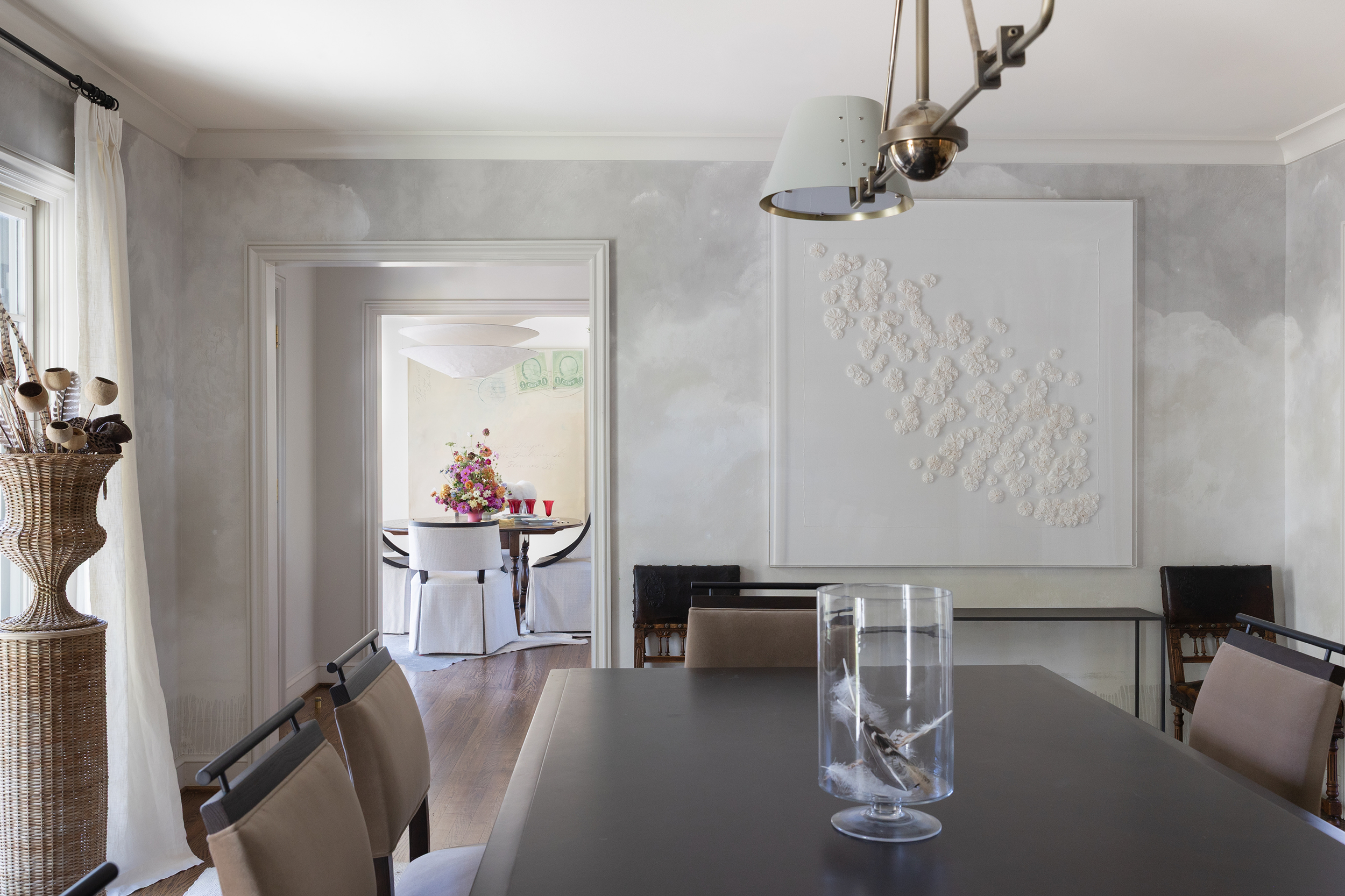
Dreamy Schumacher wallpaper sets a serene backdrop for the dining room.
Statement art by Megan Adams Brooks (from Odette) anchors the space.
“Our kids get to grow up somewhere they can roam around in the woods and be immersed in nature. It has really changed our life being somewhere with so much outdoor space.” —Ivy Schuster, homeowner and interior designer
The Girls’ Rooms
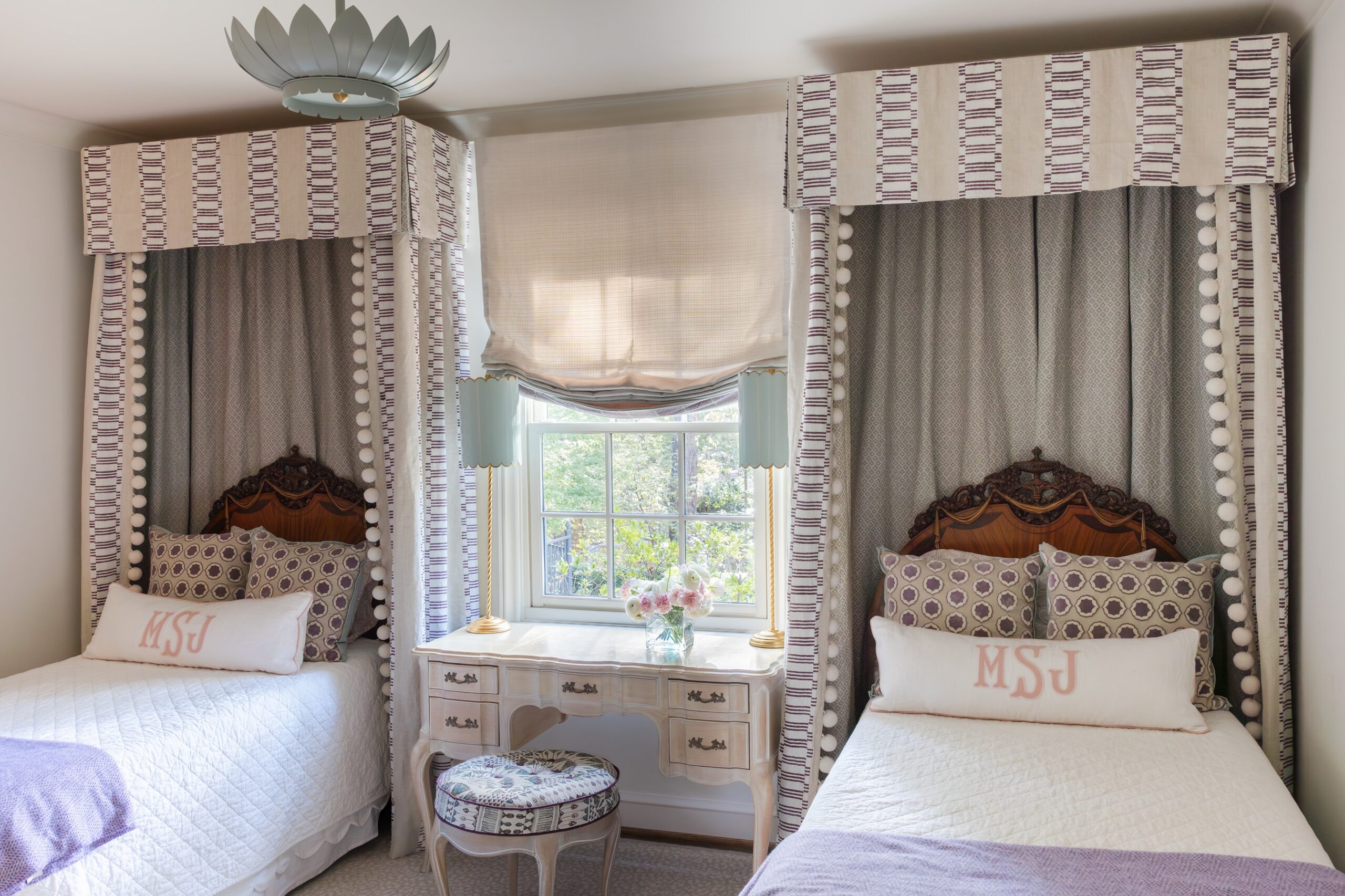
Tip: Double the fun. This linear room was the perfect size and shape for two twin beds. Josef worked with Jeanette Hightower to fabricate the bed canopies in a Thibaut print that adds vertical height, color, and pattern for a tailored look in the younger daughter’s room.
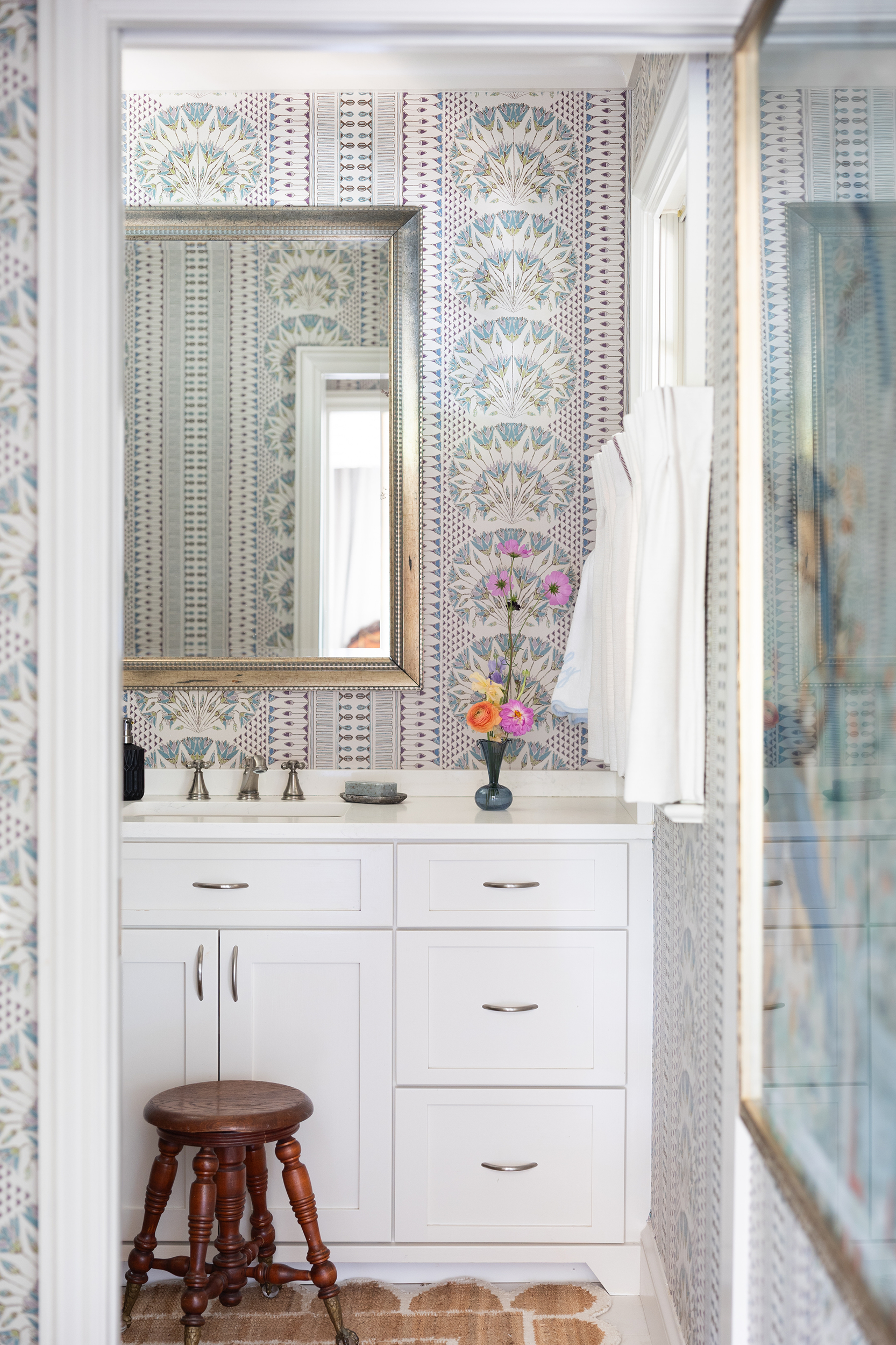
A graphic Thibaut wallpaper adds joyful pattern to a small bathroom and complements the fabric canopies in the adjacent bedroom.
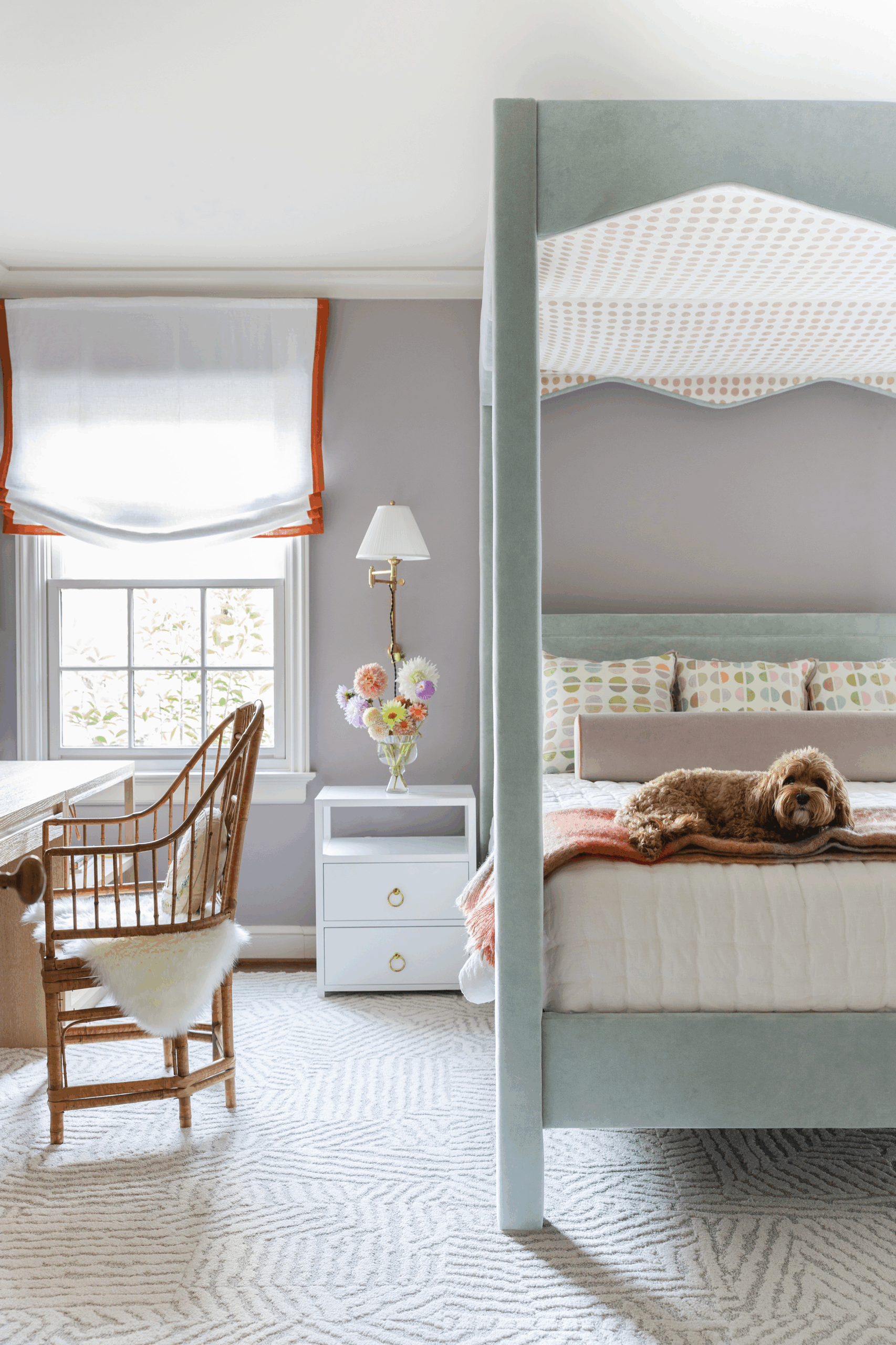
The girls’ rooms were designed to reflect their personalities and grow with them. This one leans more sophisticated but still youthful with dashes of bright color and a favorite spot for the family’s Cavapoo, Rooster.
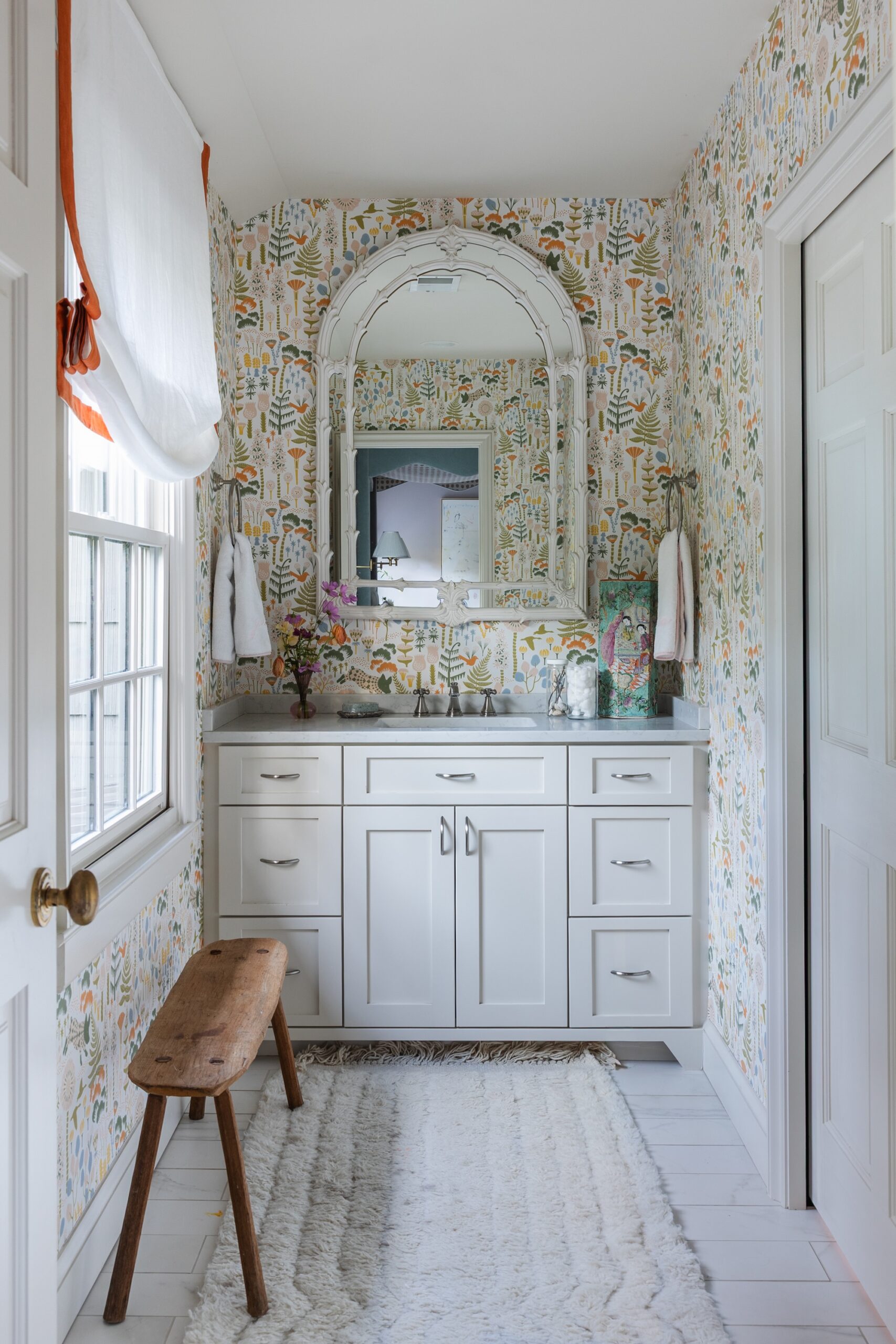
This girl’s bathroom has a woodsy Schumacher wallpaper that reflects the setting of the home and adds some whimsy.
Where the Setting Comes First
“I think I was really inspired most of all by the setting,” says Ivy. “I clearly remember waking up in the house on the first day and looking out the window. I saw nothing but trees; it was so quiet. It was amazing—and very much my vibe. I could be a hermit here if my husband let me!” And, with a house like this, that prospect is certainly tempting.
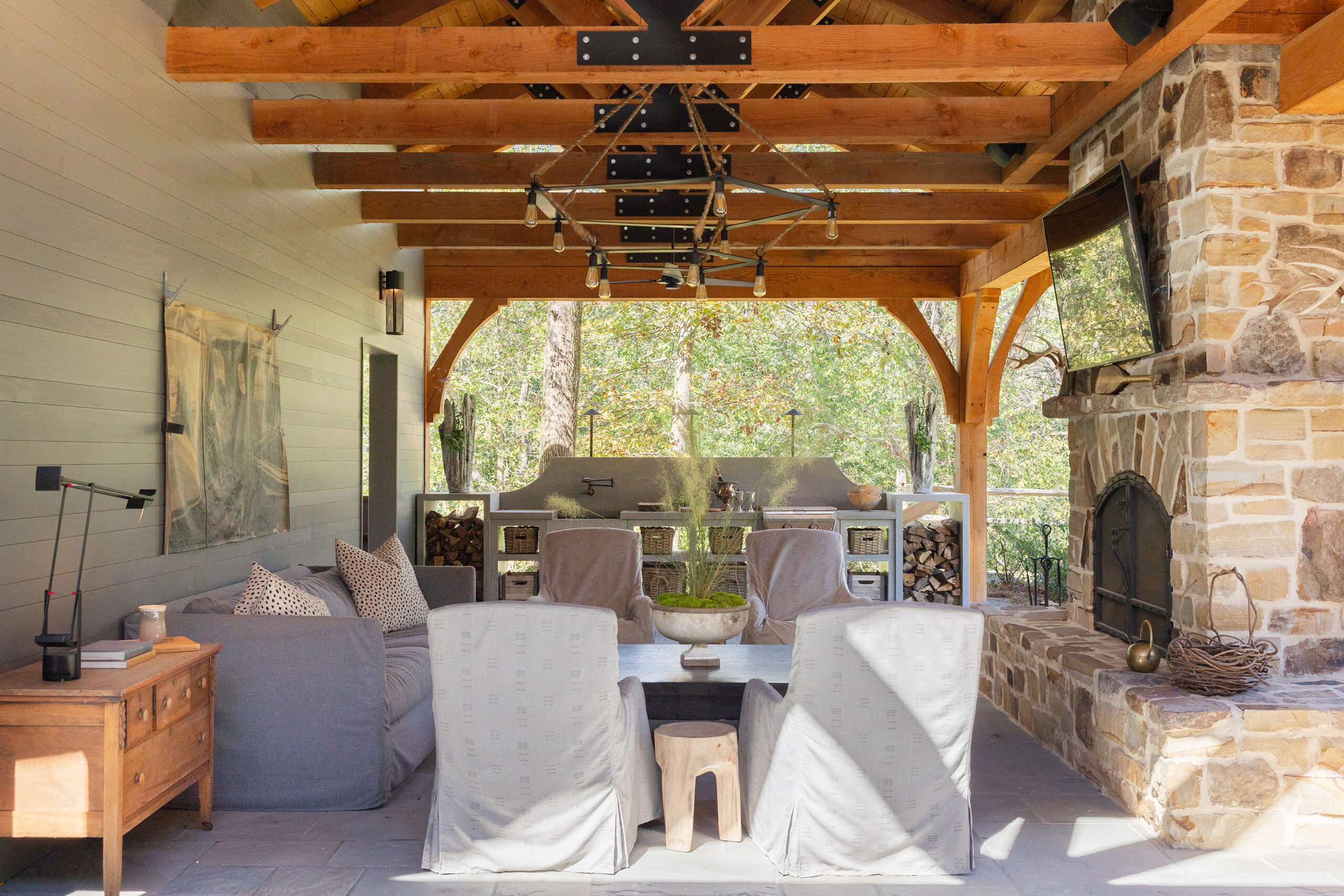
The outdoor entertaining space resides beneath a trestle ceiling and includes a custom concrete kitchen, a seating area, and a fireplace that opens on both sides // Photography by Holly Schumpert // Floral Design by Vicka Hanson // Styling by Margaret Hicks
Some houses look out at their gardens. This one seems to be built around them. On a wooded lot in Abingdon, the 1950s cedar shake home that Ivy and Josef Schuster renovated is surrounded by trees, and nearly every door leads to a place worth sitting down: a front porch, a fireside room under heavy timbers, a cooking pavilion, a pool deck, and a long table set out in the garden. Here is a walk through all five, in the order a guest might find them.
Where the Setting Comes First
“I think I was really inspired most of all by the setting,” says Ivy. “I clearly remember waking up in the house on the first day and looking out the window. I saw nothing but trees; it was so quiet. It was amazing—and very much my vibe. I could be a hermit here if my husband let me!” And, with a house like this, that prospect is certainly tempting.
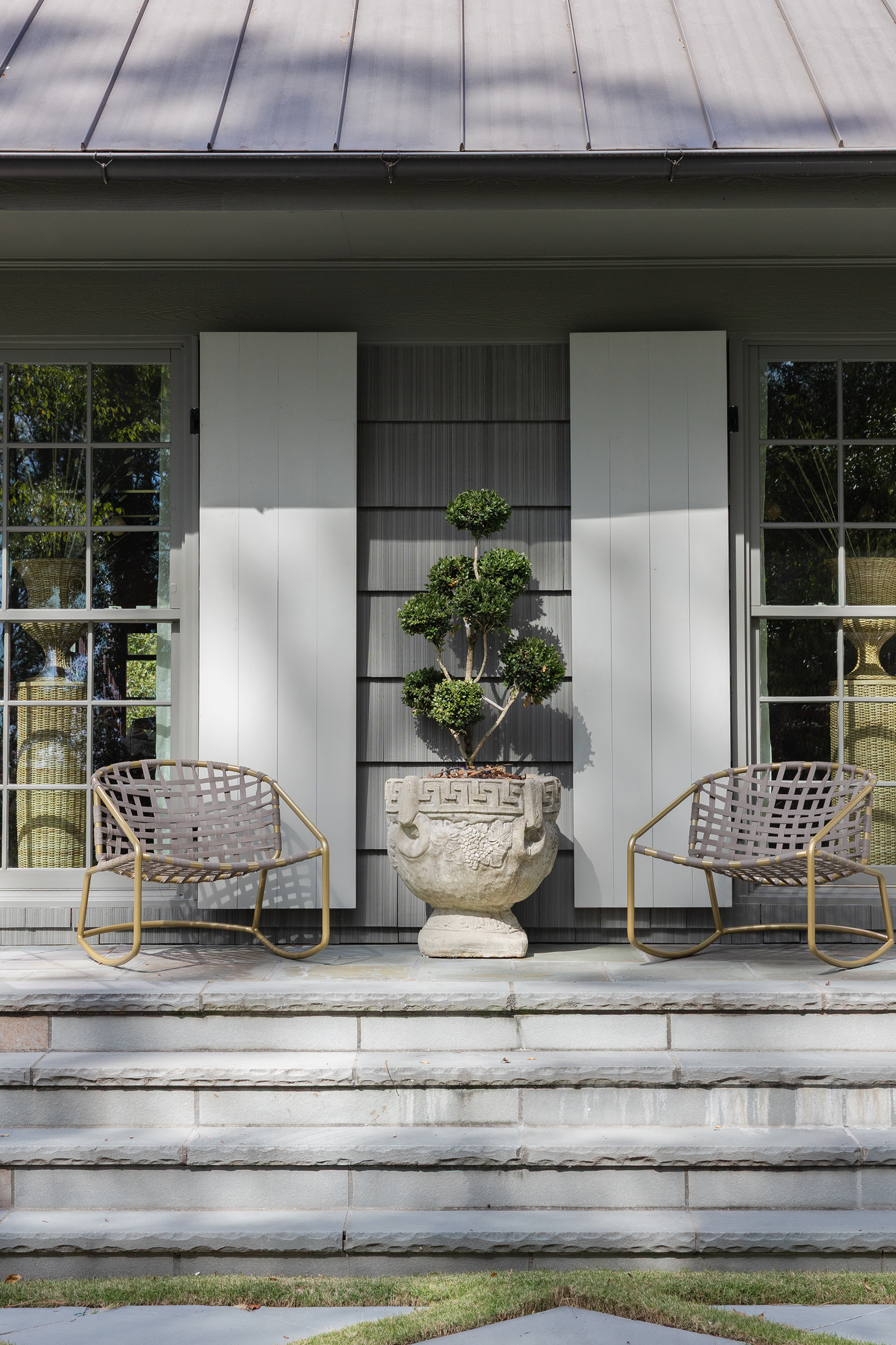
Arrival is quiet and well mannered. Wide stone steps lead to a porch where two slim rocking chairs sit on either side of a cast stone urn. The urn holds a topiary clipped into rounded tiers, a formal note against the soft gray of the cedar shakes and the pale plank shutters. The shingled exterior was updated with Gray Gardens by Benjamin Moore, along with fresh landscaping.
Two gold-framed rocking chairs face each other across a weathered stone urn.
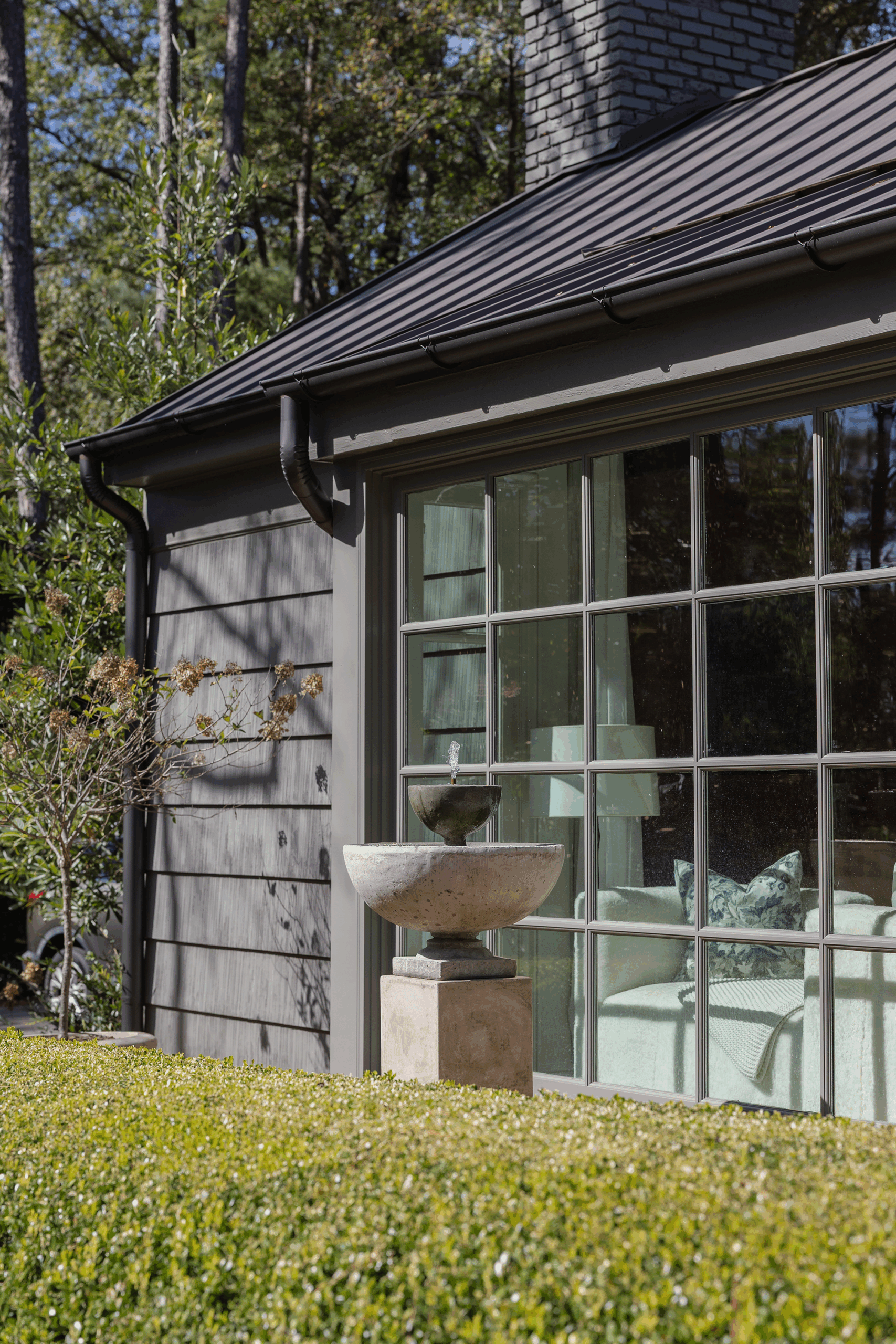
A cast stone fountain stands behind a clipped hedge, just outside the sitting room window.
Around the side of the house, a stone fountain rises from a square plinth before a tall, many-paned window. Through the glass you can see the room it serves, so the garden and the living space are never far apart.
The Room Beneath the Trestle
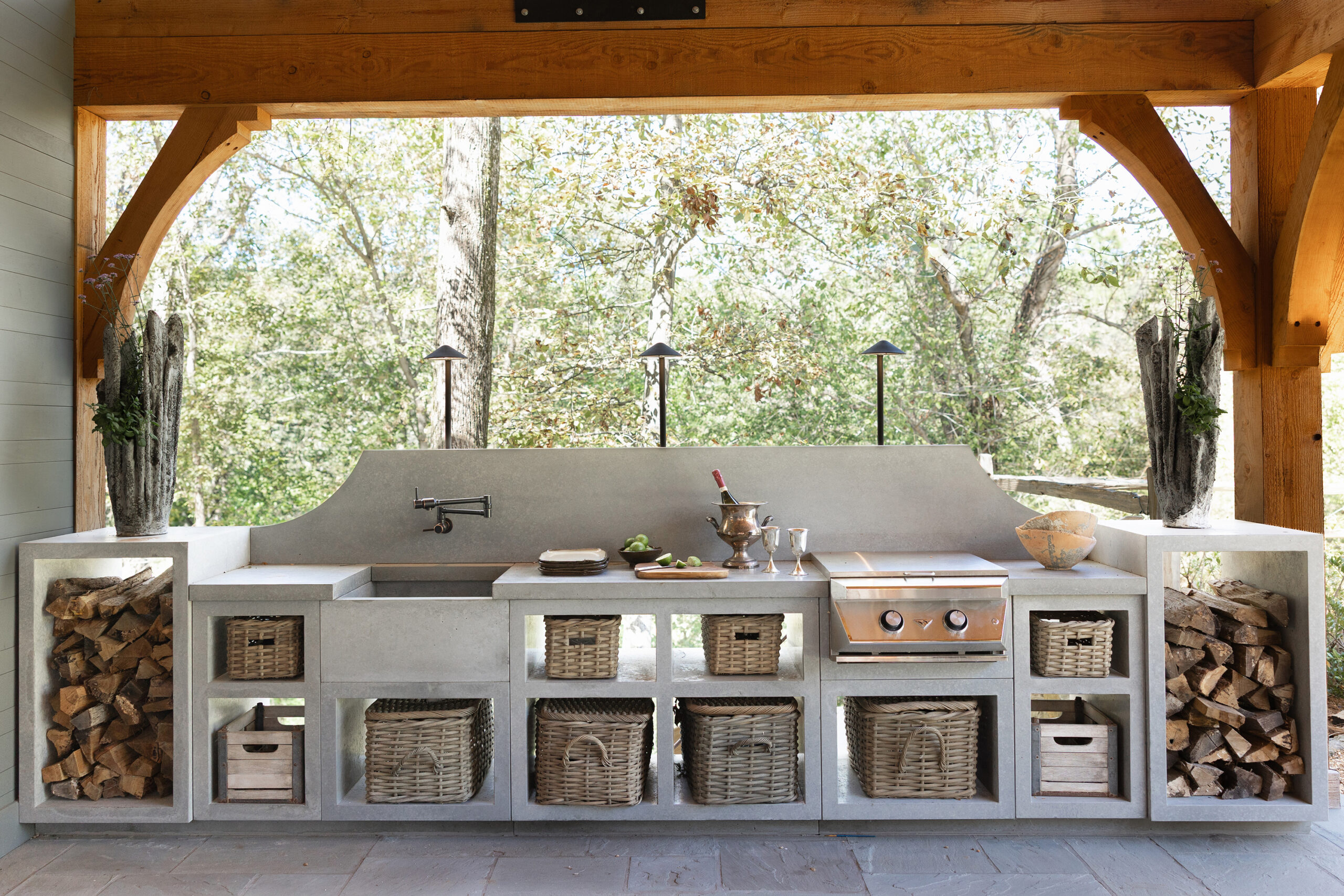
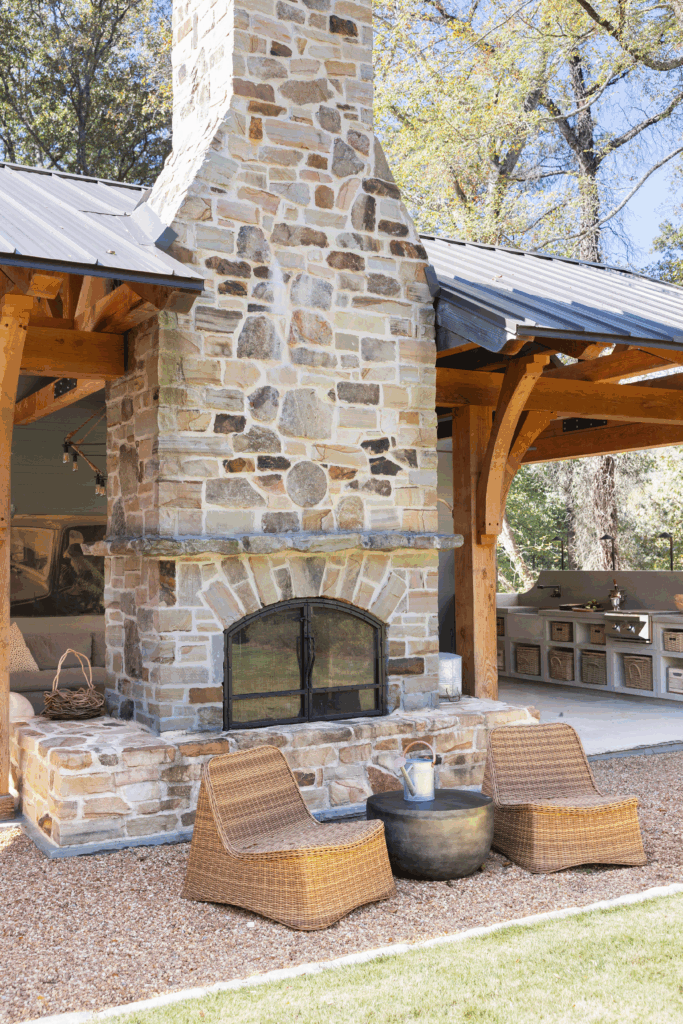
The heart of the property is a covered room framed in heavy timber. Arched brackets and dark metal plates carry the beams, and a metal roof shelters the seating and the kitchen beneath it. At the center rises a stone chimney in warm tans, grays, and rusty browns. At the far end, the custom concrete kitchen is as handsome as it is practical.
Open niches at each end hold stacked firewood. Woven baskets and weathered crates tuck beneath the counters, a pot filler stands over a deep concrete sink, and a built-in grill sits to the right.
The fireplace opens on both sides, one hearth serves two settings: the seating area under the trestle on one side, and on the other a pair of woven lounge chairs.
“One draw to the house is its great layout for hospitality and entertaining which is what makes it unique—there is such good flow between the rooms and the outdoor spaces.”
-Ivy Schuster, homeowner and interior designer
A Second Kitchen
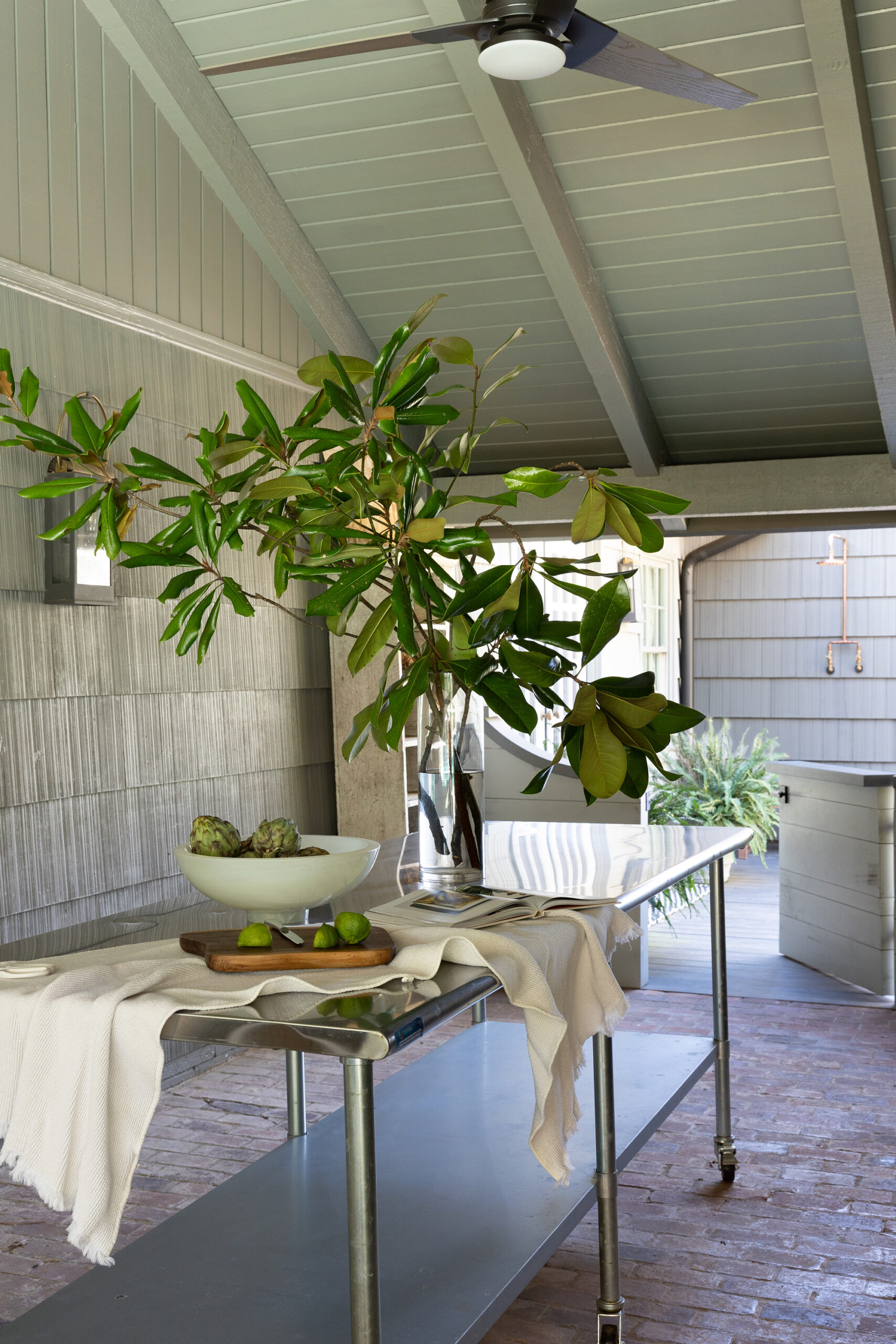
Magnolia branches, artichokes, and limes dress a stainless steel table on casters.
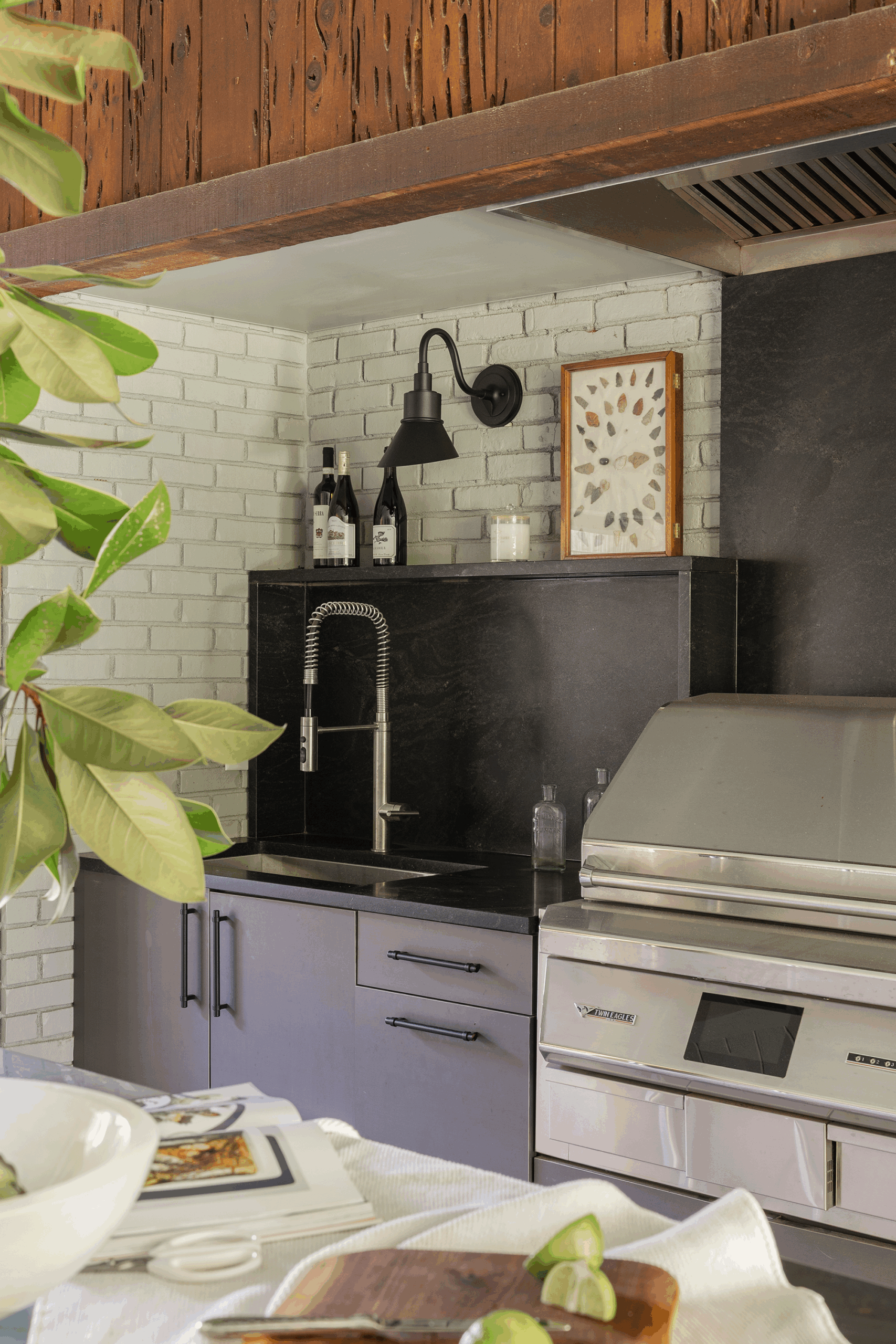
A black gooseneck sconce and a framed collection of arrowheads give the corner its character.
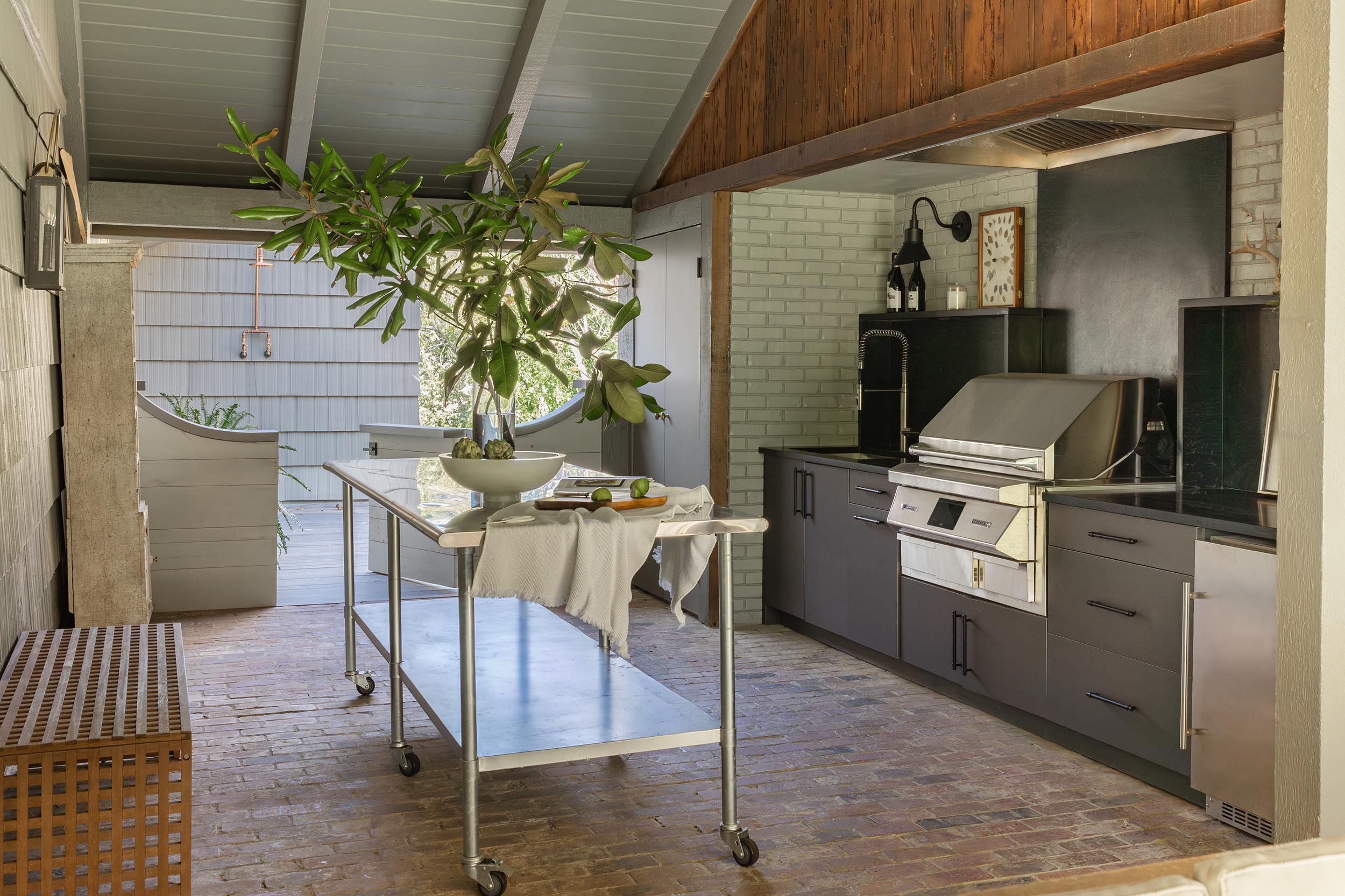
A second covered kitchen has a brick floor and a painted, beamed ceiling. A stainless steel work table on casters can be rolled wherever the party is. Along the far wall, dark cabinetry, a black counter and backsplash, and a built-in grill under a hood sit against painted brick. A black gooseneck sconce and a framed collection of arrowheads keep the corner from feeling like a showroom. Beyond the open side, a copper outdoor shower stands against the shingled wall.
Brick underfoot and a beamed ceiling overhead: a covered kitchen built for the busier side of hospitality.
The Pool Deck
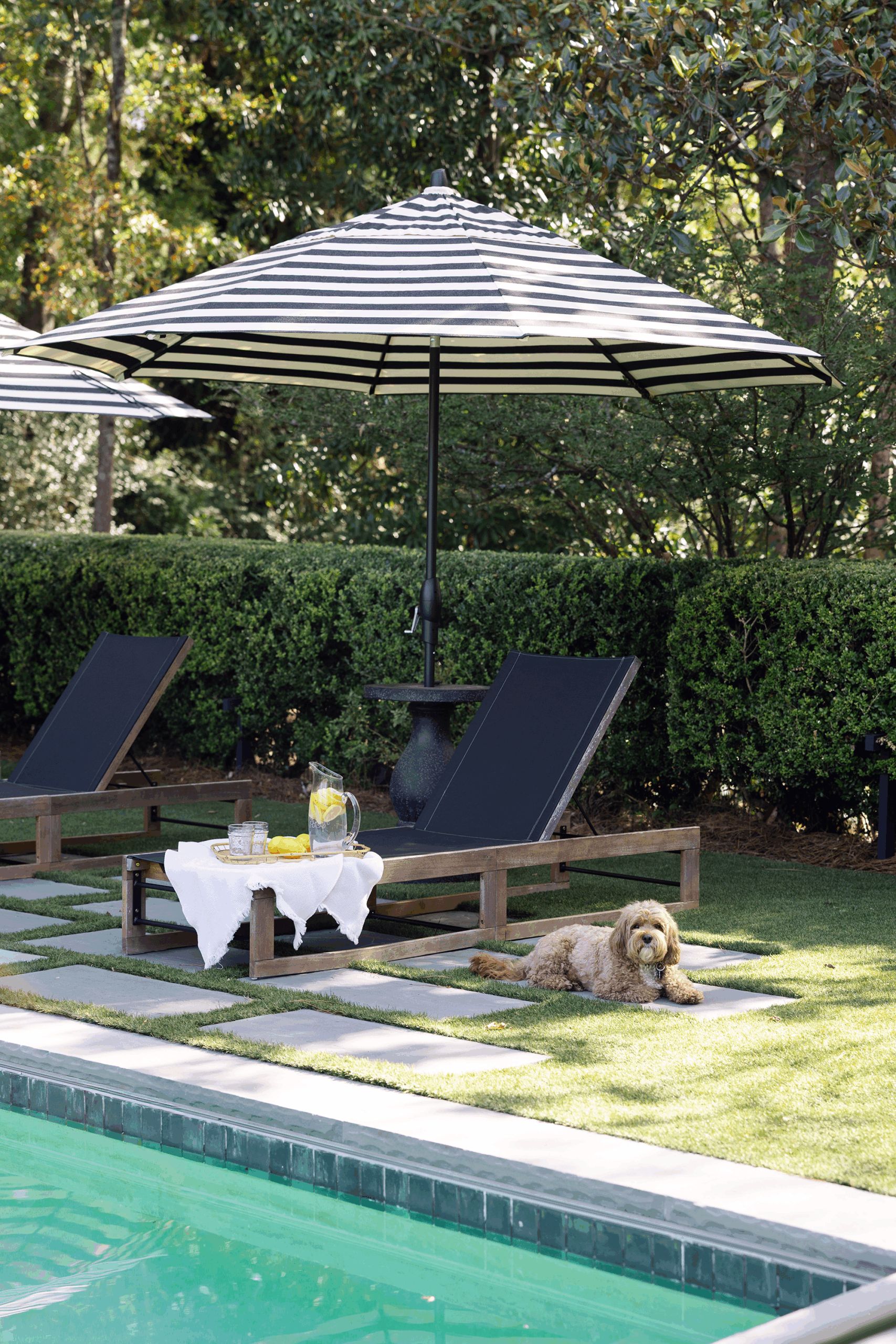
Past a gravel path and stepping stones, the pool deck opens beneath a canopy of leaves. Rectangular stone pavers are set into green turf, and black-and-white striped umbrellas shade teak-framed chaises. A clipped hedge gives the whole deck a green wall, and in the dappled shade the family dog has already claimed his place.
The reworked pool deck makes staying home all the more enticing.
Rooster, the family’s Cavapoo, has found the best spot on the pool deck.
Our kids get to grow up somewhere they can roam around in the woods and be immersed in nature. It has really changed our life being somewhere with so much outdoor space.
– Ivy Schuster
The Garden Table
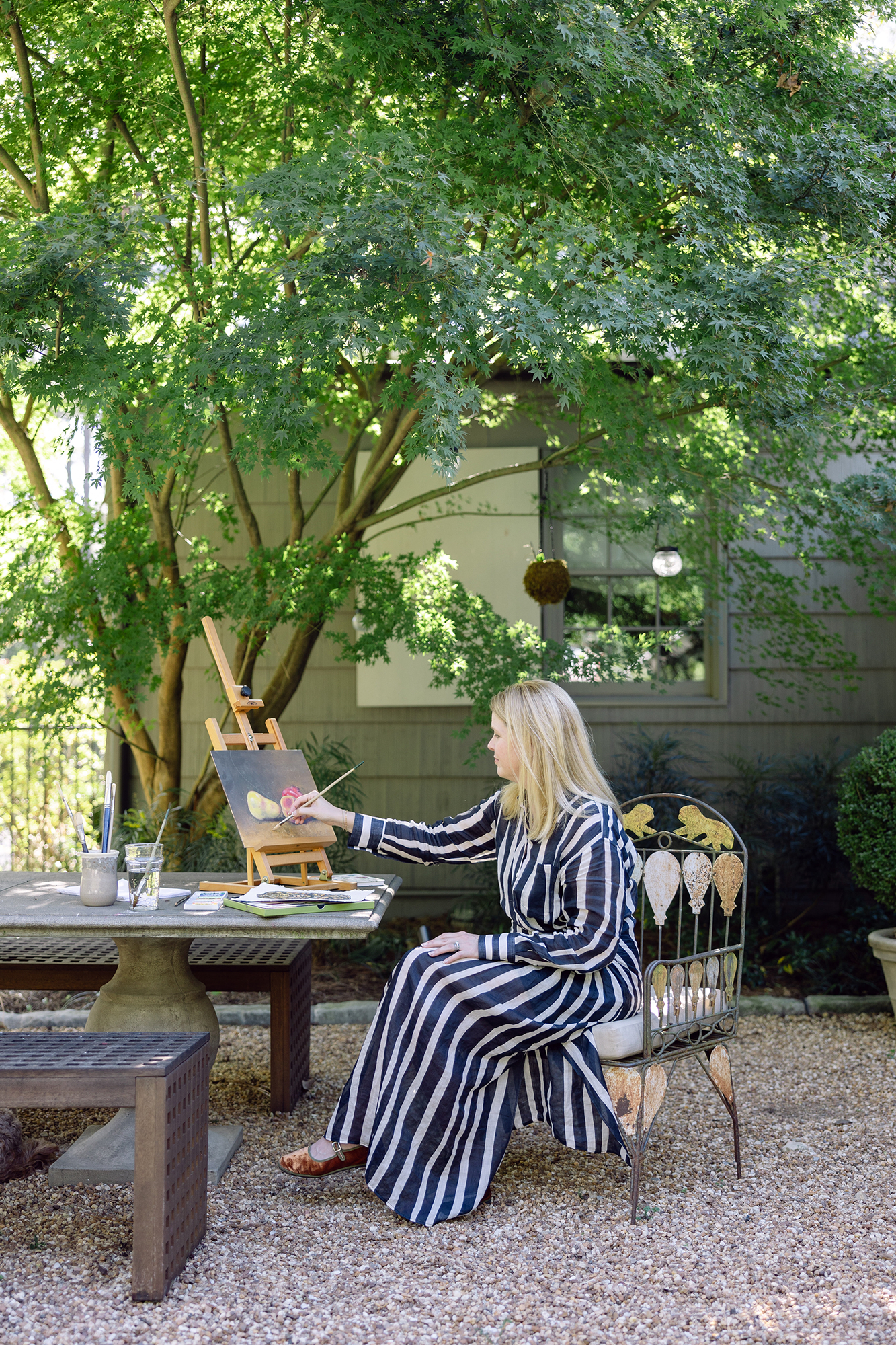
Down the garden, a long stone table on ball-shaped pedestals sits on a gravel court.
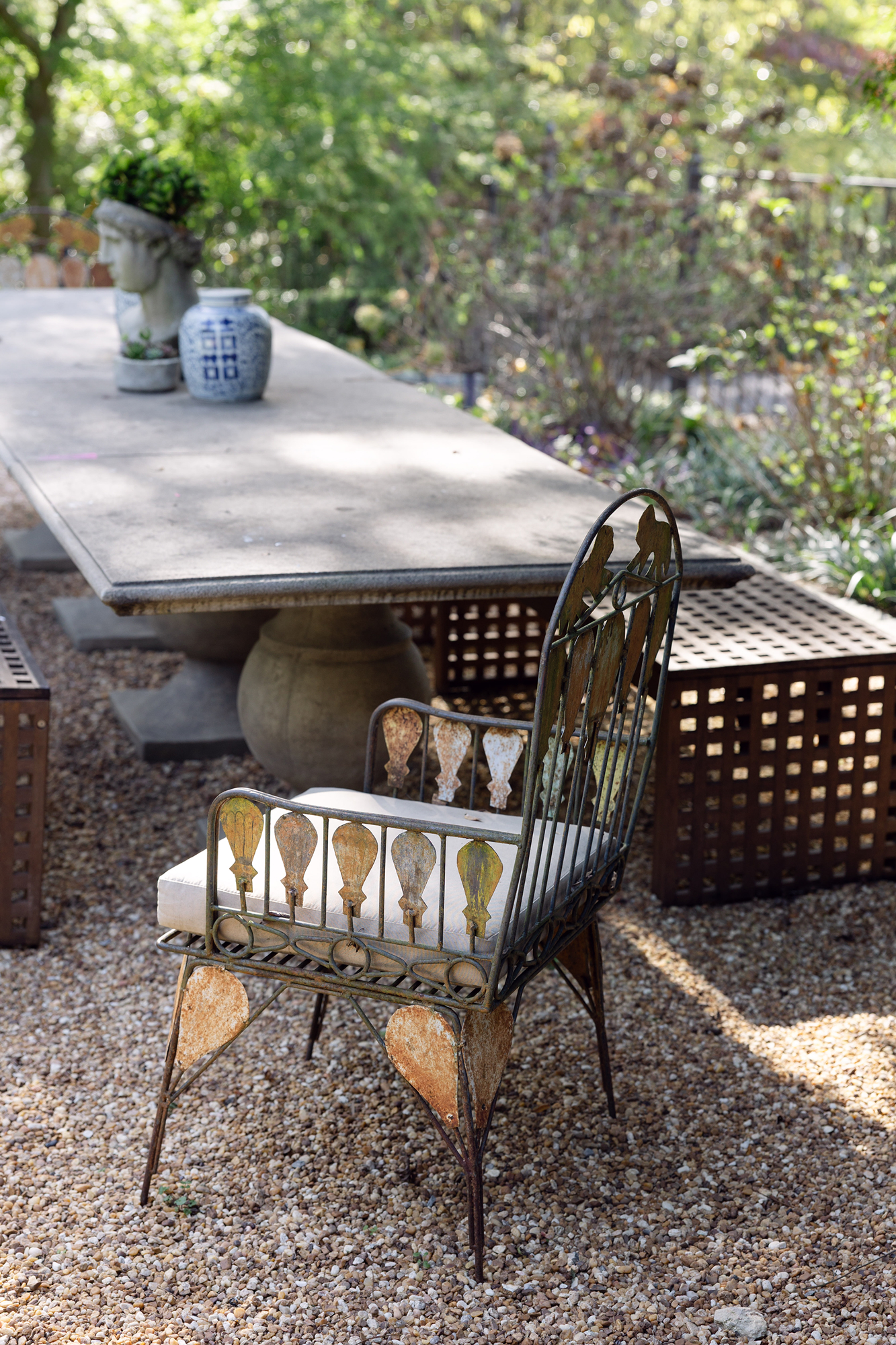
Antique iron chairs, their leaf-shaped panels worn to soft golds, whites, and rust, add the patina that only age gives.
The stone table doubles as an open-air studio for Ivy Schuster.
Bring the Look Home
Frame a room with timber. Heavy beams and arched brackets give a covered space presence before a single chair is set down.
Give the fireplace two faces. One hearth can serve a seating area and a terrace at once.
Keep firewood in sight. Open niches built into the kitchen make storage part of the design.
Let baskets and crates carry the storage. They’re easy on the eye and easy to move.
Light the edges. Low path lights mark a room and leave the woods beyond to the dark.
Set a long table in the garden. Stone, teak, and a few old iron chairs will weather together.
Continue the Tour
See the interiors: step inside “A House in the Woods,” the full home tour.
Builder Chuck Gillespie designed this custom waterfront home to seamlessly fit the slope and trees of the shoreline // Photography by Jean Allsopp // Styling by Christina Brockman
After several years as Smith Lake property owners, Cathy and Danny Harrell sold their family vacation home—and immediately regretted it. “We were heartbroken, and the kids were so sad,” she says of the day the reality set in. Luckily, they already owned the waterfront lot next door. “We wanted a place on Smith Lake to call home again, and we broke ground almost immediately.” Enter designer Bee Martin Little of JackDavis, LLC, and builder Chuck Gillespie of Gillespie Construction Company, LLC. Bee has been the Harrells’ go-to for interiors for years, “but this was our first time from the ground up,” Cathy says.
Danny already had a set of floor plans that encapsulated many of the family’s requirements, but Bee tweaked the plans to better fit the lot, improve traffic flow and furniture placement, and add bonus rooms in otherwise unused spaces.
“This is our happy place. Being surrounded by the trees, the water, and nature gives us a sense of peace that’s hard to describe. It’s more than just a beautiful lake house—it’s a home that our family can look forward to coming back to for generations.”
—Cathy Harrell, homeowner
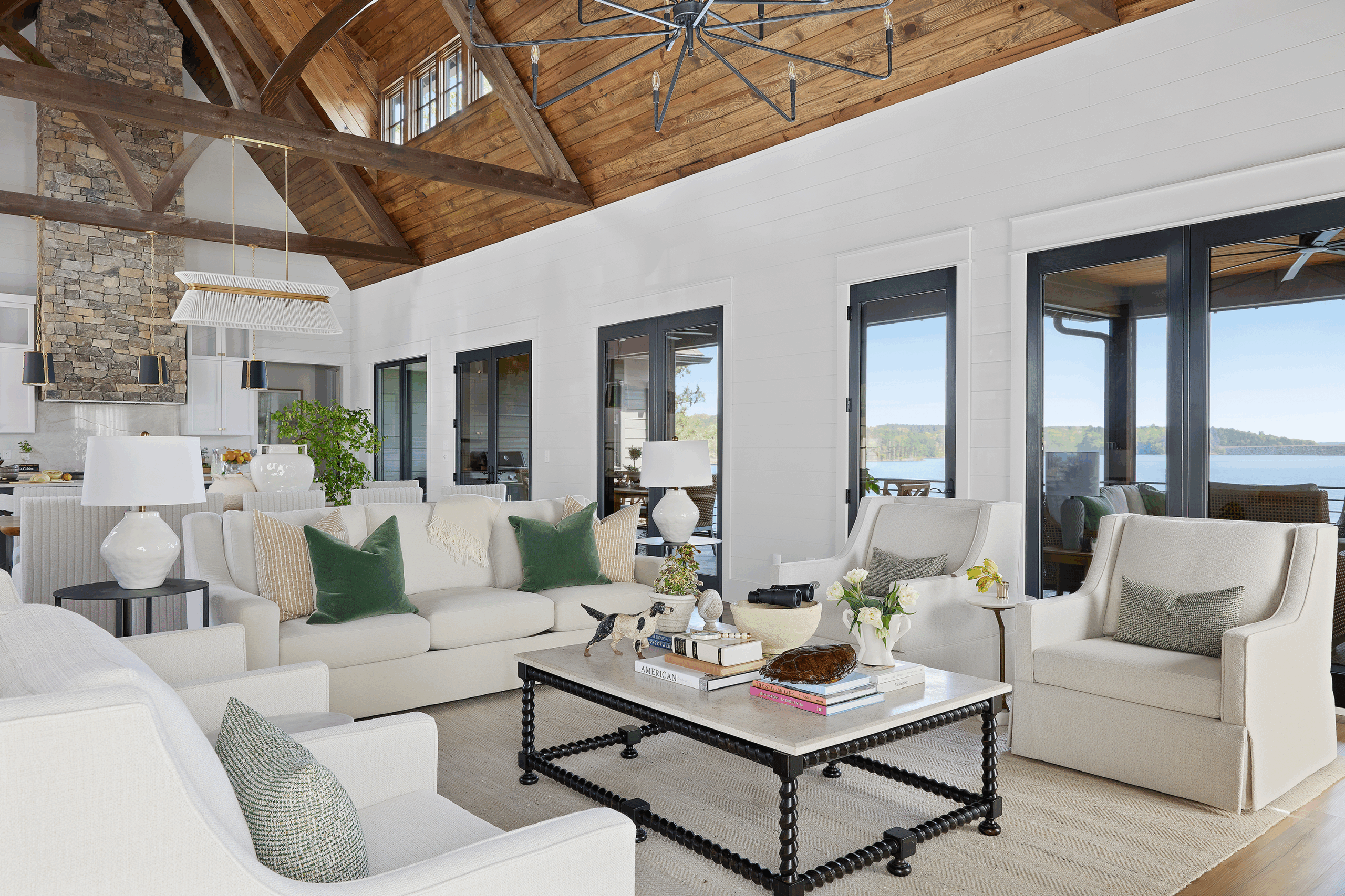
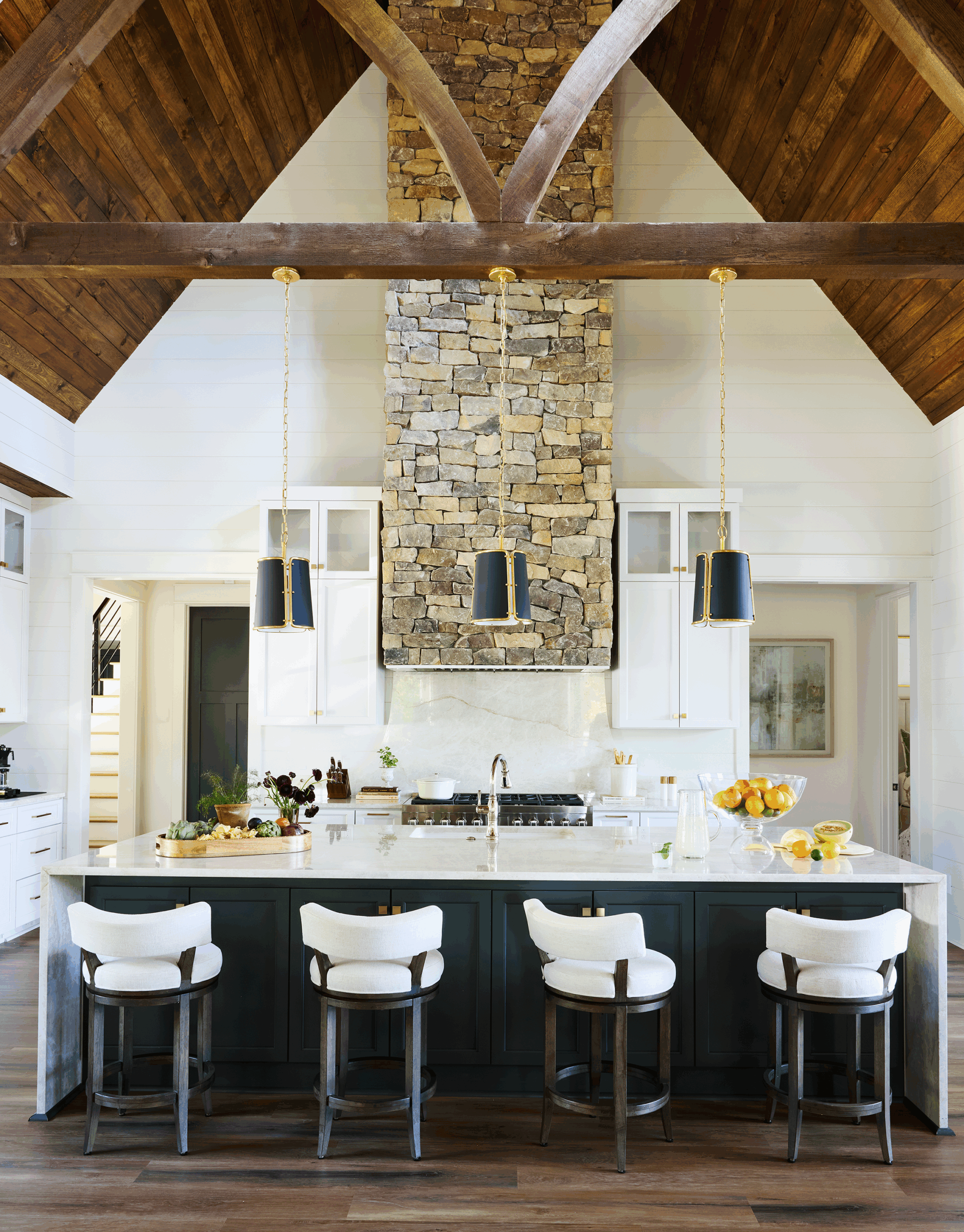
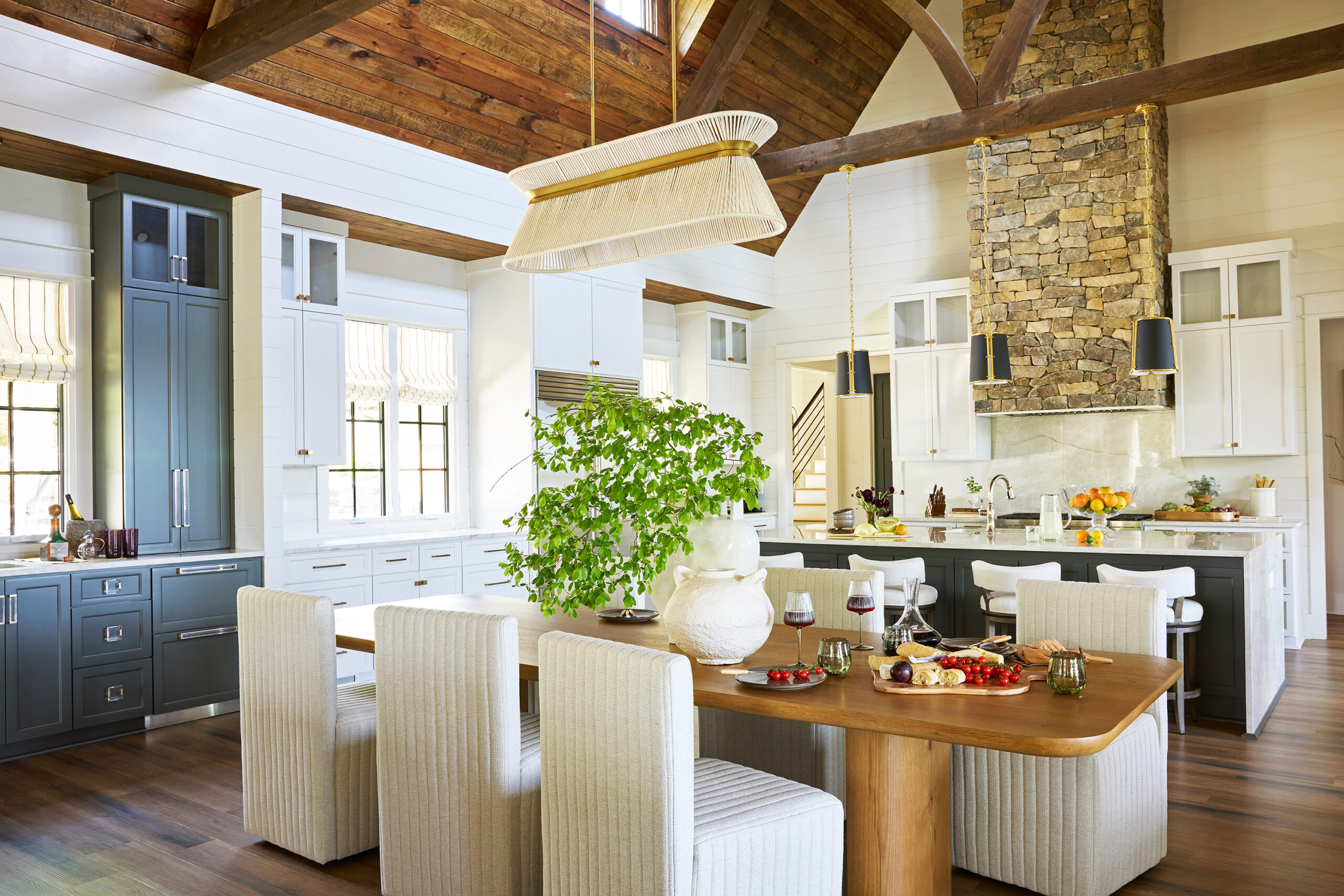
Performance fabrics make the living area’s white seating carefree, even during toddler grandchildren’s frequent visits. Pillows in shades of green—custom made through Housewarmings—echo the outdoors. Sofa and coffee table by Bernhardt; lamps by Gabby Home.“The kitchen was designed to be both functional and visually striking,” Bee says. Taj Mahal quartzite counters top off both perimeter cabinets (painted Sherwin-Williams City Loft) and the island (painted Sherwin-Williams Rock Bottom), where it waterfalls down both ends. “The backsplash was designed to accent the range hood,” Bee says, noting the towering stacked-stone installation that stretches to the ceiling, echoing the fireplace in the living area.
One big change they made is immediately visible just inside the front door. “The great room had a flat ceiling [on the plans], but we vaulted it,” Chuck says. “We did some custom, handmade-by-us trusses and beams and nickel gap wood on the ceiling.” Bee adds, “The beams are positioned to separate the space into ‘rooms’ and draw the eye to the gorgeous wood ceiling.” At both ends, stacked stone rises dramatically to the ceiling’s peak. The kitchen side features a stunning stone range hood while the living room end showcases a commanding stone fireplace. Between the anchors, a wall of windows and doors captures vistas of the lake and surrounding shores.
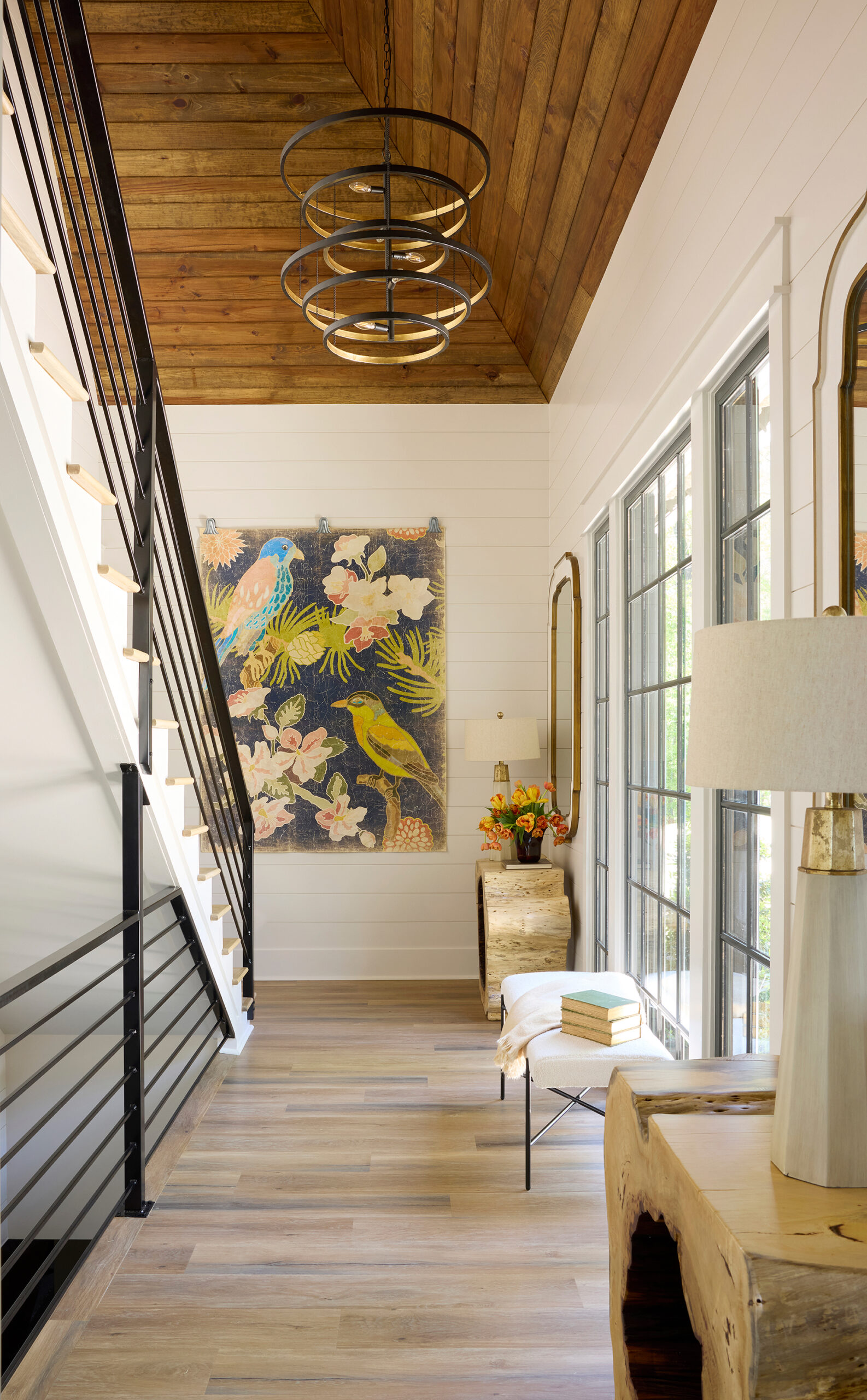
The dining area divides the upper-level great room’s living and cooking spaces. “Cathy wanted an extra-large dining table to accommodate her entire family for meals, which she found at Restoration Hardware,” Bee says. Chairs are custom.In the stair hall, the transitional space between levels is a hidden gem with the same vaulted, wood-clad ceiling as the great room. “A vibrant oversized wall hanging with colorful birds, sourced from France through artist Savanna Kidd at Morning Glory Art, steals the show,” says Bee.
Another showstopper, at least for the Harrells’ overnight guests including their three adult children, spouses, and grandchildren, is the lower level. The space includes a large game room, three king bedroom suites, and a bunkroom. Twin-over-queen bunk beds accommodate a variety of guests in what was, on the original plans, a storage room.
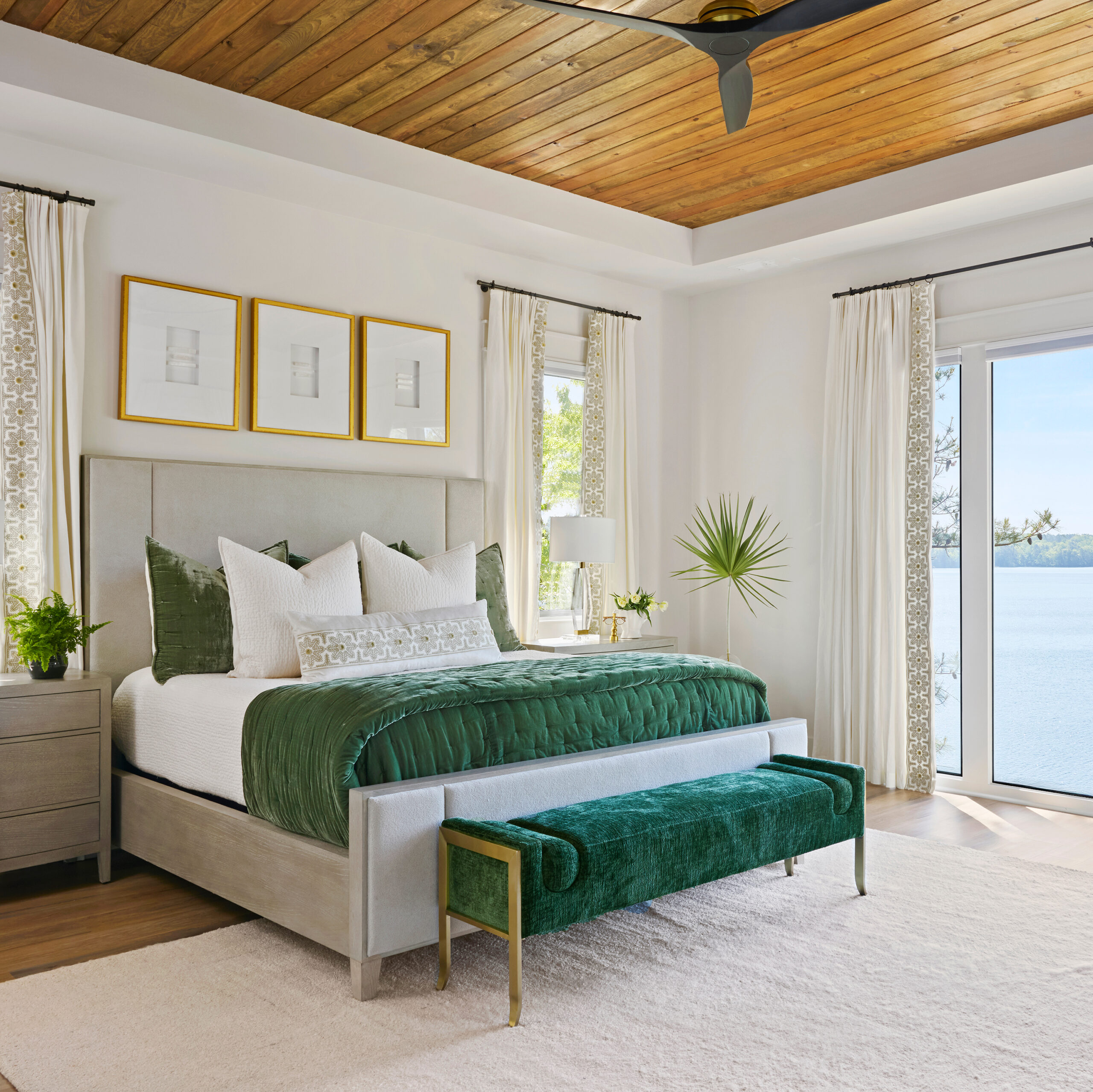
From inside, the primary suite feels as if it is suspended over the lake. Custom emerald green bedding dresses the upholstered bed.
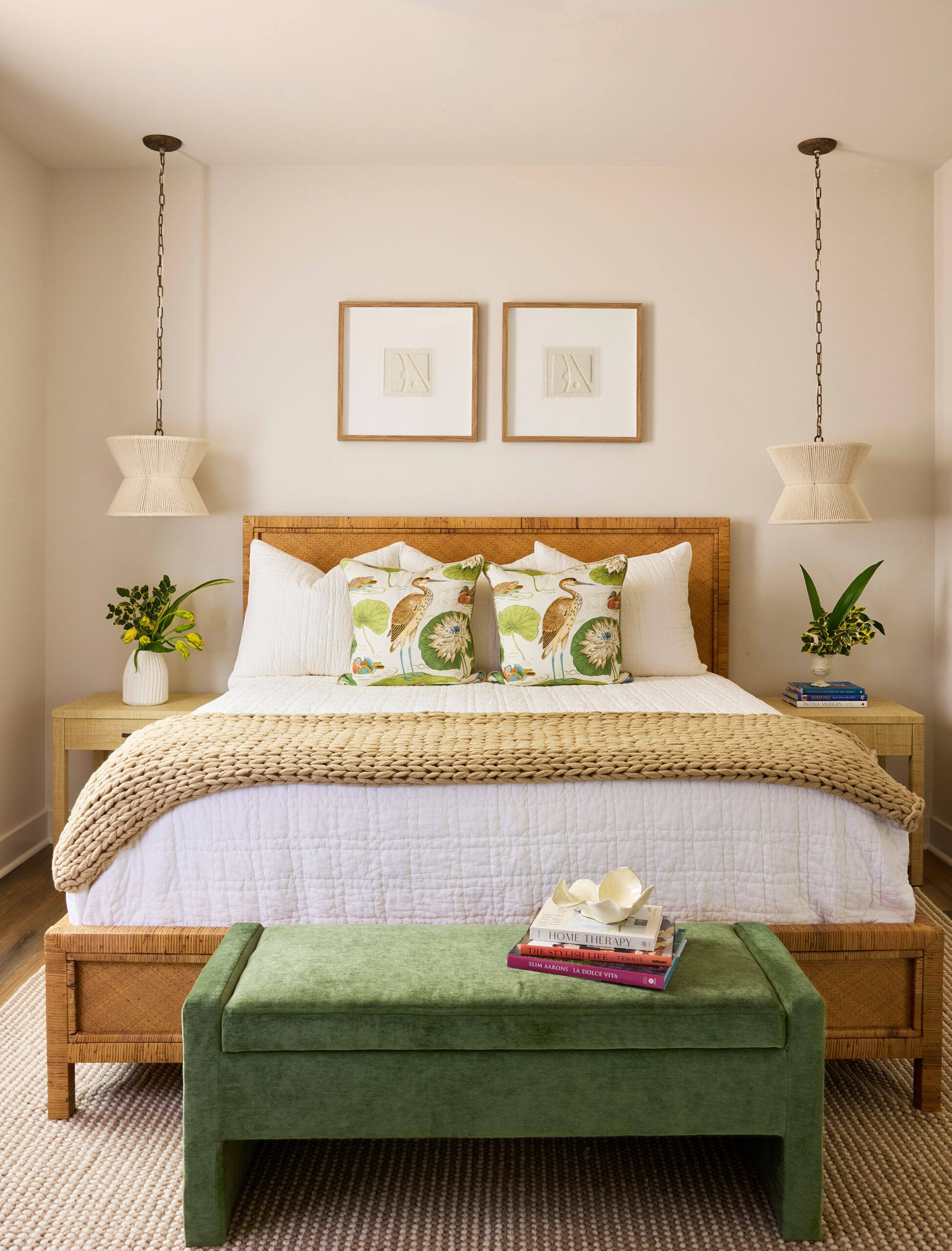
Framed egret artwork hangs above a bedside lamp in a bedroom with views of the trees.
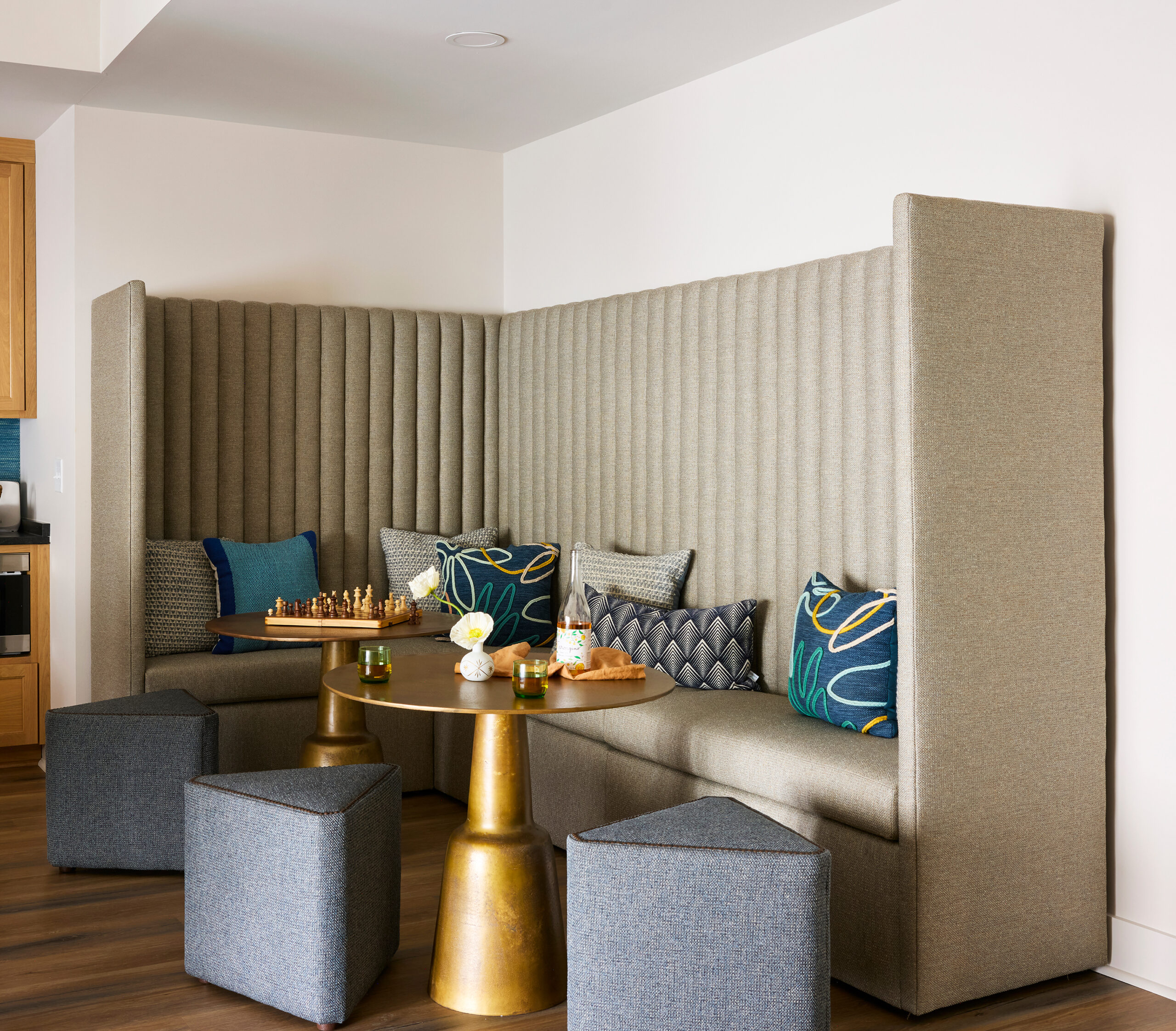
In the game room, a custom banquette is dressed in performance fabric for durability.
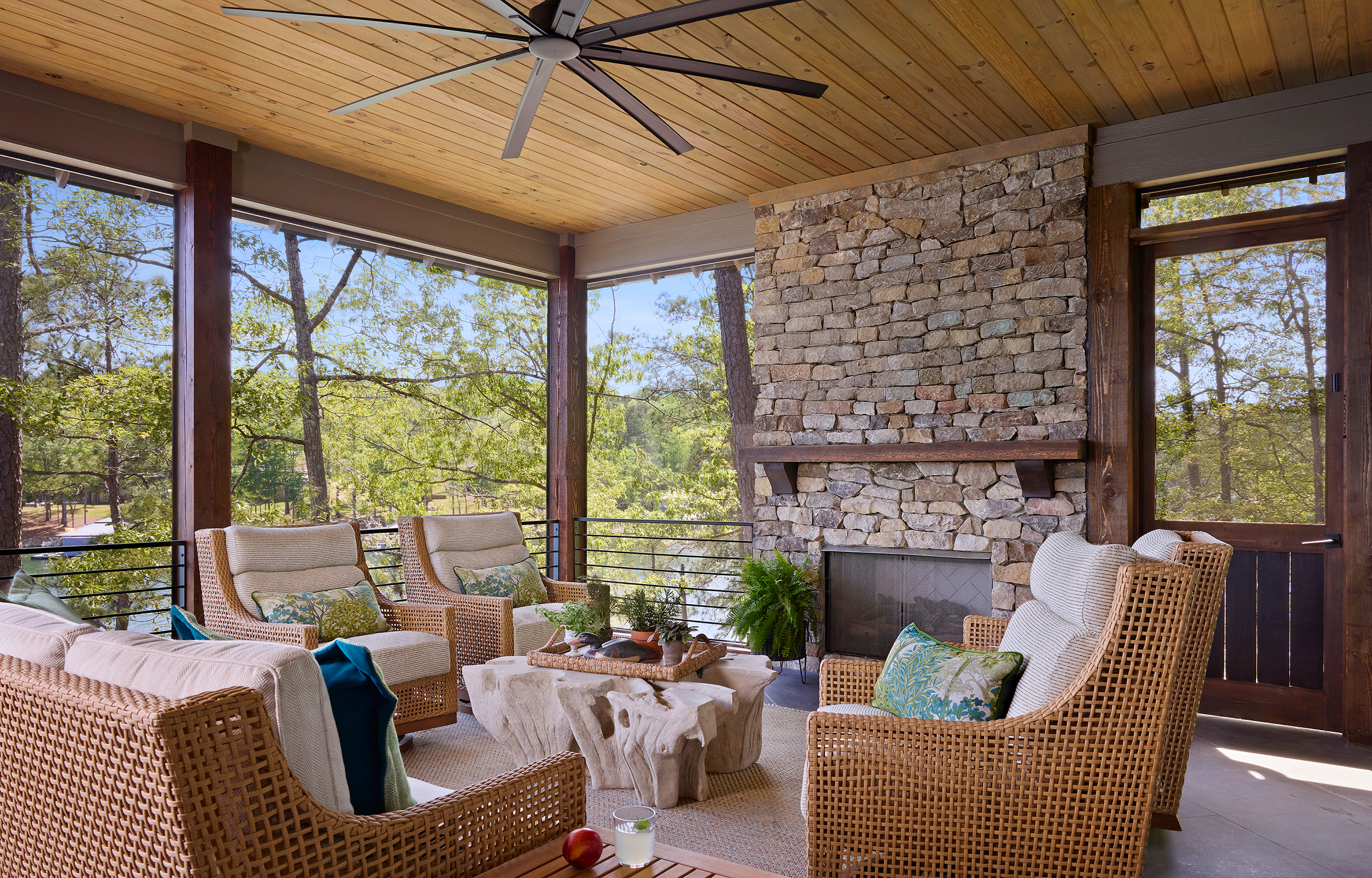
On both levels, screened porches beckon every hour of the day. The main level includes a porch that mirrors the great room and features living and dining areas. The family gathers, eats, plays—“cards, board games…it’s always a competition,” Cathy says—and even sleeps on the porch. “I have fallen asleep out there while reading or watching TV,” she says. “It almost sounds like being at the beach with the water moving and crashing.”
Chuck agrees. “The upper porch is my favorite space in the house. I could live out there looking at that lake.”
“With lots of seating, fun pillows, and gorgeous views, the main-level screened porch is everyone’s favorite lounge space,” Bee says.
Fall has a way of making us think differently about our homes.
As the days grow shorter and we spend more time indoors, rooms that felt light and breezy all summer can suddenly seem like they need a little more warmth. We bring out throws, add texture, and settle back into the spaces where we will spend much of the season.
Your windows can be part of that transition, too.
One of the most effective ways to add warmth, depth and function to a room is by layering window treatments. Instead of choosing between a shade and drapery, for example, the right solution may be to use both.
It is a technique designers have relied on for years. And while the finished result can look sophisticated, the idea behind it is surprisingly simple.
Each layer has a job to do.
Start with what you need the window to do
Before thinking about fabrics, colors or styles, consider how you use the room.
Do you want plenty of natural light during the day but more privacy in the evening? Does afternoon sun create glare? Do you want a bedroom to feel darker at night? Or does the room feel like it is missing something?
Those answers can help determine whether layering makes sense.
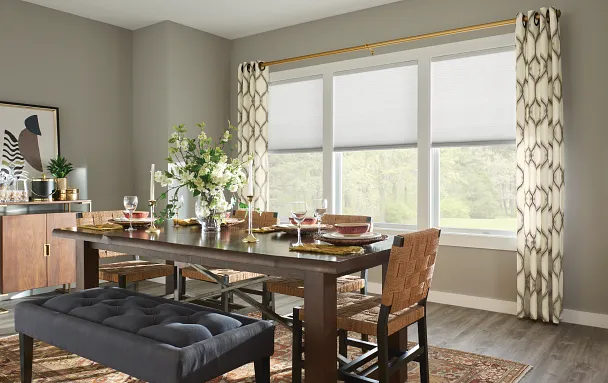
For example, a shade can provide everyday control over light and privacy. Add drapery to introduce softness, texture, and another level of light control, while giving the entire window a more finished appearance.
The result is not simply more decoration. It is more flexibility.
Why shades and drapery work so well together
Think of the shade as the hardworking layer.
Depending on the treatment you choose, it can filter bright sunlight, provide privacy or give you greater control over how much natural light enters the room. It can also offer a clean, tailored look when used on its own.
Drapery brings something different.
Fabric softens the architectural lines of a room and introduces color, pattern or texture. It can also visually frame a window, draw the eye upward, and help the window feel more proportional to the room around it.
Put the two together and you get the strengths of both.
During the day, you might use the shade to soften sunlight while leaving the drapery open. In the evening, closing the drapery can create a warmer, more private atmosphere.
And when both treatments are open? The window still feels intentionally designed.
Layering can make a room feel more complete
There are some rooms where you cannot immediately identify what is missing.
The furniture is right. The rug works. The artwork is hung. The lighting is beautiful.
Still, the room feels a little unfinished.
Look at the windows.
Bare windows or treatments that feel too small for the space can sometimes make the rest of the room feel disconnected. Adding drapery around an existing shade can introduce the softness and scale needed to bring everything together.
This can be particularly effective in living rooms, dining rooms and bedrooms where you want the space to feel comfortable and polished without becoming formal.
The goal is not to make the windows the loudest element in the room. It is to help them feel like they belong.
Does layering make a room feel heavy?
It does not have to.
Layered window treatments can be light, tailored, and understated. Much depends on the fabric, color, treatment style, and how everything is installed.
A room with clean-lined shades and simple neutral drapery can feel completely different from one with richer fabrics and more dramatic color.
That is the beauty of custom treatments. You are not trying to fit your room into a predetermined look. The treatments can be designed around the architecture, furnishings, and overall feeling you want to create.
In some spaces, that might mean barely-there softness. In others, a little more drama may be exactly what the room needs.
And sometimes, one layer is enough
Layering is not the answer for every window.
A beautiful shade may be all a kitchen needs. Shutters may provide the architectural character and privacy a particular room calls for. A streamlined space may look best with a single, thoughtfully selected treatment.
More is not automatically better.
The question is whether another layer improves the way the room looks or functions.
If it does not, you probably do not need it.
You do not have to know what goes together
This may be the most important part.
You do not need to walk into a consultation knowing whether you want a Roman shade with drapery panels, shutters on their own or another combination entirely.
Start with the room.
How do you want it to feel? What bothers you about the windows now? How much privacy do you need? What happens when the afternoon sun comes through? Are there colors, textures, or furnishings you already love?
Those details provide a much better starting point than a product name.
From there, an experienced window treatment professional can help narrow the possibilities and recommend combinations that make sense for your home.
Because good design is not about adding more for the sake of more.
It is about choosing the right elements, giving each one a purpose and bringing them together in a way that feels natural.
And sometimes, the layer that finishes the room has been waiting at the window all along.
Sponsored by VanGogh Window Fashions
Not sure whether your windows need one treatment or a layered look? VanGogh Window Fashions can help you explore custom shades, shutters, and drapery designed around your home and the way you live.
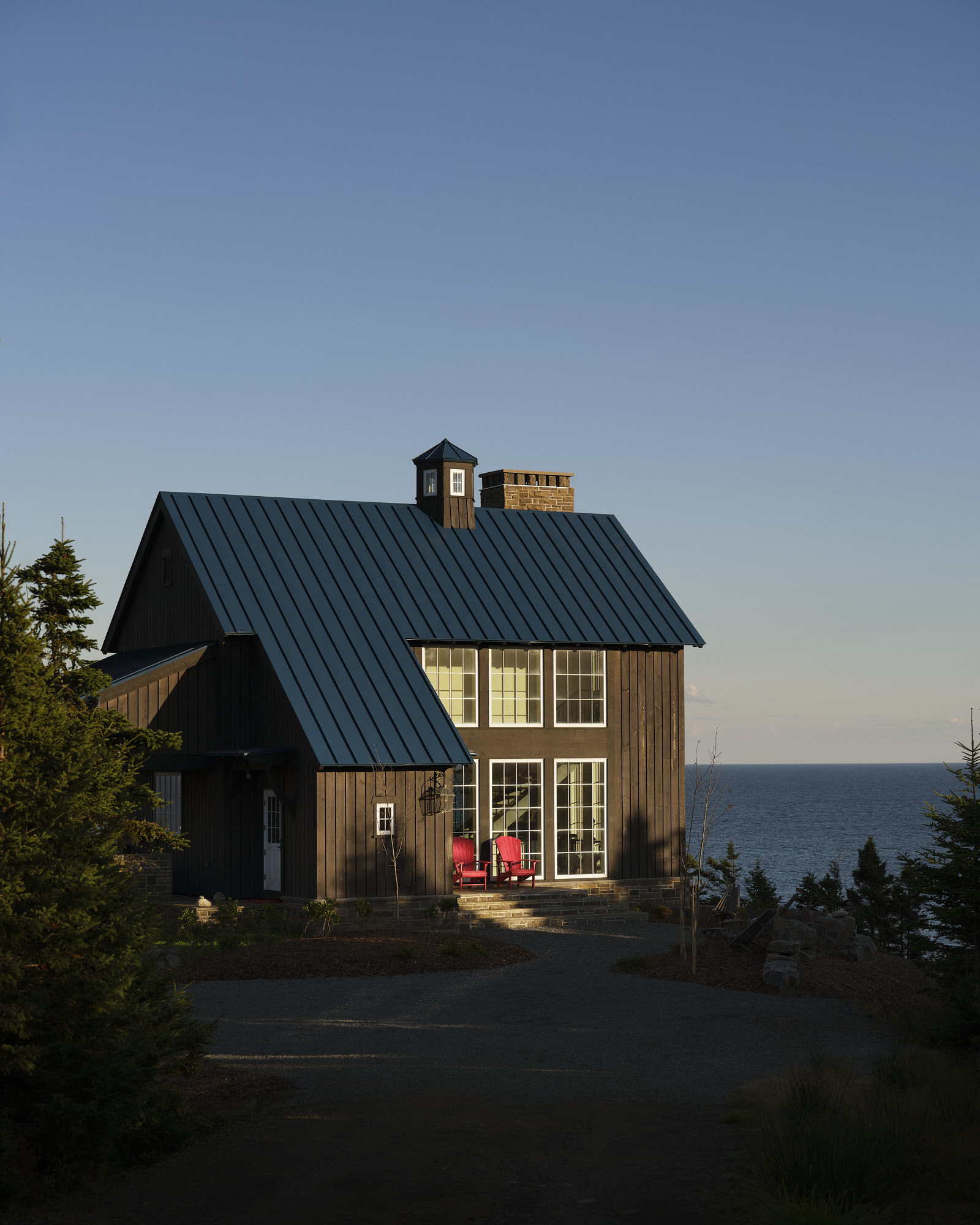
A board-and-batten home rises from the Nova Scotia coastline in The Soulful House, architect Jeffrey Dungan’s new monograph. Photos by Adrian Gaut.
Some architects design houses. Jeffrey Dungan creates sanctuaries — homes that appear less constructed than discovered, as though they’ve quietly emerged from the landscape itself. Renowned for the organic beauty and poetic clarity of his architecture, Dungan has spent recent years working far beyond his Southern roots, and The Soulful House (Rizzoli) gathers that evolving body of work into a single, thoughtfully curated volume.
The book moves through more than ten residential projects, including Dungan’s own home, alongside essays on emotion, balance, and form. Together, they trace the inspirations and guiding principles behind a career built on one belief: that a house, at its best, is an intimate personal expression of a life.
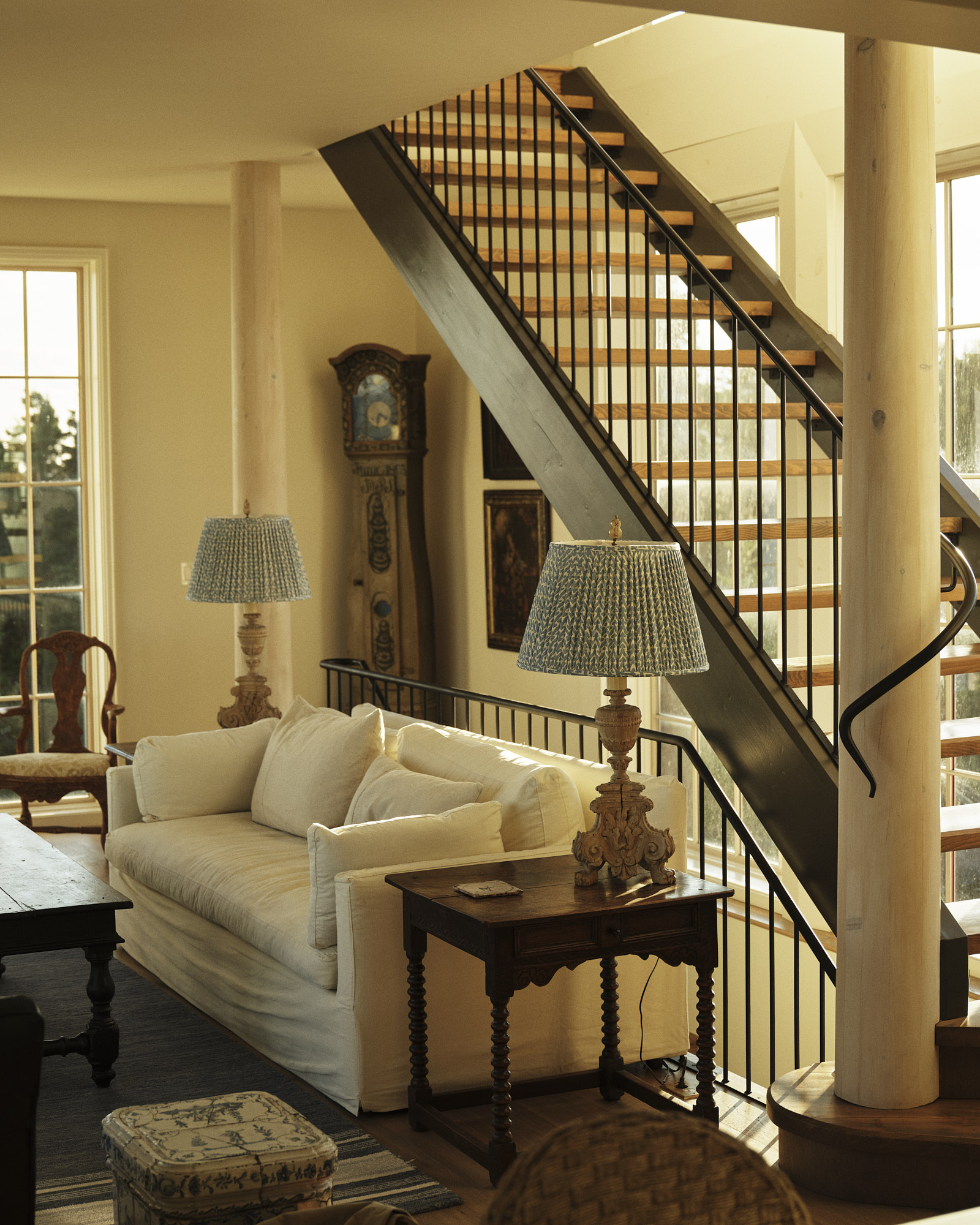
Late-day light fills a living room on the Nova Scotia coast, where an open-tread staircase rises beside a slipcovered sofa. Photo by Adrian Gaut
Readers move from a sun-washed retreat on the Pacific to a windswept cottage on the raw coast of Nova Scotia, from a Pennsylvania barn reimagined on a hillside in an island paradise to a ranch settled into the open terrain of the American West. Each project is distinct, shaped by its own site and climate, yet all are united by the same unmistakable hand: warm, livable interiors, thoughtful flow, and natural finishes that only improve with time.
Red Adirondack chairs face the sea outside a board-and-batten cottage, topped with a cupola and a standing-seam metal roof.
Weathered beams, steel-framed windows, and a view of the rolling hillside beyond show Dungan’s approach to warm interiors, honest materials, and generous natural light.
It’s in the details that the book lingers longest — stucco warmed by afternoon light, an alcove shaped quietly by shadow and scale. These are not flourishes added at the end, but the result of a guiding philosophy: that architecture, done well, rises from its surroundings with a sense of inevitability and grace, rather than imposing on them.
The Soulful House: Stories of Beauty, Belonging, and the Spirit of Home
Published by Rizzoli // Photography by Adrian Gaut
Part monograph, part meditation on architecture as lived poetry, The Soulful House is as inspiring for architects and designers as it is for anyone who believes a well-crafted home has the power to shape daily life.
Jeffrey Dungan is one of America’s most celebrated residential architects. His work has earned honors from the American Institute of Architects, the Institute of Classical Architecture & Art, and the Palladio Awards. In 2024, Forbes named him among the nation’s Top 200 Architects.
On September 24, as part of the Southbound Food Festival HOSTED series, Highlands Bar & Grill opened its doors for a rare aperitivo hour, bringing Marie Stitt and Edward Crouse of babas home to the bar where Marie grew up. She found the ritual while studying food culture in Northern Italy and built a life around it in Charleston. For one evening, she brought it home to her father Frank’s bar, alongside Pardis and Weston Stitt.
The night was one night only. The ritual doesn’t have to be.
Aperitivo isn’t a happy hour. It’s the hour that opens an evening rather than closes it out: a little bubbles, a few small bites, conversation that isn’t in a hurry. It asks for almost nothing in the way of fuss, and almost everything in the way of good ingredients. Below, a spread built for exactly that: one drink, three bites, and a set of instructions your evening self will thank your afternoon self for following.
Aperitif: Hugo Spritz with Elderflower & Mint
The classic spritz gets its low-ABV, bittersweet-adjacent lift here from St. Germain and a mint tea syrup instead of Aperol or Campari: floral, bright, and easy to make for a crowd.
Fill a glass with ice, at least halfway. Add the St. Germain and mint simple syrup. Add the prosecco and soda water, and stir briefly and gently to combine. Garnish with a mint sprig and lemon wheel.
Make-ahead note:
The mint simple syrup can be made up to three weeks in advance and stored in the fridge, which means the only thing left to do the day of is pour. To make it: bring 1 cup water and 1 cup sugar to a boil, remove from heat, and stir until the sugar dissolves. Steep one bag of mint tea in the hot syrup for 5 minutes, then remove and refrigerate. For a crowd, multiply the spritz ingredients and mix a large pitcher ahead of time, adding the soda water just before serving so it stays bright and bubbly.
Warm Nibble: Roasted Tomato & Burrata
Warm, jammy roasted tomatoes blended with burrata into a creamy, spreadable dip: equal parts rustic and elegant, and better the longer it sits.
Preheat oven to 375°F. Place tomatoes on a baking sheet, drizzle with olive oil, and add the sliced garlic, salt, pepper, and red pepper flakes, tossing to coat evenly. Bake for 20 to 25 minutes, until the tomatoes burst and soften.
Place the roasted tomatoes, burrata, and ½ cup basil in a food processor. Pulse until creamy and thoroughly combined, adding more salt and pepper if needed. Refrigerate for several hours or overnight.
Spread on warm toasted French bread slices. Garnish with a fresh basil leaf and a sprinkle of black pepper.
Make-ahead note: This one prefers to be made ahead. Bake and blend the tomato-burrata mixture the night before, or at minimum give it several hours in the fridge, so the flavors have time to meld. Toast the bread just before your guests arrive.
Handheld Bite: Beef Carpaccio Crostini with Zesty Egg Topping
Paper-thin cured beef, a bright, briny egg topping, and a good olive oil. It’s elegant but simple enough to pull together in twenty minutes.
2 tablespoons capers, drained, rinsed, and chopped
2 tablespoons minced cornichons
2 tablespoons chopped fresh chives
1½ tablespoons fresh lemon juice
½ teaspoon sea salt
¼ teaspoon fresh cracked black pepper
3 tablespoons extra-virgin olive oil, divided
6 ounces thinly sliced air-dried beef, such as bresaola (or substitute prosciutto)
5 ounces baby arugula
Fresh grated Parmigiano-Reggiano, as desired
Baguette, sliced and toasted, for serving
Force the hard-boiled eggs through a garlic press into a medium bowl. Add the radishes, capers, cornichons, and chives. Stir in the lemon juice, salt, and pepper, followed by 2 tablespoons of the olive oil.
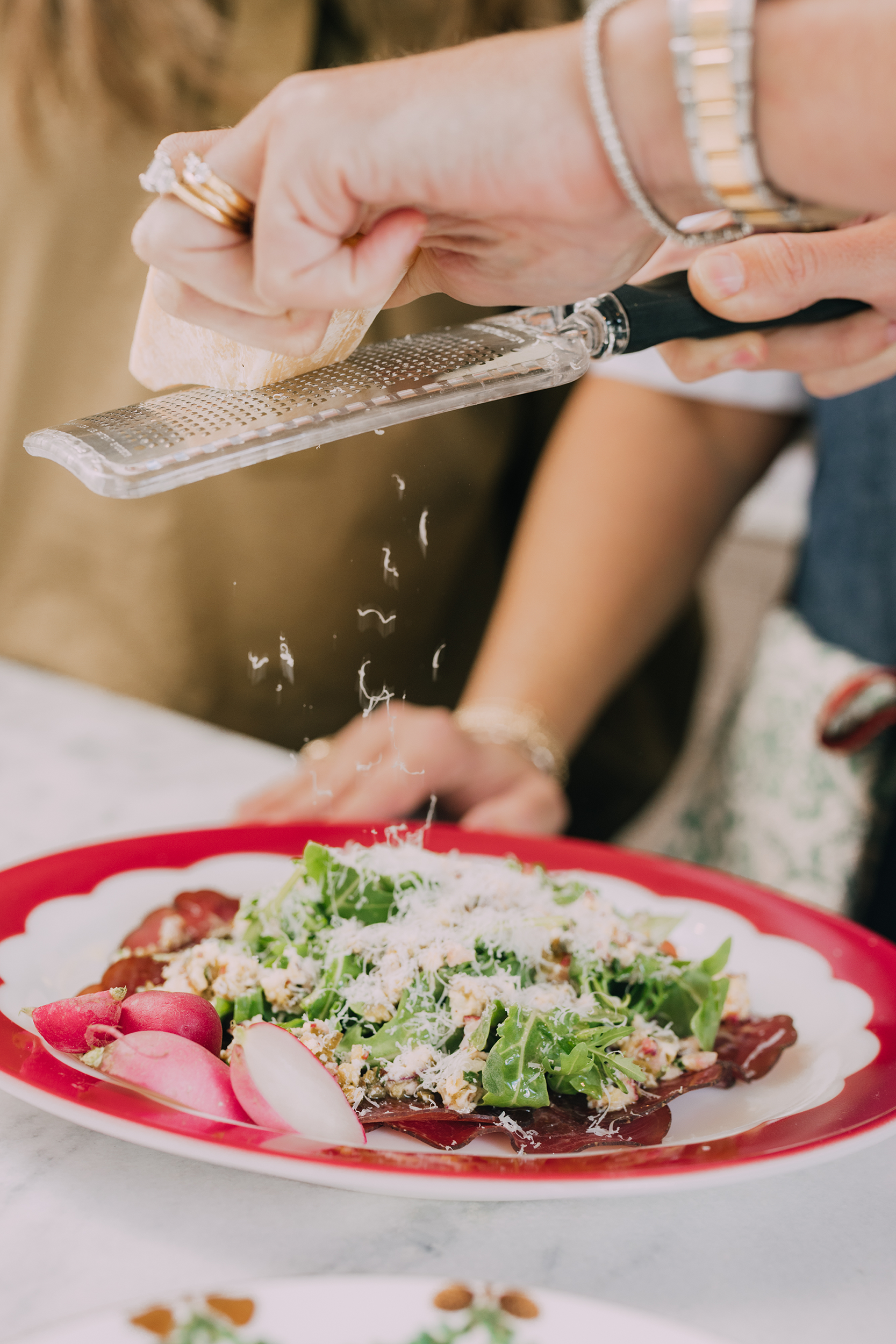
To assemble: layer a slice of bresaola over each toasted baguette round, top with a small handful of arugula, drizzle with the remaining olive oil, and spoon the egg mixture over top. Finish with a microplane grating of Parmigiano-Reggiano.
Make-ahead note: The egg topping can be mixed a few hours ahead and chilled. Assemble the crostini right before serving so the bread stays crisp and the beef stays fresh.
Fresh Skewer: Melon Caprese Picks
A three-melon, mozzarella, and herb skewer built for grazing: bright, no-cook, and endlessly easy to scale up or down.
Thread melon balls, a cucumber round, a tomato, a mozzarella ball, and a basil or mint leaf onto each skewer, in whatever order pleases you. Arrange on a platter and set out small bowls of olive oil, balsamic, salt, and pepper for dipping and finishing.
Make-ahead note: Thread the skewers up to 4 hours ahead and keep chilled, covered, until serving. Hold off on the oil, vinegar, salt, and pepper until just before guests arrive.
How to Put It All Together
None of these four require a stove going at the same time, which is really the point of aperitivo hour: a spread that looks like effort and requires very little of it in the moment. Batch the spritz ahead, roast and blend the tomato-burrata the night before, mix the egg topping a few hours out, and skewer the melon whenever you have a spare ten minutes in the afternoon. By the time your first guest arrives, the only thing left to do is pour, plate, and let the evening take its time.
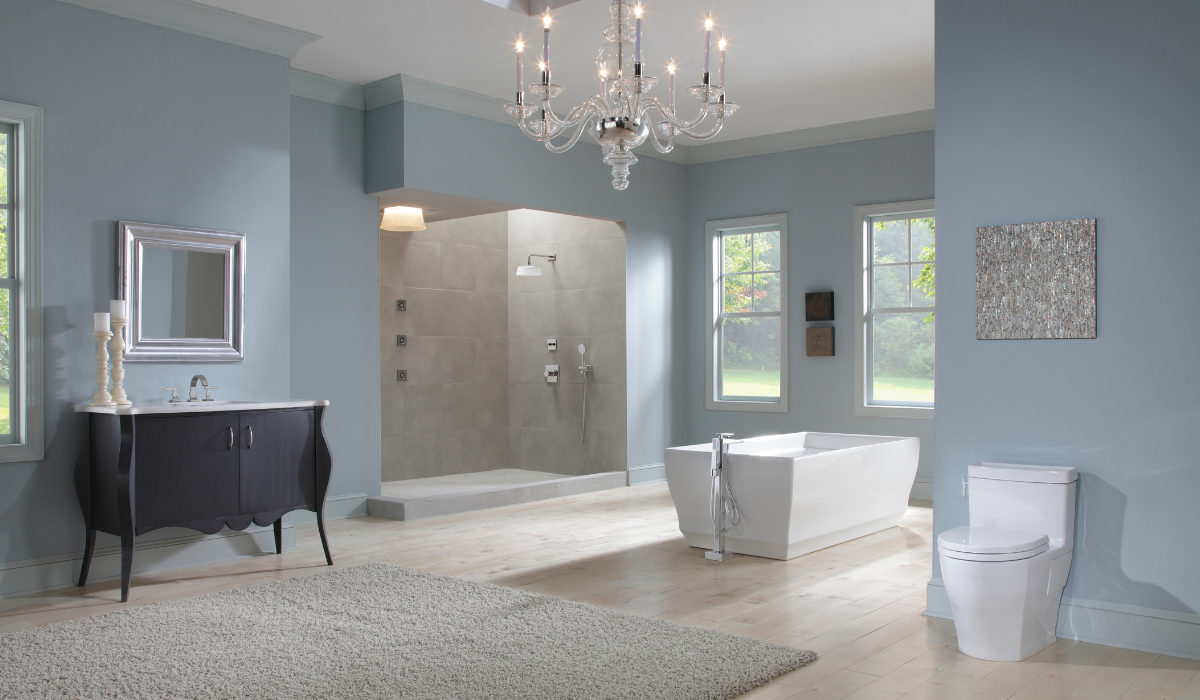
The right fixtures, finishes, and thoughtful design choices can transform an ordinary space into one that feels uniquely yours.
When homeowners begin planning a kitchen or bathroom renovation, it’s easy to focus on the big decisions: cabinetry, countertops, tile, flooring, and paint. But often, it’s the smaller details that give a space its personality—and make it feel truly custom.
A thoughtfully chosen faucet, an unexpected sink configuration, or a beautifully coordinated shower system can do more than complete a room. These are the elements homeowners interact with every day, making them an important part of both the look and experience of a space.
At GLS Supply Kitchen & Bath Showrooms, our consultants help homeowners, designers, and builders bring those details together every day. Here are a few of the choices that can have an outsized impact.
Start with the Fixtures
Faucets, sinks, tubs, showers, and other plumbing fixtures are functional necessities, but they can also become defining elements of a kitchen or bathroom.
Rather than treating fixtures as items to select at the end of a project, consider them part of the overall design from the beginning.
Pay Attention to Proportion
One detail that can be difficult to appreciate from a photograph is scale.
A faucet that looks beautiful online may feel too small for a large kitchen island—or too substantial for a compact vanity. The same is true for sinks, tubs, shower fixtures, and even cabinet hardware.
Considering the size and proportions of the surrounding elements helps create a room that feels balanced. Seeing fixtures in person can be especially helpful when making these decisions.
Think Beyond One Finish
Matching every metal finish in a room used to be the standard approach. Today, homeowners have more freedom to mix finishes and create a layered, collected look.
A polished faucet might work beautifully alongside warm cabinet hardware, while a shower system in a complementary finish can add another layer of visual interest.
The key isn’t necessarily to match everything. It’s to make intentional choices that feel connected.
Design for How You Live
Custom design isn’t only about appearance. Some of the most meaningful choices are the ones that make everyday routines easier.
A touch-activated kitchen faucet can be convenient when your hands are full. A workstation sink can streamline food preparation and cleanup. In the bathroom, a hand shower, multiple shower functions, heated elements, or a steam system can turn an ordinary routine into something more comfortable.
Think about what frustrates you about your current space—and what would make your daily routine work better. Those answers can often guide some of your best design decisions.
Don’t Forget the Details You Don’t See at First
Some of the most important decisions happen behind the walls or underneath the finished surfaces.
The way a shower system is configured, the plumbing requirements for a particular fixture, or the installation specifications for a sink can all influence the construction process. Making selections early and discussing them with knowledgeable professionals can help prevent surprises later.
This is one reason showroom guidance can be valuable, particularly during a new build or major renovation. A showroom consultant can help homeowners understand how individual selections work together and identify potential considerations before installation begins.
Let Your Home Reflect You
A custom-feeling kitchen and bath doesn’t necessarily require the most expensive materials or the latest trend. More often, it’s the result of thoughtful decisions that reflect the people who live there.
Maybe that’s a dramatic freestanding tub, a highly functional kitchen sink, a unique faucet finish, or a shower designed around your morning routine. These personal touches are what make a space feel more like home.
At GLS Supply Kitchen & Bath Showrooms, our consultants help homeowners, designers, and builders bring those details together every day. Here are a few of the choices that can have an outsized impact.
Because sometimes, it’s the smallest details that make the biggest difference.
Sponsored by GLS Supply Kitchen & Bath Showrooms
Explore kitchen and bath fixtures, finishes, and configurations at the Birmingham showroom.
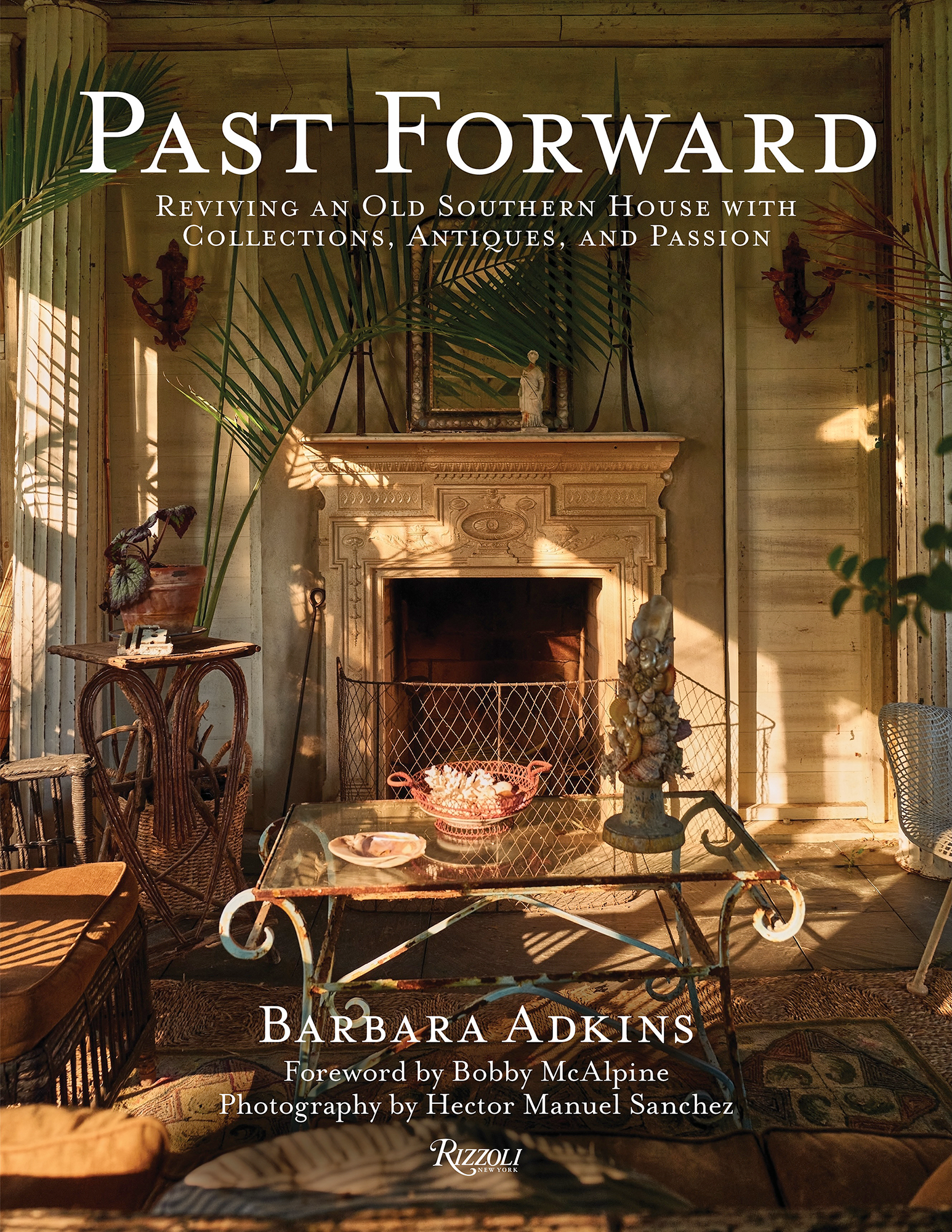
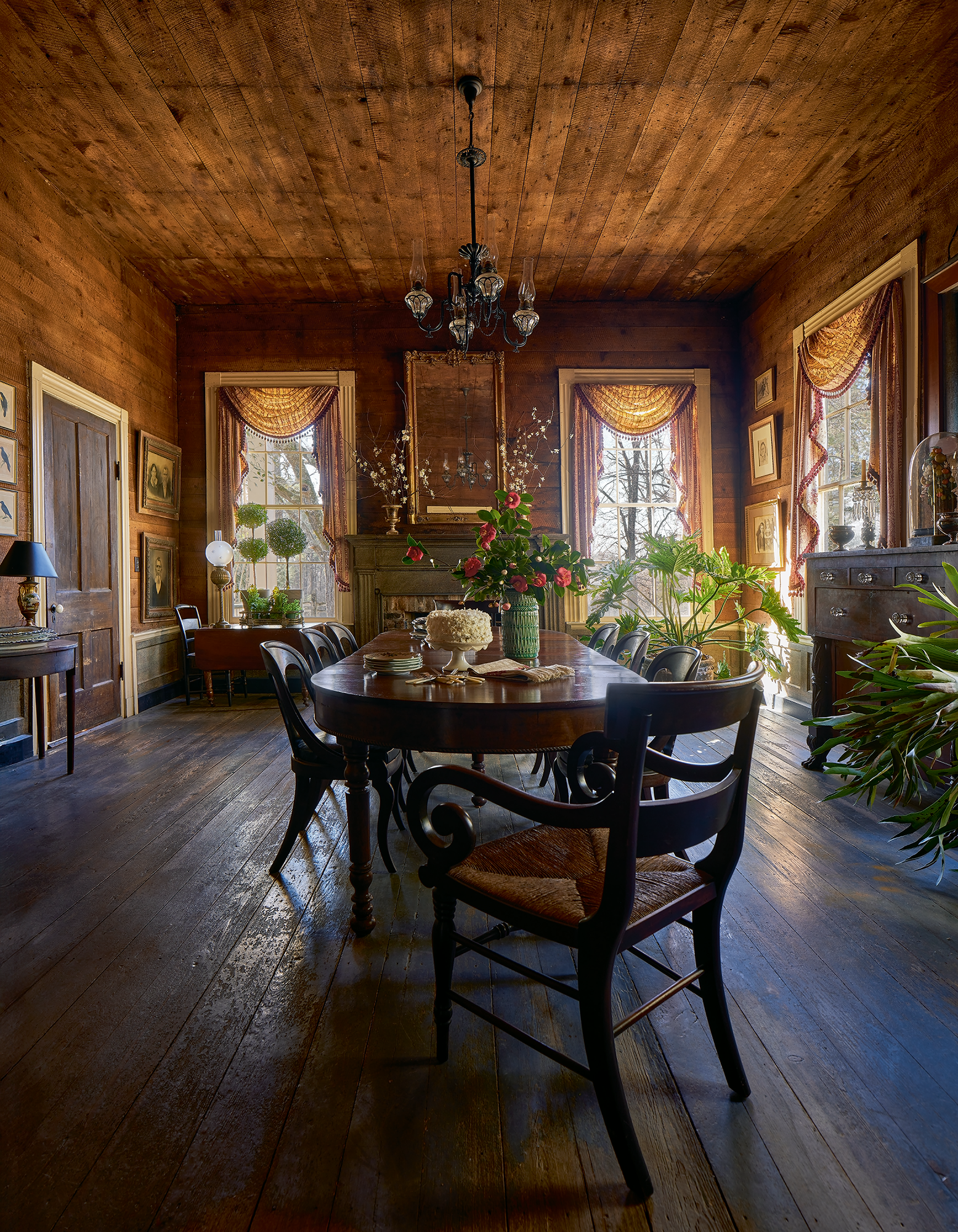
Some houses are restored. Others are gently awakened. In Past Forward: Reviving an Old Southern House with Collections, Antiques, and Passion, Barbara Hamby Adkins shows how her family’s Harpersville farmhouse became an enduring expression of Southern style — not through renovation, but through decades of living, collecting, and paying attention.
The home, occupied by five generations of Barbara’s family, is the backdrop for a meditation on collecting, preservation, and the quiet beauty of living with history.
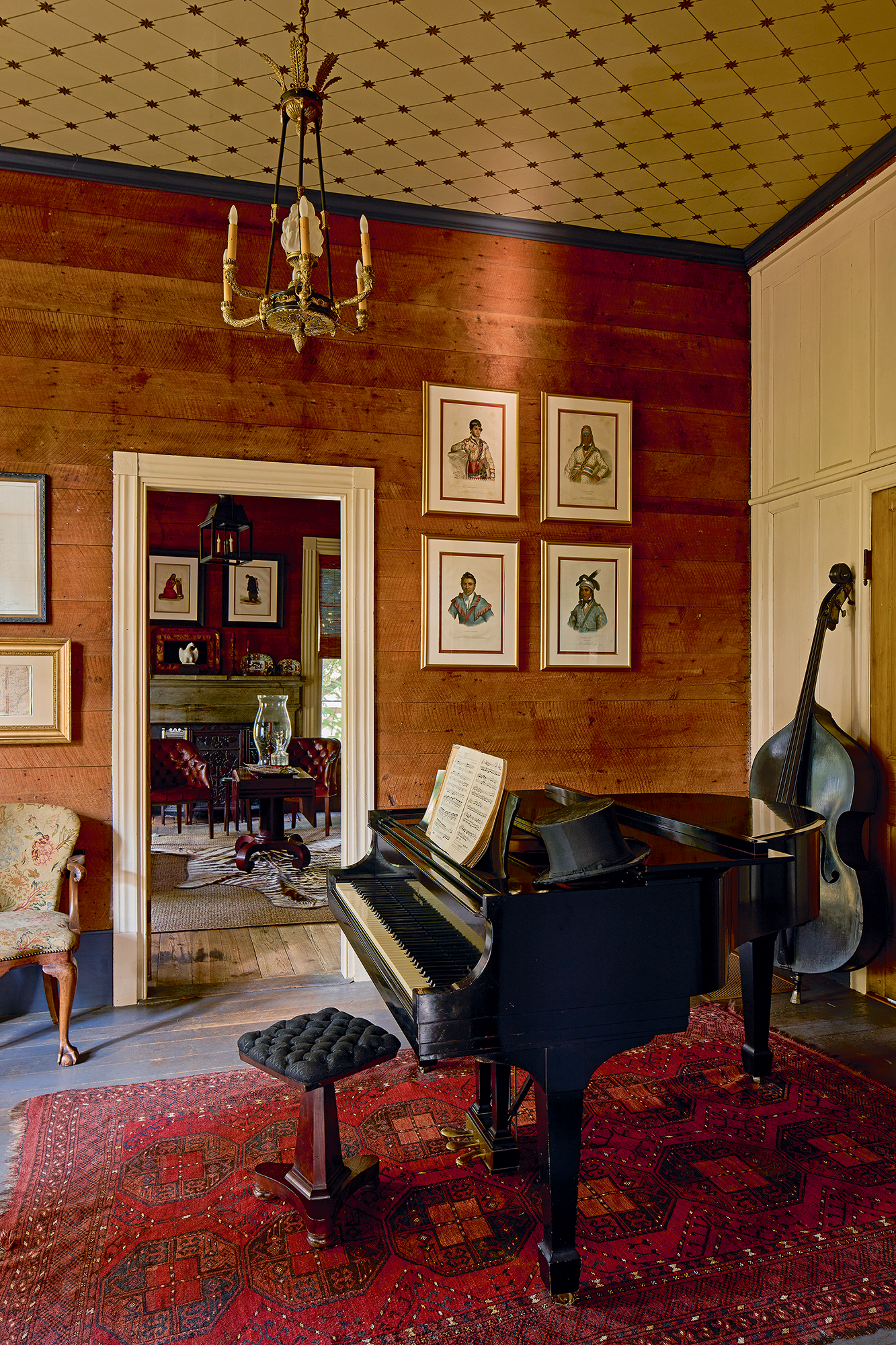
Timeworn antiques and heirloom pieces fill the 19th-century farmhouse, where every object adds to a larger story.
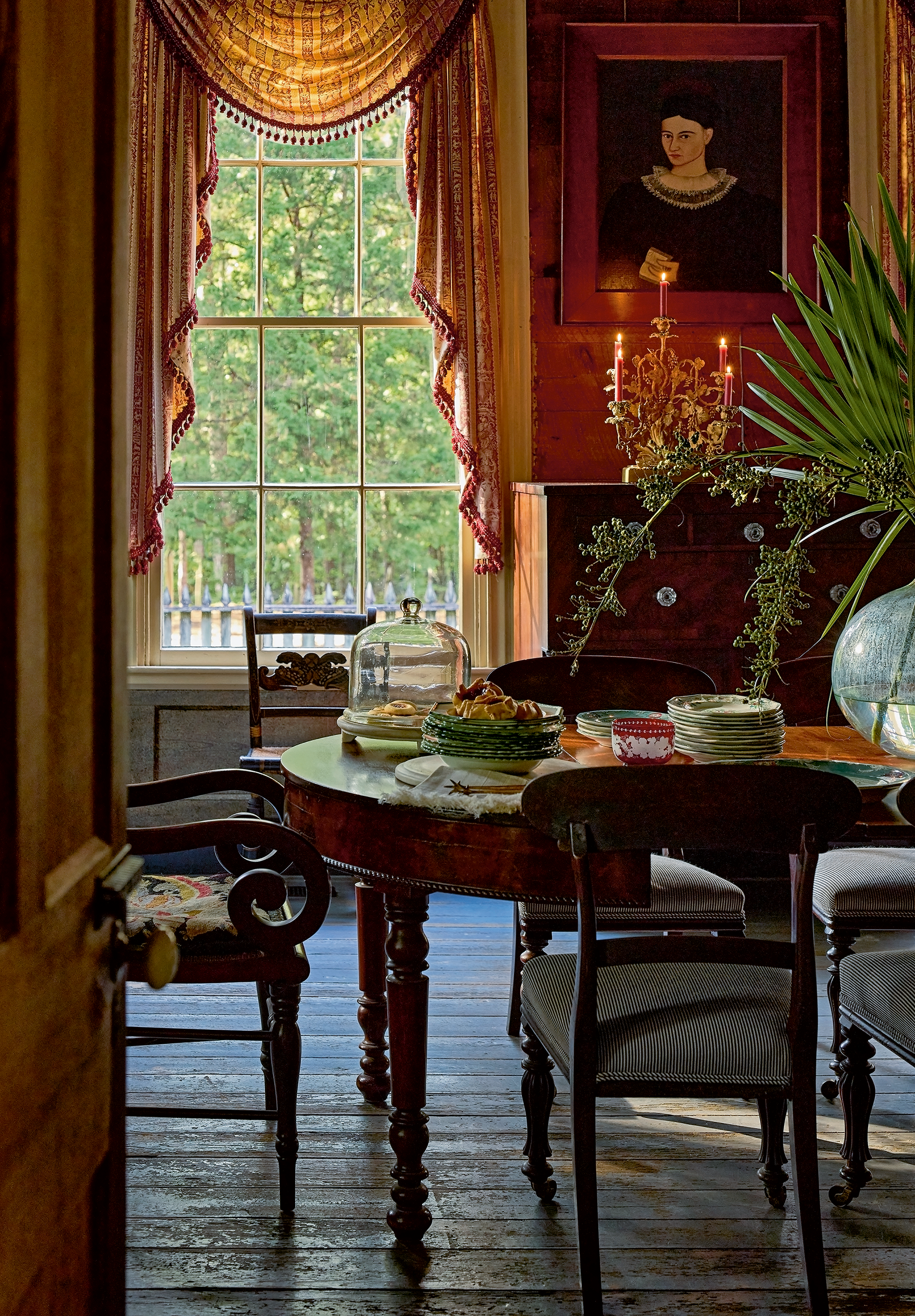
In the dining room, antiques and foraged florals are layered with an easy hand, so the space feels personal rather than decorated.
Known for her discerning eye as the founder of Black Sheep Antiques in Harpersville, Barbara has spent decades shaping interiors that feel deeply personal rather than decorated. Heart pine floors, timeworn antiques, heirloom textiles, and foraged floral arrangements are layered with an effortless hand, creating rooms where every object contributes to a larger story.
Heart pine floors, heirloom textiles and collected pieces give each room its patina.
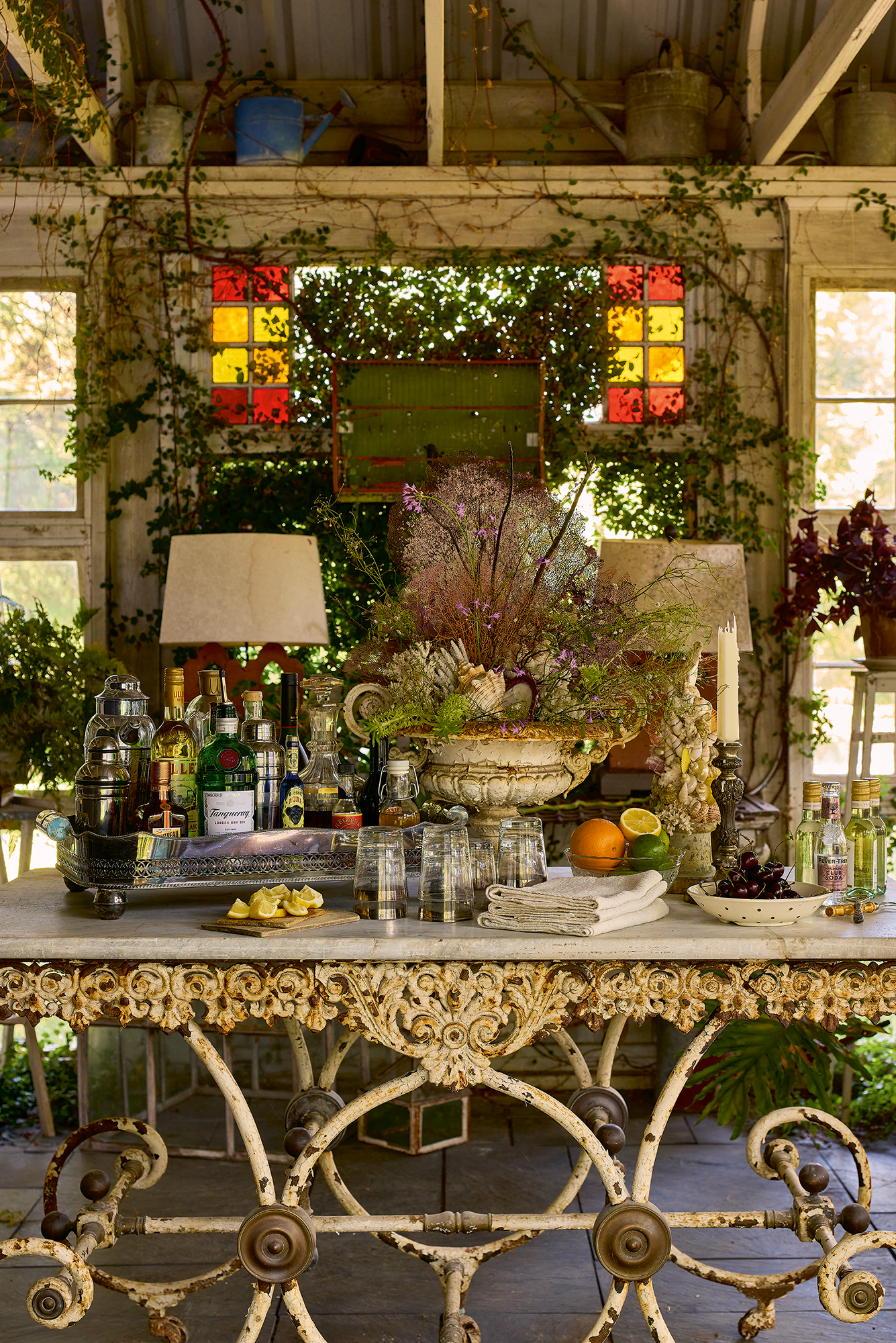
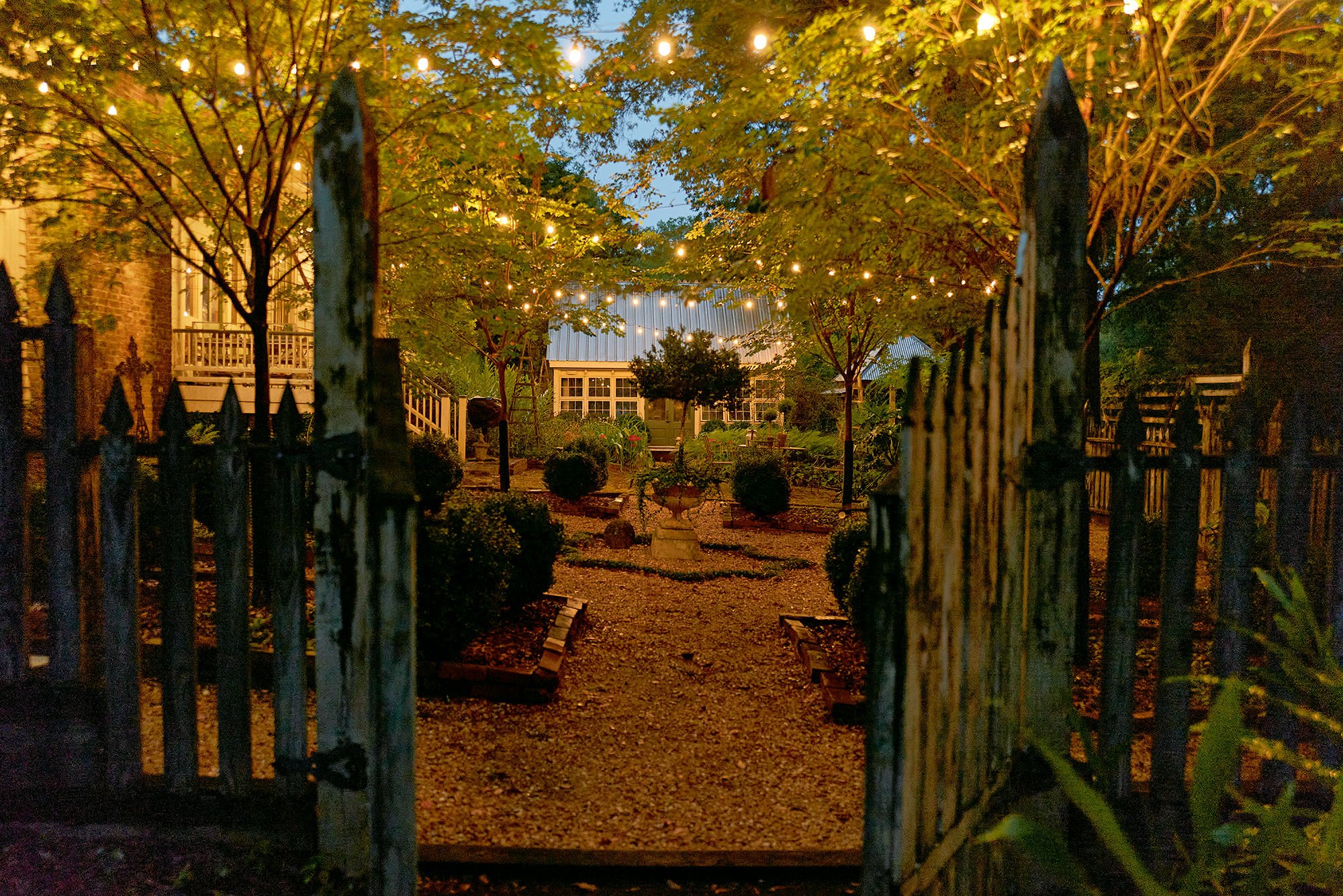
The garden summer house extends the home’s Southern hospitality outdoors.
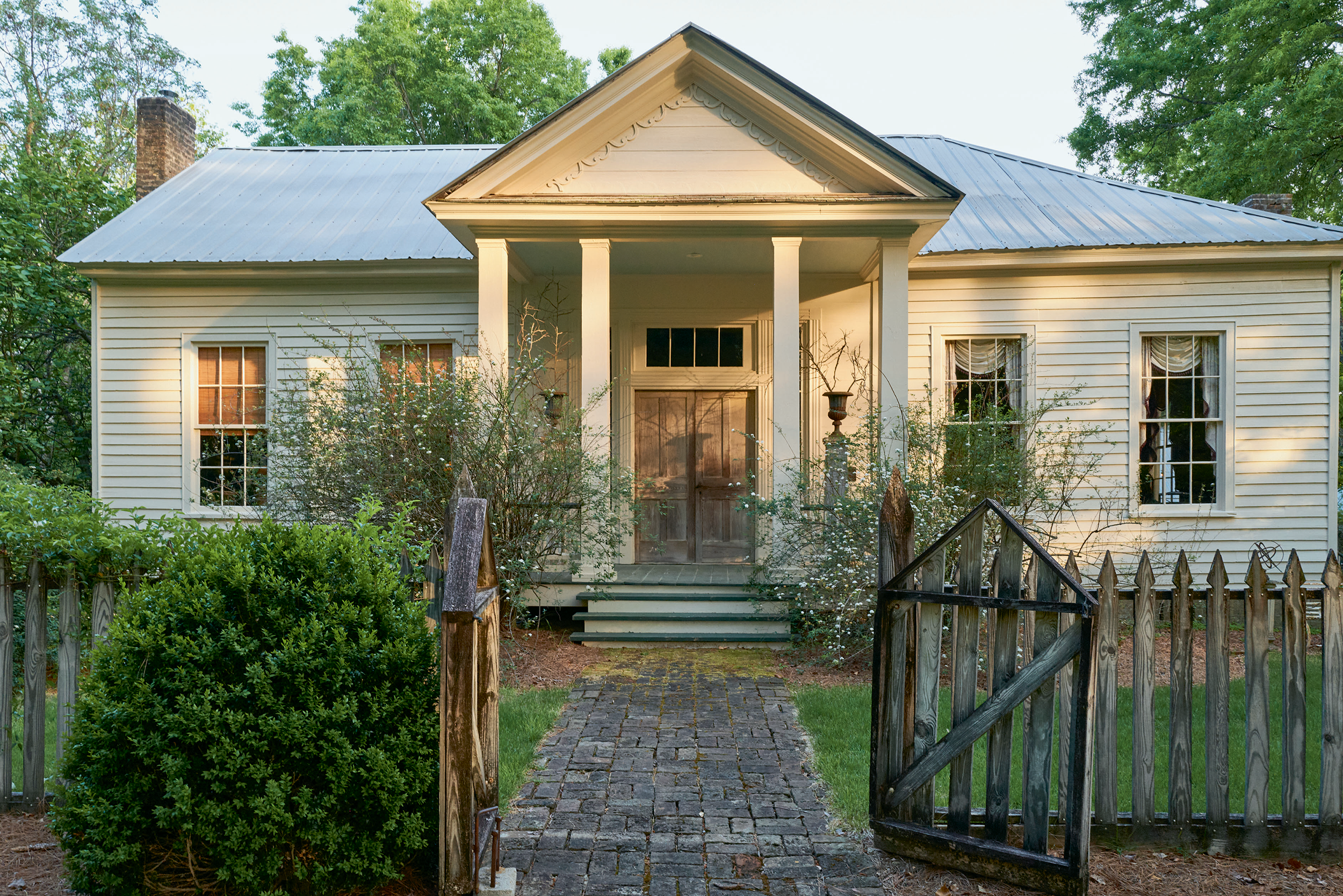
The Greek Revival farmhouse, surrounded by historic plantings and intimate garden rooms.
The landscape is just as compelling as the interiors. Historic plantings, seasonal blooms, intimate garden rooms, and a charming summer house extend the home’s sense of place beyond its walls — a reminder that in the South, architecture and landscape are rarely separate conversations. Throughout the book, Barbara reflects on the rituals of Southern hospitality and the pleasures of collecting with intention.
Past Forward: Reviving an Old Southern House with Collections, Antiques, and Passion
Published by Rizzoli // Foreword by Bobby McAlpine // Photography by Hector Manuel Sanchez
Richly layered and quietly transporting, Past Forward is an invitation to appreciate the beauty of patina, the resonance of inherited objects, and the enduring power of a house shaped over generations. Get your copy HERE.
Barbara is the founder of Black Sheep Antiques, located at 39509 Highway 25 in Harpersville, Alabama. For book signings and local retailers, follow @black_sheep_and_co on Instagram.
In the fall of 2006, Antiques at the Gardens co-chairs Joan Starnes and Kim Matthews gathered 45 committee members, 33 premier antiques dealers, and one big idea under the theme “Heirlooms in Bloom.” That first Antiques at the Gardens raised more than $262,000 and welcomed over 1,400 guests—and the dealers lined up to return the next year. Today, the show has prospered into a four-day celebration of antiques, design, floral artistry, and collecting that draws visitors from around the world.
This year’s event is led by co-chairs Jennifer Ard, Jeremy D. Clark, Marguerite Johnson, Stephanie Lynton, and Rachael Rummel. They are joined by the 2026 honorees—Bart McCorquodale, Richard Keith Langham, and Margot Shaw—whose involvement dates back to the show’s earliest days. Guests will be invited to explore a collection of phenomenally transformed galleries and gathering spaces filled with botanical and antique beauty. The show supports the mission of the nonprofit Friends of Birmingham Botanical Gardens: to protect, nurture, and share the wonders of the Gardens.
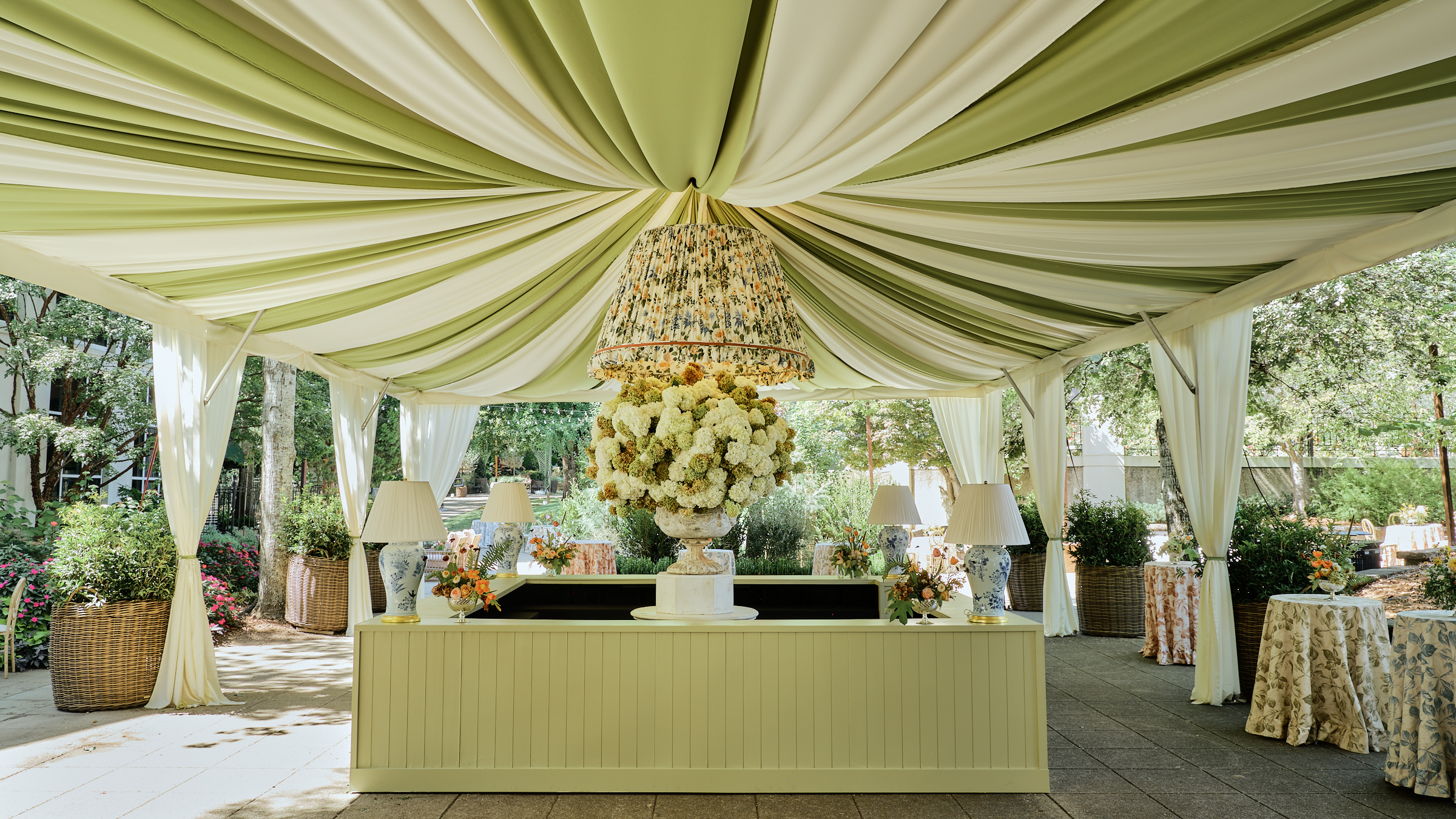
Presented by 1919 Investment Counsel and Fidelity Brokerage Services and featuring 20th Anniversary Design Sponsor Gracie, this year’s show embraces a richly layered design vision inspired by romantic garden follies, hand-painted chinoiserie, and timeless collected interiors.
Tickets are on sale now. For tickets, show schedule, speaker bios, and dealer information, visit bbgardens.org/antiques. Follow show announcements and reveals on Facebook and Instagram.
2026 Honorees
RICHARD KEITH LANGHAM, BART McCORQUODALE, AND MARGOT SHAW
Honored Thursday, October 1 at the Honoree Celebration, all three have been involved with Antiques at the Gardens since its earliest days.
Thursday, October 1
Honoree Celebration*
6 p.m. — Honoring Richard Keith Langham, Bart McCorquodale, and Margot Shaw
Gala in the Gardens
7–11 p.m. — Sponsored by Jones Walker LLP & ServisFirst Bank
Friday, October 2(Show Hours: 10 a.m. – 5 p.m.)
Red Diamond Lecture Series
Sponsored by Red Diamond Coffee & Tea. Introduction by Richard Keith Langham.
In Conversation
Veere Grenney and Amy Astley, Editor in Chief, Architectural Digest** 11 a.m., book signing to follow — Sponsored by Red Diamond Coffee & Tea and Gracie
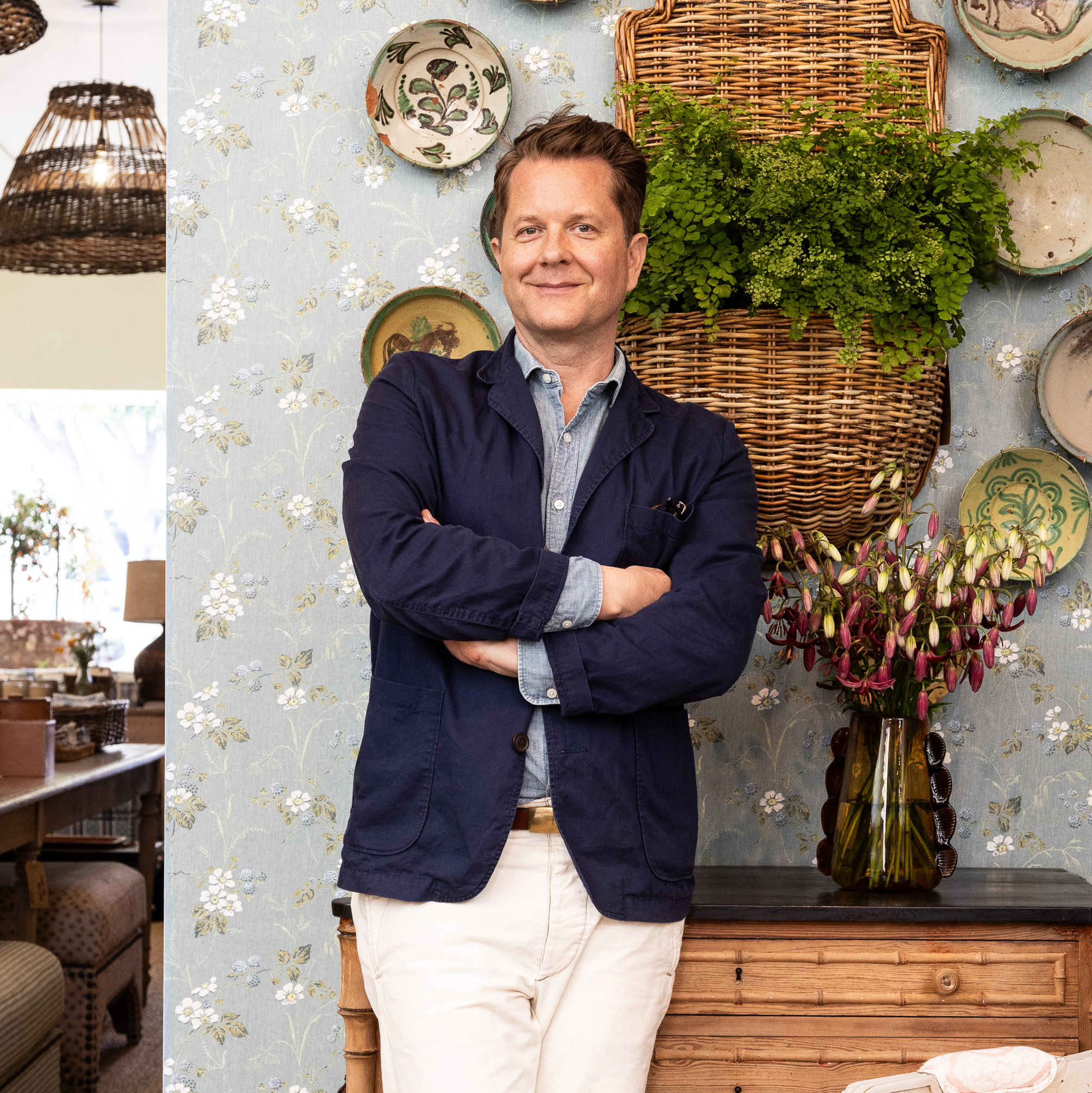
VEERE GRENNEY has spent 30 years building a portfolio of houses around the world. Born in New Zealand, he trained under Mary Fox Linton and served as a director at Colefax and Fowler. He was inducted into the AD100 Hall of Fame in 2023. The author of On Decorating and Seeking Beauty, he recently launched a course with Create Academy.
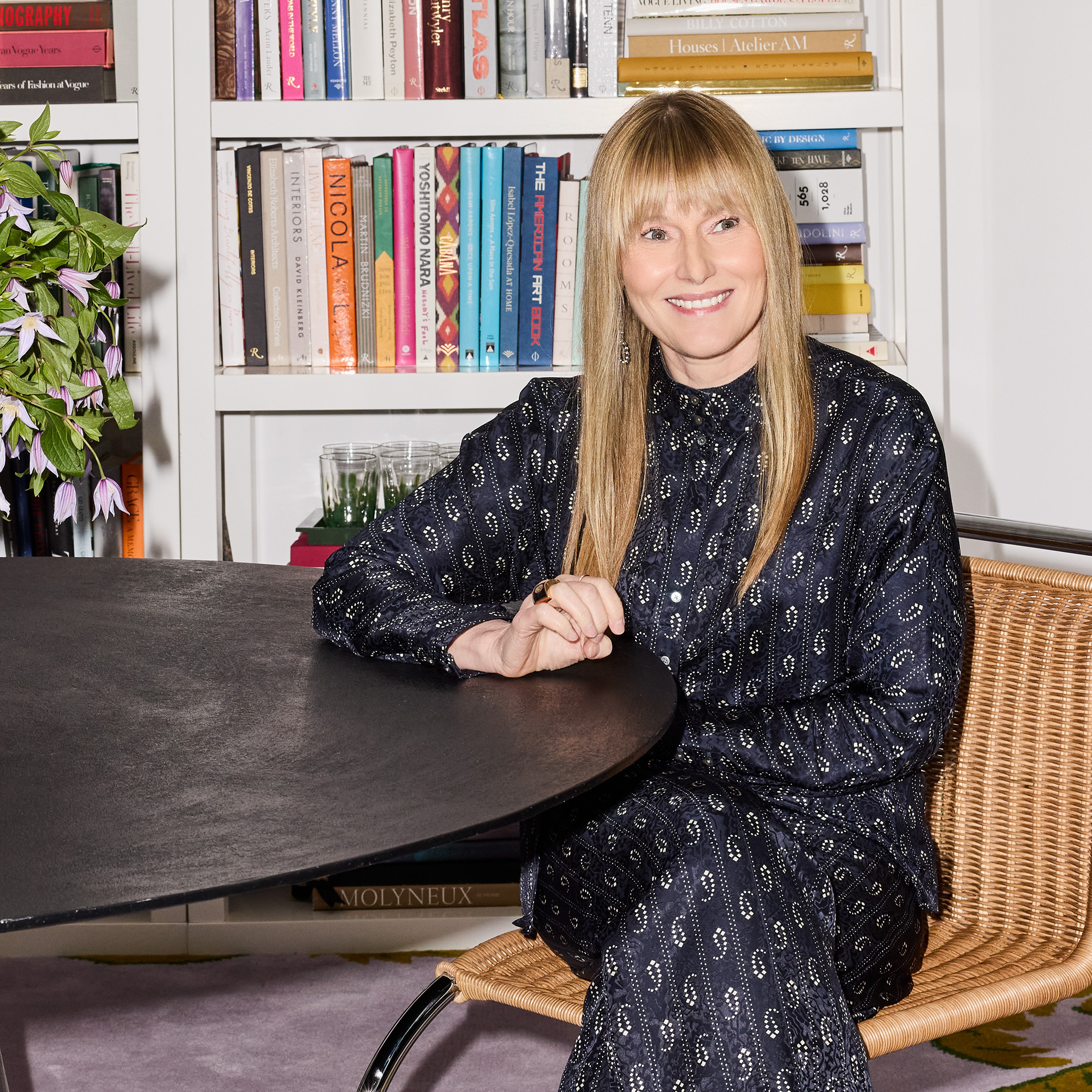
AMY ASTLEY is the global editorial director and U.S. editor-in-chief of Architectural Digest (AD). Prior to AD, she founded Teen Vogue and served as editor-in-chief. She is also the editor of the newly released AD at Home (Rizzoli).
Dialogue in Design
David Netto, Richard Bories, and James Shearron** 2 p.m., book signing to follow — Sponsored by Red Diamond Coffee & Tea
DAVID NETTO is a Los Angeles-based interior designer and writer. His work has appeared in Vogue, Elle Decor, AD, House Beautiful, Town & Country, and VERANDA. He has written for The Wall Street Journal, The New York Times, and Cabana, and he currently pens “Case Studies” for Town & Country. A self-titled book represents 20 years of his own designs.
RICHARD A. BORIES & JAMES SHEARRON “Good proportion, suitability, and a sense of invention” is the credo of architect Dick Bories and James Shearron, partners in their award-winning AD100 architectural firm. Their passion is translating the best principles of classical and modern architecture into inspiring spaces for today. Projects range from Grey Gardens in East Hampton to Montecito and Palm Beach. The firm collaborates with interior designers including Mark Sikes, David Netto, Markham Roberts, and the late Suzanne Rheinstein.
Street Theater Documentary Screening
Robert Rufino and Mish Tworkowski 3:30 p.m. — Sponsored by McCorquodale Transfer and The Urban Electric Co.
ROBERT RUFINO is a celebrated design editor, stylist, and visual storyteller whose eye has shaped the pages of House Beautiful, VERANDA, and Elle Decor. The Urban Electric Company’s short film, Street Theater, by Joshua Charow, explores Rufino’s career and early beginnings designing windows for iconic New York institutions—from Henri Bendel to Tiffany & Co.—helping pioneer the display style known as “street theater.”
MISH TWORKOWSKI is a Palm Beach-based jewelry designer whose botanical collections have earned a devoted following. He serves in leadership roles with the New York Botanical Garden and the Preservation Foundation of Palm Beach. In Street Theater, he offers behind-the-scenes insights.
Saturday, October 3(Show Hours: 10 a.m. – 5 p.m.)
The Making of a Collection
Alexander Widener, Rudy Saunders, and Max Sinsteden 9 a.m. — Moderated by Hudson Moore, Frederic — Sponsored by Paige Albright Orientals & Visual Comfort & Co.
ALEXANDER WIDENER Alexander Widener built a career in the textile world working with Matouk, Sister Parish, and Samuel & Sons. He now owns Widener Company, an interiors shop and guest cottage in coastal Maine, where his collector’s eye makes him a natural voice on living with the things you love.
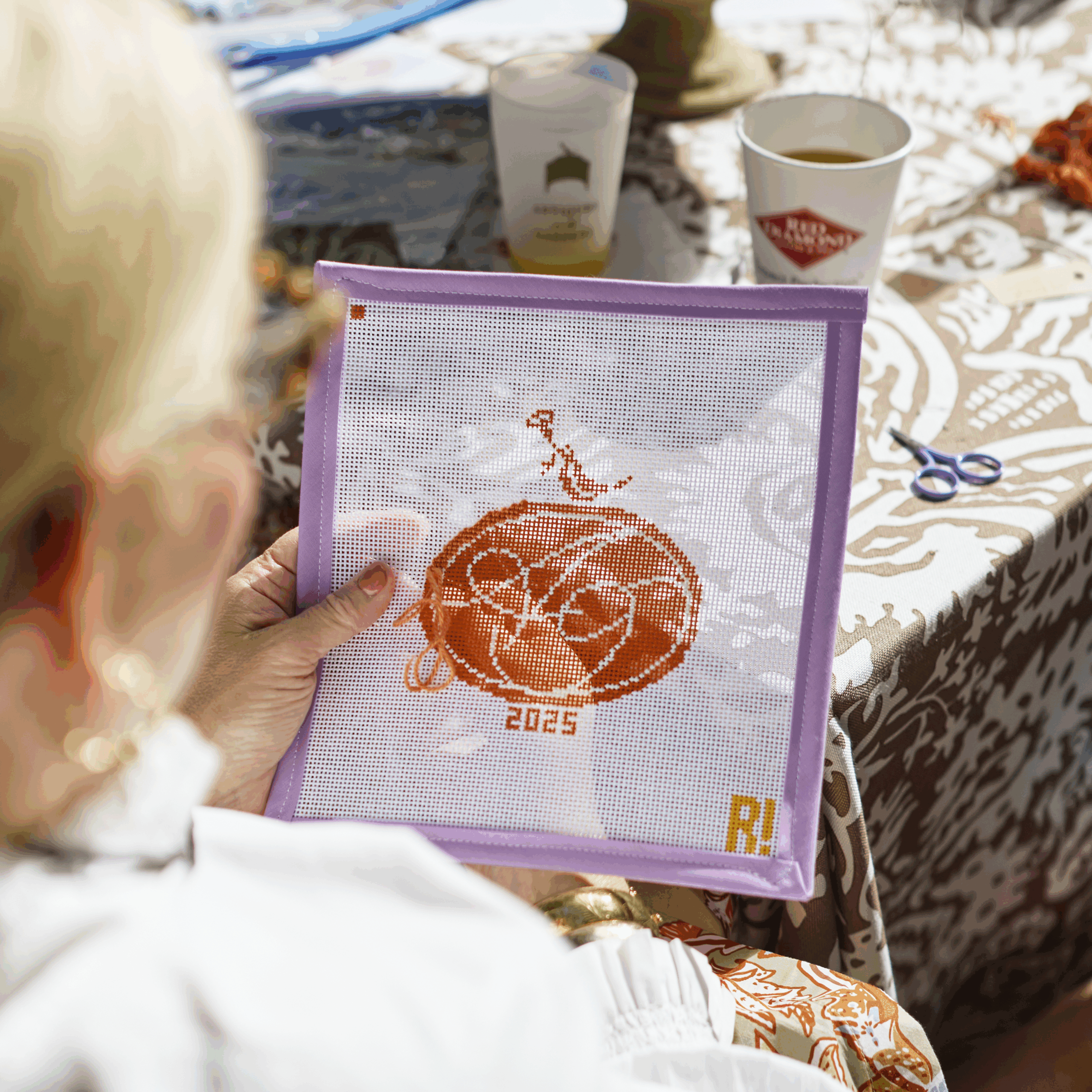
RUDY SAUNDERS Rudy Saunders, design director of Dorothy Draper & Company, Inc., oversees interiors across the U.S. and internationally, including hospitality projects at The Greenbrier and Mackinac Island’s Grand Hotel. He launched his exclusive R! by Rudy collection in 2020 and leads Sunday’s “Needlepoint with Rudy” workshop.
MAX SINSTEDEN Max Sinsteden is a New York-based interior designer celebrated for his fresh take on traditional American decorating, layering antiques and fine art into rooms that feel both elegant and livable. His work has been featured in Architectural Digest, House Beautiful, Elle Decor, and VERANDA.
HUDSON MOORE (moderator) Hudson Moore is the senior design editor at FREDERIC magazine. He previously served as the brand manager of Schumacher.
Designing a Forever Home
Matthew Carter, Annie Meyers-Shyer, and Nathan Turner** 11 a.m., book signing to follow — Moderated by Steele Marcoux, Editor in Chief, Veranda — Sponsored by Cobbs Allen, PURE Insurance & Veranda
MATTHEW CARTER is an award-winning, Lexington, Kentucky-based designer known for his thoughtful use of antiques, heirlooms, and architectural detail. Named one of VERANDA’s Next Legends, Carter has projects spanning Palm Beach, Napa Valley, and Charleston.
ANNIE MEYERS-SHYER Daughter of filmmaker Nancy Meyers, Annie Meyers-Shyer is the voice behind @thisoakhouse, where she documents the restoration of her 1940s Gerard Colcord home in Los Angeles. Drawing on an editorial background at Harper’s Bazaar and CHANEL, she champions the belief that a home should feel as good as it looks. Her debut book, This Oak House, arrives from Chronicle Books in 2026.
NATHAN TURNER A fourth-generation Californian, Nathan Turner merged his passions for design, travel, and food into his namesake shop on La Cienega in West Hollywood. He is the author of three best-selling books and has appeared on the Today show and Good Day LA/NY.
STEELE MARCOUX (moderator) Steele Thomas Marcoux is the editor-in-chief of VERANDA, overseeing brand strategy and writing on architecture, design, travel, jewelry, and gardening.
Legacy in Action: Wealth, Family, Purpose
Rudy Saunders, Kaitlyn Sheehy, and Special Guest 12:30 p.m. — Moderated by Jennifer Evans — Sponsored by 1919 Investment Counsel & Fidelity Brokerage Services LLC
Designing Women
Jennifer Gracie, Elizabeth Locke, Ann Mashburn, and Frances Schultz** 2 p.m., book signing to follow — Moderated by Karen Carroll, Flower — Sponsored by Flower, Synovus + Pinnacle Financial Partners
JENNIFER GRACIE is the creative director of Gracie, representing the fifth generation of the family. She co-authored The Art of Gracie (Rizzoli, 2024) and speaks on craft and artisanal interiors. Gracie carries a selection of Chinese and Japanese antiques, but it is still best known for its exquisite custom hand-painted wallpapers.
ELIZABETH LOCKE draws on a lifelong fascination with antique Etruscan, Greek, and Roman jewelry in her neo-classical handmade 19k gold designs. A former Town & Country editor turned gemologist, she founded Elizabeth Locke Jewels in 1988 and scours the globe for antiquities to transform into wearable art.
ANN MASHBURN is a renowned American womenswear designer, former fashion editor, and co-founder of the eponymous lifestyle brand she built with her husband, Sid Mashburn. Their retail empire is known for timeless classics and hospitality-driven shopping.
FRANCES SCHULTZ Author, speaker, and artist Frances Schultz has built a career from her love of houses, gardens, and travel. She has written and co-written 10 books, including The Bee Cottage Story. She is editor-at-large for VERANDA and a contributing editor for FLOWER magazine.
KAREN CARROLL (moderator) is the editorial director of FLOWER and previously served as editor-in-chief and vice president of Southern Accents, and editor-in-chief of Entrée. She was a founding contributing editor for Coastal Living. Karen is the author of the book Entertaining with Southern Style (Bulfinch Press) and has been a contributing writer for other books, including Living Floral (Rizzoli).
Sip & Clip: A Lesson in Floral Design*
Shean Strong 3:30 p.m.(includes materials and take-home arrangement) — Sponsored by Anna Cooper
SHEAN STRONG is an internationally recognized event and floral designer based in Atlanta and known for refined color palettes and architectural installations. His work has been featured in BRIDES, VERANDA, Architectural Digest, and Martha Stewart Weddings, with events produced across destinations worldwide
Sunday, October 4(Show Hours: 10 a.m. – 4 p.m.)
Stitch with Rudy Saunders: Needlepoint with Friends
9 a.m. — Sponsored by Leah Mackin Taylor
Enduring Decoration
Bunny Williams & Elizabeth Lawrence** 11 a.m., book signing to follow — Moderated by Anne Hardy — Sponsored by Regions Bank
BUNNY WILLIAMS An AD100 Hall of Fame member and fixture of Elle Decor’s A-List, Bunny Williams received the New York School of Interior Design’s Albert Hadley Lifetime Achievement Award and the ICAA’s Arthur Ross Award. The author of eight books, Williams oversees businesses, including Williams Lawrence and Bunny Williams Home, and has collections with Ballard Designs, Lee Jofa, Dash & Albert, and Currey & Company.
WITH ELIZABETH LAWRENCE Bunny Williams’s business partner, Elizabeth Lawrence, runs the Bunny Williams umbrella of brands alongside her mentor. Her work has appeared in The New York Times, Architectural Digest, Elle Decor, VERANDA, and House Beautiful.
ANNE HARDY (moderator) Journalist and strategist Anne Hardy is a contributing editor for House & Garden. Her work has been featured in House & Garden, Town & Country, Architectural Digest, Milieu, and CTCG.
In Pursuit of Beauty
Charlotte Moss and Margot Shaw, Editor in Chief, Flower** 2 p.m., book signing to follow — Sponsored by Christopher Collection and Life Insurance Company of Alabama
CHARLOTTE MOSS is synonymous with Southern hospitality. She has designed residences across the U.S. and abroad. Licensed collections include Century Furniture, Fabricut, and Stark Carpet. Her newest book, Charlotte Moss: At Home in Virginia, arrives in September 2026. Accolades include the New York School of Interior Design’s Centennial Medal and Elle Décor’s Grand Masters list.
MARGOT SHAW is the founder and editor-in-chief of FLOWER, which inspires, educates, and entertains readers with a point of view that sees the world through a botanical lens. She is the author of Flowering Outdoors and Living Floral: Entertaining and Decorating with Flowers. Her conversation with Charlotte Moss, “In Pursuit of Beauty,” promises a fitting finale to the anniversary weekend.
*Patron ticket required. **Book signing sponsored by Leaf & Petal at the Gardens.
Design Sponsors
20th Anniversary Design Sponsor: Gracie — We are honored to welcome Gracie as this year’s design sponsor. Renowned for its hand-painted wallpapers, the family-owned company continues a tradition of artistry, crafting rooms and interiors that are entirely unique.
Returning as long-standing sponsors, Gabriella White—home of Gabby and Summer Classics—and Visual Comfort & Co. continue their valued partnerships with the event. This year’s décor sponsors also include Samuel & Sons, Mirth Studio, Little Greene Paint Co., Elegant Earth, and more. Design partners include Claremont Furnishing Fabric, Architect Sissy Austin of Austin & Co., and Trestle Construction.
Antiques at the Gardens 2026 Dealers
1841 Antiques • Antique Cupboard • Beth Poindexter • Black Sheep Antiques • Blackwell Botanicals • Christopher Cawley • Dana Kelly Oriental Rugs • Edwin C. Skinner • Gray Antiques • Gum Tree Farm Designs • Hedgerow Antiques • Justin Westbrook • Kevin L. Perry • Kristy Cohn Design • Mayfair Design • McDonough Fine Art • Pennoyer Newman • The Pigeonnière • Piggy Kitchen • Recreo • Relic Interiors • Right Proper • Roger D. Winter • The Silk Purse • Thomas M. Fortner Antiques • Village Braider • Virginia Richardson • Whitehall Antiques
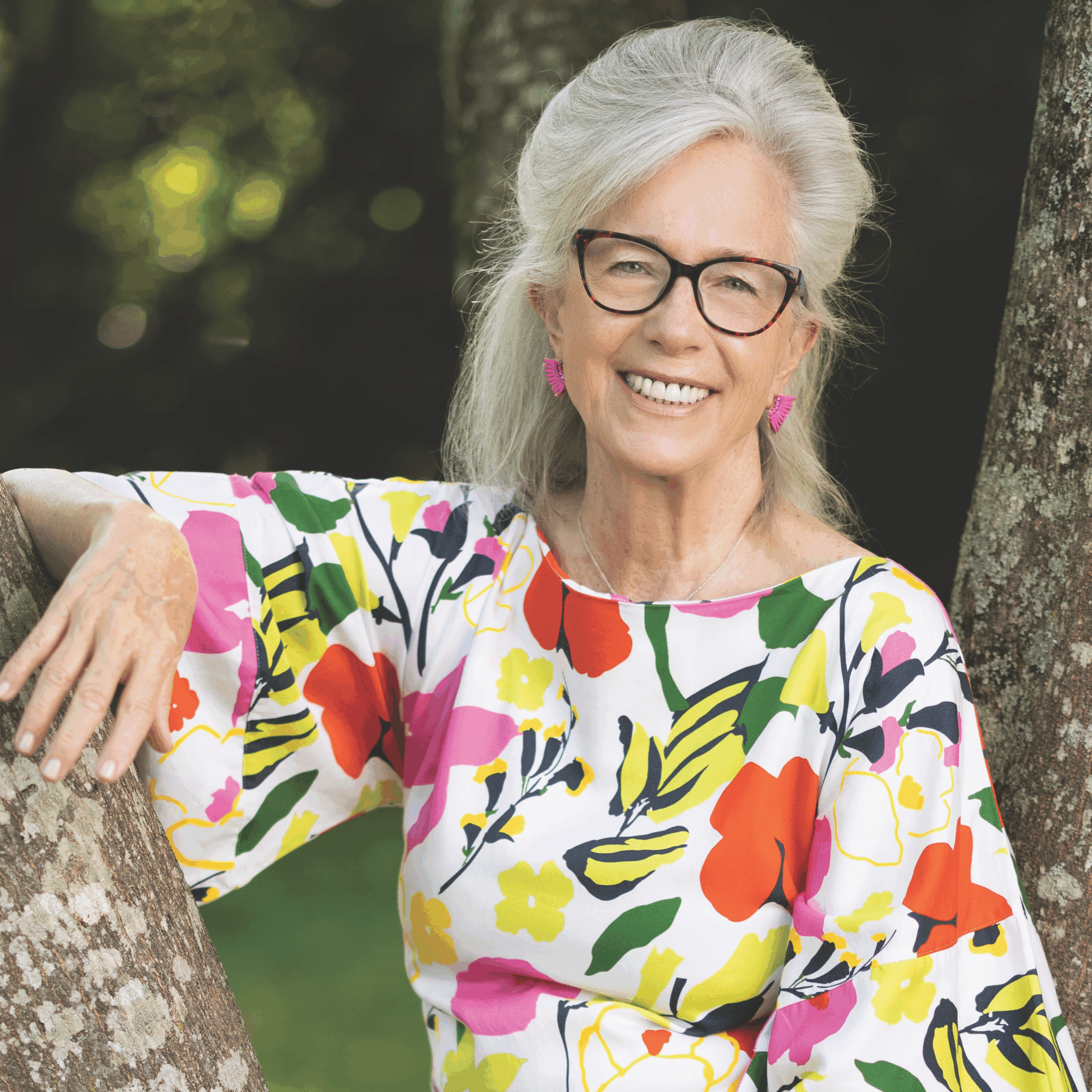
Leigh Cassady is the homeowner behind BH&G’s “Colorful Fun in the Sun.” Read the full house tour.
Leigh Cassady’s personal copy of Cotton Country Cooking.
Recipes for the Ages
Cotton Country Cooking is a celebrated cookbook first published by the Junior League of Morgan County in 1972 and includes several recipes and a photograph of Leigh’s mother, Tolly Shelton. Honoring her family’s North Alabama roots, Leigh keeps a copy of the vintage cookbook on her kitchen counter and still turns to it regularly. “Those old recipes are perfect for the beach,” she says. “The garlic cheese grits are a breakfast requirement. And guests think I’ve lost my mind if I don’t make Pat Sexton’s pimento cheese.”
THE RECIPES
The garlic cheese grits come from Cotton Country Cooking. The pimento cheese is a separate family recipe — see “The Big (Pimento) Cheese,” below.
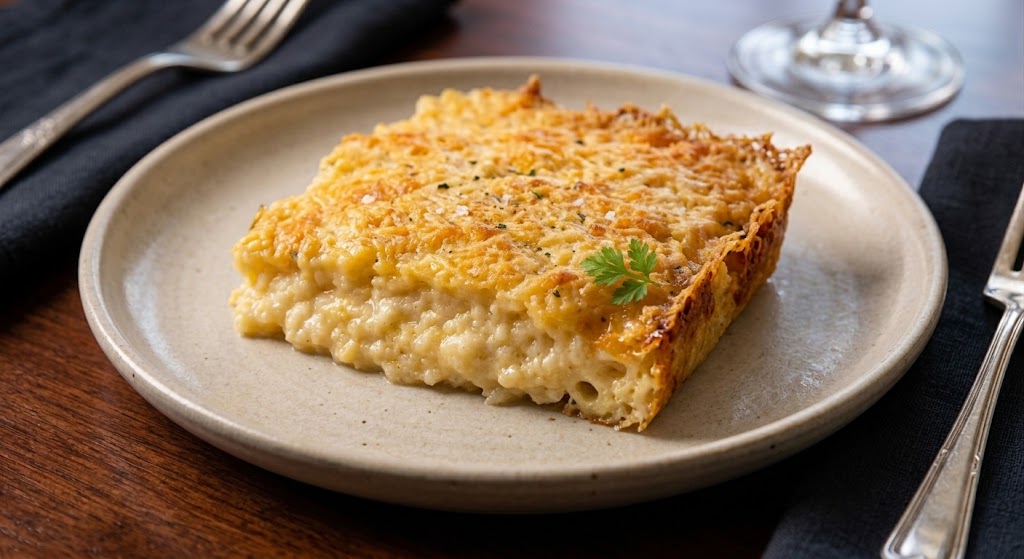
GARLIC CHEESE GRITS
YIELDS 8 to 10
Ingredients
1 cup quick grits
1 teaspoon salt
4 cups water
1 roll garlic cheese, cut up (substitute this with 8 oz. of Kraft Velveeta or cream cheese plus 1/2 to 1 teaspoon of garlic powder)
½ cup butter
½ cup milk
2 eggs beaten
grated cheddar cheese
Directions
Cook grits slowly in 4 cups of salted water.
Add garlic cheese and butter.
Stir in milk and eggs; mix well.
Pour into greased casserole, and bake at 350° for 40 minutes.
Remove from oven, top with grated cheddar cheese, and cook an additional 5 minutes.
PAT SEXTON’S PIMENTO CHEESE
Ingredients
1 block sharp cheddar cheese, finely shredded
1 block Colby cheese, finely shredded (can use pre-shredded bagged cheese for both cheeses)
1 jar chopped pimentos, juice and all
2–3 heaping teaspoons garlic salt
2–3 cups Hellman’s Real Mayonnaise
Directions
Combine all ingredients, mixing well.
Refrigerate 2 hours, and serve with Fritos Scoops.
EMERALD SUNRISE
YIELDS 1 Drink
Ingredients
5 ounces fresh orange juice
1½ ounces tequila
1½ ounces blue Curaçao
Garnishes: mandarin orange slice or orange twist
Directions
Layered Version
Pour the orange juice and tequila into a tall glass, and stir gently.
Place a large straw (like a smoothie straw or a bubble tea straw) into the glass.
Slowly pour the blue Curaçao down the straw so it settles at the bottom (gravity does the layering).
Mixed Version
Combine the orange juice, tequila, and blue Curaçao in a pitcher.
Serve chilled over ice for a bright-green, festive drink perfect for crowds.
*Because many of these heirloom and 1972 cookbook recipes come from historic family notes without original photography, AI visual tools are used to illustrate what the finished dish looks like. These conceptual images serve as a presentation guide while preserving the authentic vintage instructions.