Inside a Mountain Brook Pool House Designed to Match Its Main House

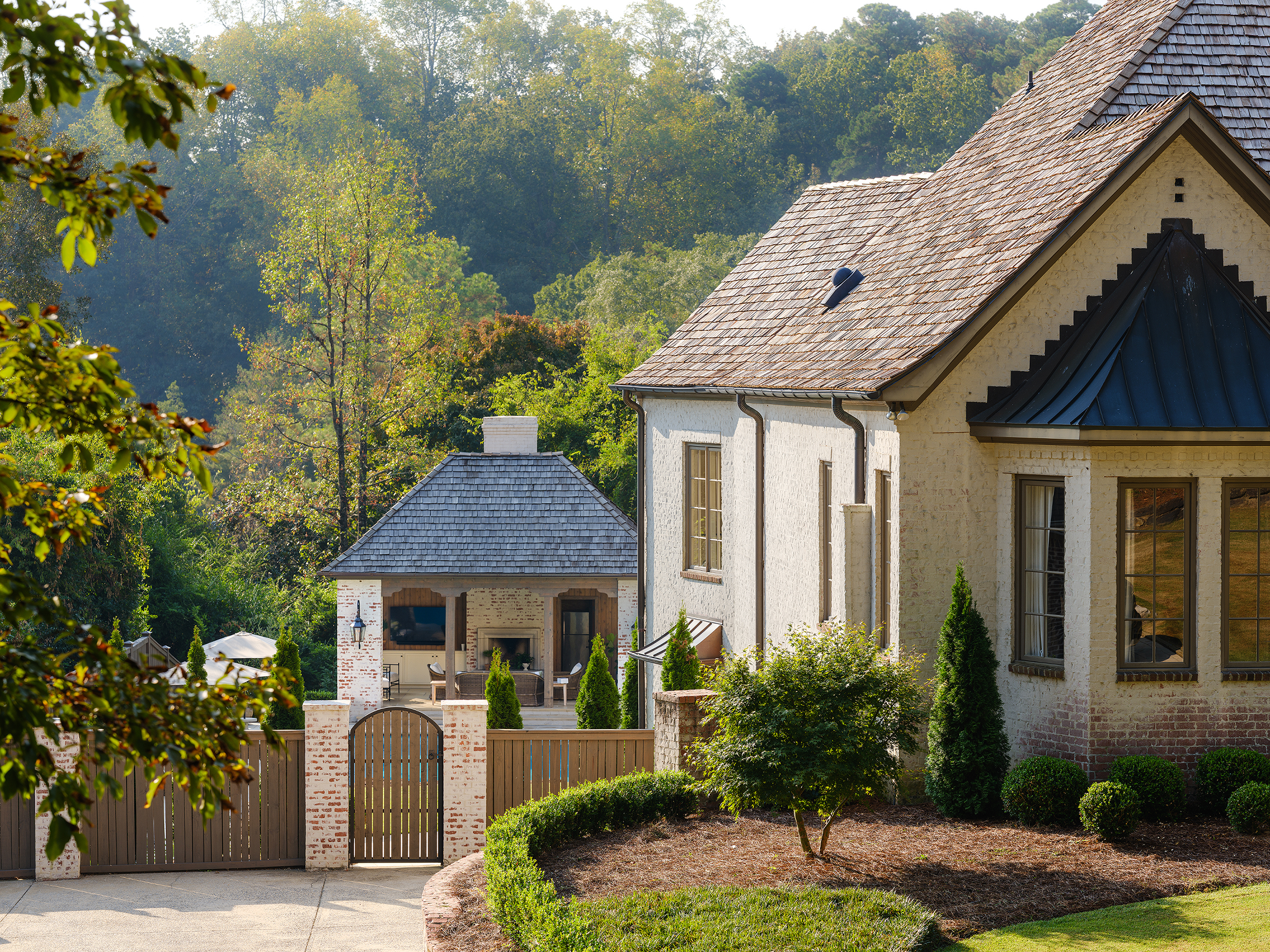
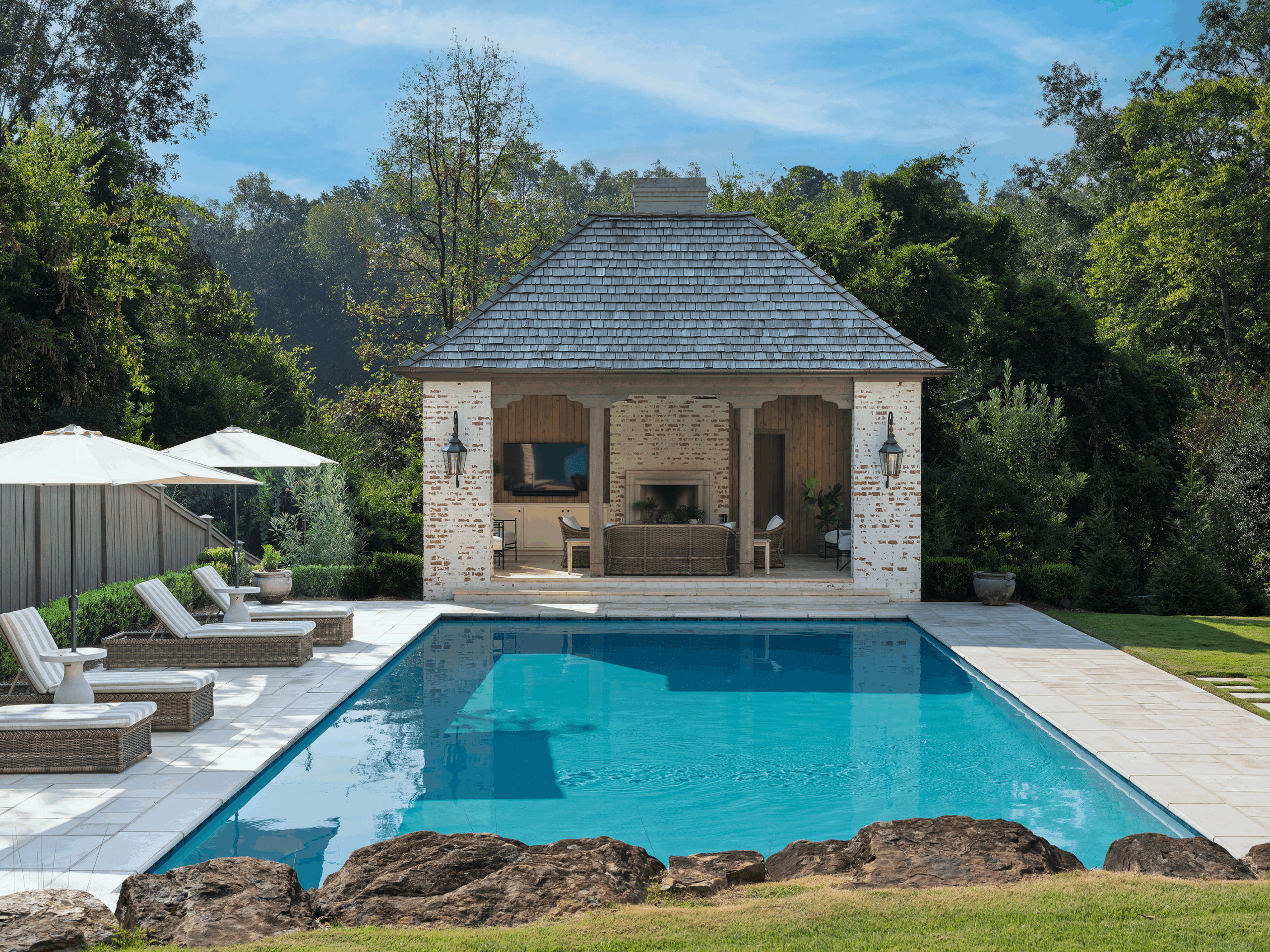
Exterior of a brick pool house with a cedar shake roof beside a swimming pool in Mountain Brook, Alabama, designed by architect David Blackmon.
Brick laid in the same time-honored bond as the main residence rises to meet a roofline of freshly milled cedar shake, its blonde tones still warming toward the silvered patina the years will bring. Photography by: Art Meripol

Clear Reflections

Fitting in yet standing out—that was the goal when architect David Blackmon set about designing a new pool house to enchance a refurbished pool and existing home for Mountain Brook clients. Taking cues from the main house, David worked with Greg Pyburn of Pyburn Building Company to match the brick and roof forms. “The homeowners planned to upgrade the existing home’s asphalt shingle roof to cedar shake, so we specified the roofs to match,” David says. “We kept the form relatively simple to accentuate and enhance the existing architecture.”

Close-up of a cedar shake roof on the Mountain Brook pool house, matching the main home's upgraded roofing material.
David Blackmon built this entire project around a single detail: authentic, hand-split cedar shingles. Fake materials just can’t copy the unique, irregular edges of real wood.
Pool house exterior nestled among mature trees on a wooded residential lot in Mountain Brook, Alabama.
Tucked under a canopy of mature trees, the pool house looks like it has always been part of the Mountain Brook landscape. The building’s simple shape and low-profile let the surrounding woods and the main house take center stage.

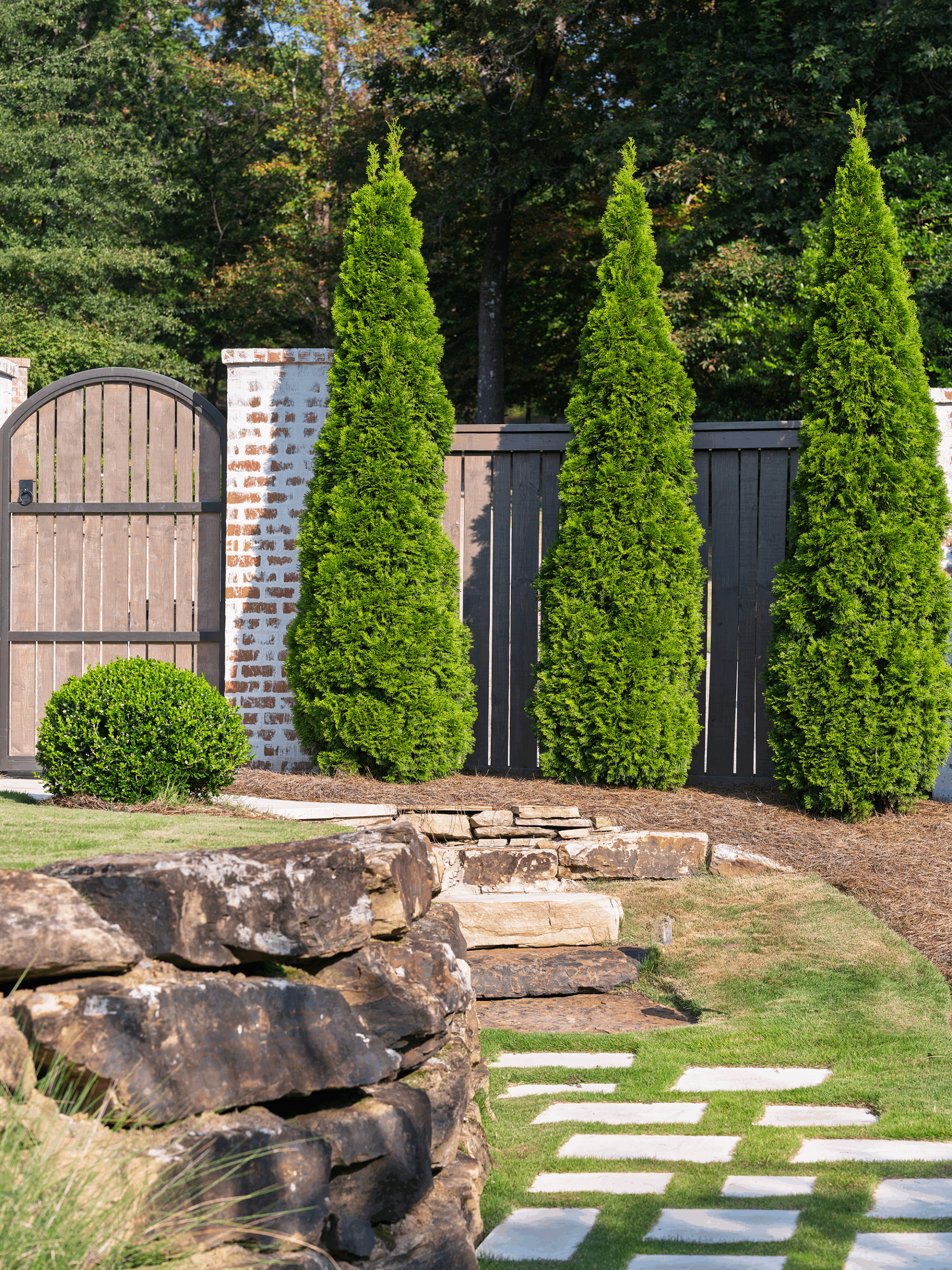
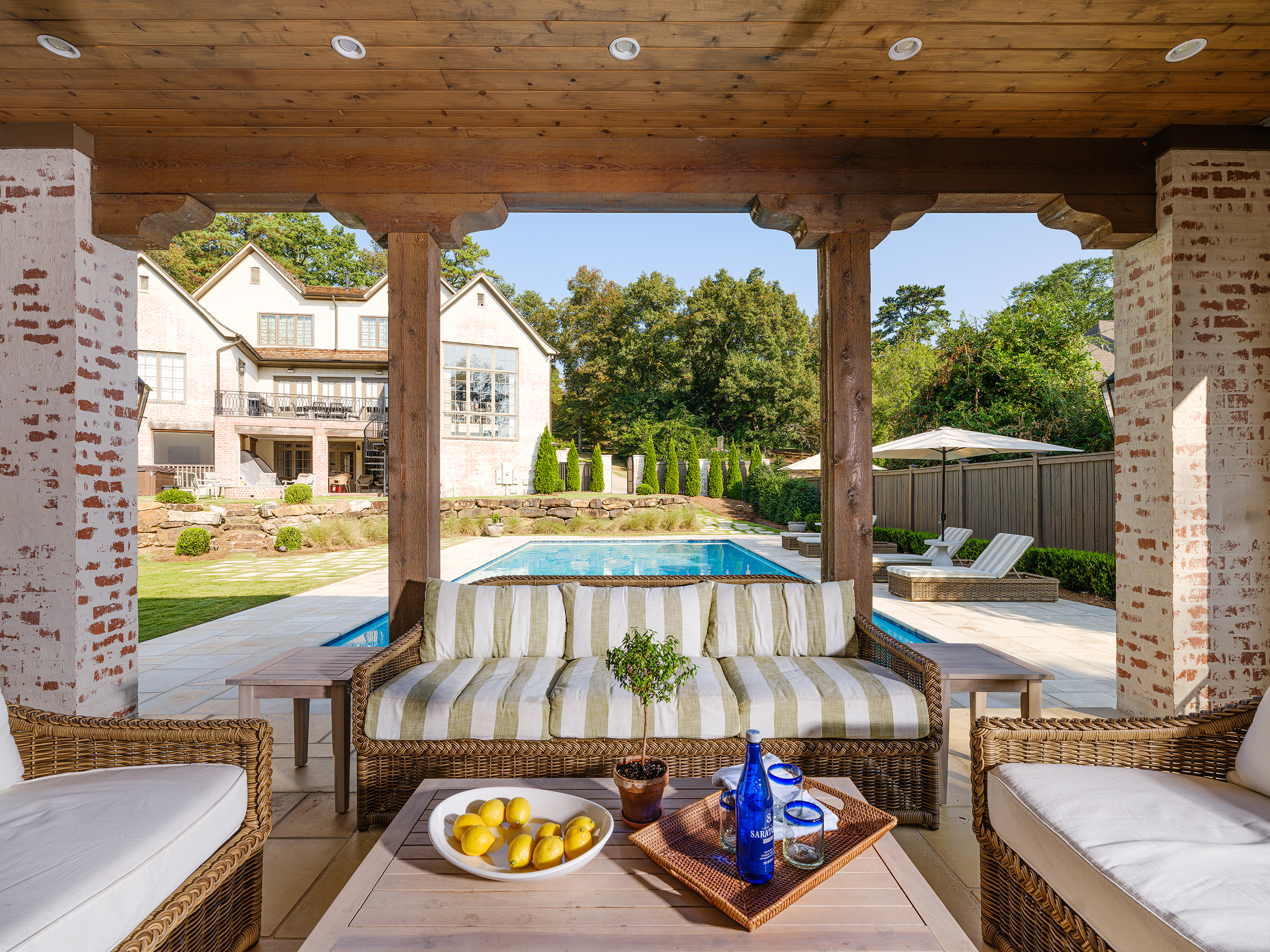
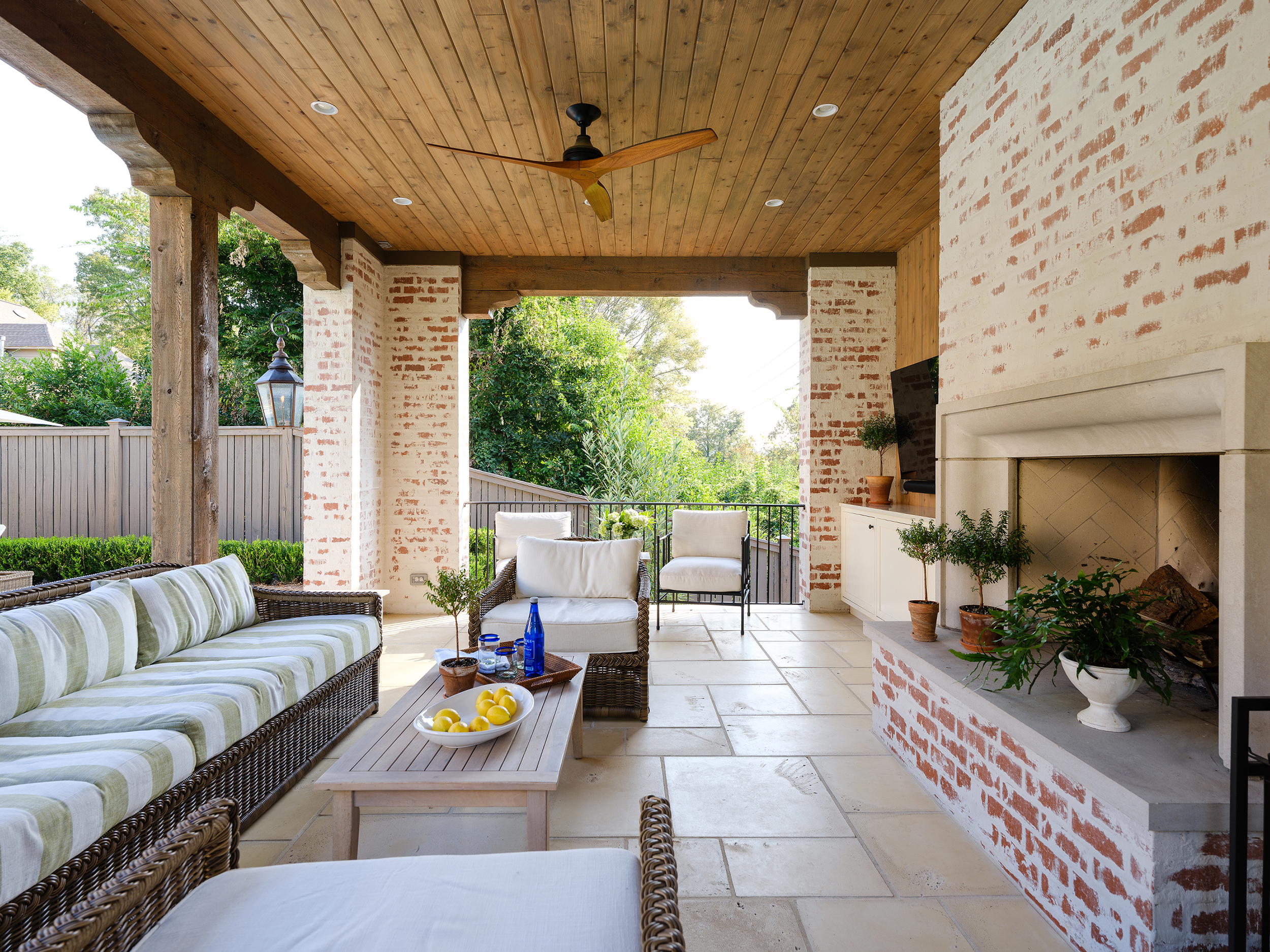
A retreat unto itself, the new pool house offers plenty of indoor/outdoor comforts—a seating area facing a fireplace, cabinet storage with TV above for entertaining, a closet for pool toys, and a full basement that dips down below to store pool equipment. Lounge chairs line up resort style on the pool deck, and landscape architect Paul Lell introduced new plantings to up the style quotient.

Covered outdoor lounge area with seating and a fireplace at the Mountain Brook pool house, overlooking the pool deck.
This shaded outdoor lounge offers the easy comfort of a classic porch. With weatherproof furniture, a cozy fireplace, and direct views of the pool, it’s the ultimate spot to hang out.
Interior of the Mountain Brook pool house showing built-in cabinet storage and a seating area for entertaining.
Built for real life, this pool house is high on function but low on fuss. It includes hidden storage, a TV for hosting watch parties, and worry-free finishes that welcome wet swimsuits and bare feet. Bright, natural light keeps you feeling connected to the water, even from inside.
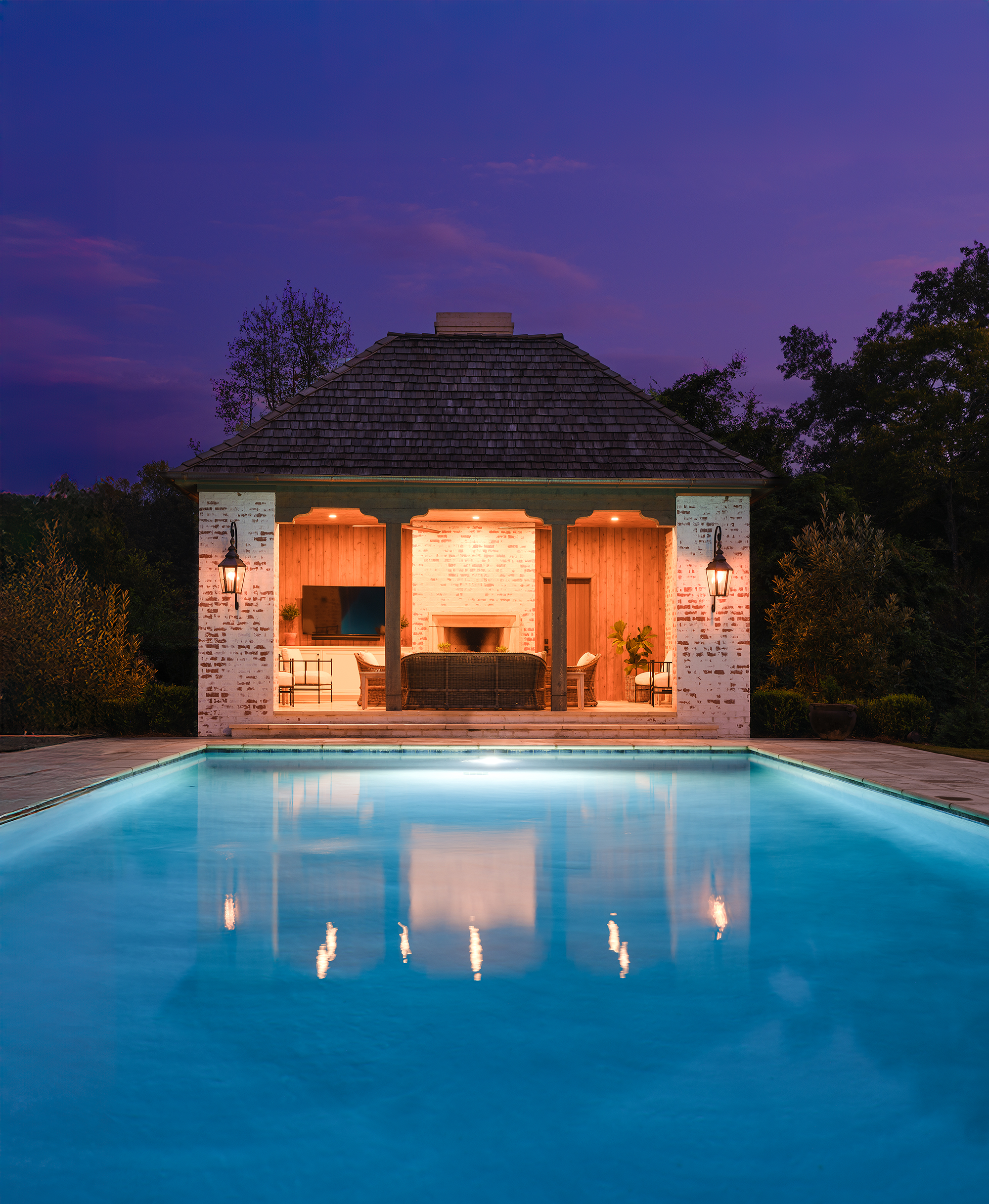
Illuminated swimming pool and pool house at night in Mountain Brook, Alabama, with dramatic landscape lighting.
At night, the mood swings to one of enchantment thanks to the dramatic outdoor lighting.

“In addition to the practicality of using the pool after sunset, we also wanted the lighting to enhance the beautiful view from the main house across the rear lawn and into the valley below,”

-David Blackmon

Resources

Architect: David Blackmon, Blackmon Rogers Architects Builder: Greg Pyburn, Pyburn Building Company Landscape Architect: Paul Lell

- Sponsors -

Finding Home with Mary Catherine Folmar in Athens

The 1929 redbrick Georgian sits just off the Athens, Alabama downtown square — the same block where Mary Catherine Folmar’s grandparents once lived. // Photos by Jean Allsopp.
Fabric designer Mary Catherine Folmar (left) and her mother, Mary Nelle Clem, on the front porch of their historic 1929 Athens home.

Fabric designer and industrial artist Mary Catherine Folmar hasn’t lived in her hometown of Athens, Alabama for years, but with family—and friends that are like family—still in the small town, she finds herself making the drive up I-65 often.

“This isn’t the house I grew up in, but it is still very much home,” says Mary Catherine Folmar of her mama’s house, a 1929 redbrick Georgian just off the Athens, Alabama downtown square where her grandparents used to live.

Longtime dairy farmers, Mary Catherine’s grandparents relocated to Athens after they retired from farm life, but they brought their quietly elegant way of life with them—something that Mary Catherine and her mom, Mary Nelle Clem, continue to hone and enjoy.

“My grandparents didn’t move into this house until I was in college, but it’s where I would find myself on weekends and holidays when I returned home,” Mary Catherine says. “It’s also where my husband, Tyler, and I had our wedding reception.”

It’s certainly an easy house to come home to—and it’s a festive venue for hosting both local get-togethers, book signings, and parties through Mary Catherine’s partnership with Lydia Menzies Supper Club. The house lends itself to outdoor entertaining on the front porch, lawn, and backyard—a recently landscaped addition by garden designer Troy Rhone.

A recently landscaped backyard by garden designer Troy Rhone connects the main house to the kitchen house, now converted into a guest suite.

Inside, Mary Nelle welcomes her daughter’s eye for keeping her style in the present through fresh takes on historical patterns, color, and a mix of furniture eras and styles both inherited, new, and sourced or thrifted, along with items from her mom’s former business, one of the first Colonial Williamsburg gift boutiques.

In typical Georgian style, the home opens onto a grand foyer and stair hall. “It’s a traditional, wide foyer that catches cross breezes from windows in the adjacent living and dining room and through to the back door,” Mary Catherine says.

“Growing up, my mom introduced me to beautiful table settings, the allure of historical design—and especially a love of Colonial Williamsburg, Virginia,” says Mary Catherine of the place her family would visit often on vacation. Her mom’s talents, combined with her early introduction to the decorative arts, heavily influence Mary Catherine’s fabric and design business, Cotton & Quill, with many of her creations on display in Mary Nelle’s house.

The dining room mural, designed by Mary Catherine Folmar of Cotton & Quill, takes its cues from damaged wall panels recovered from a nearby estate.

Mary Catherine’s designs dress upholstery, window drapery, and walls through both custom designs and items she carries in her product lines. For instance, in the dining room, Mary Nelle asked her daughter for help with a mural. Taking cues from damaged wall panels she culled from the attic of an estate down the street, Mary Catherine nodded to the original paper’s historical scenes while customizing it with personal landmarks such as the church in Athens where she grew up.

In the kitchen, Mary Catherine replicated a wallpaper that hung in her grandparents’ home. Working from a tiny scrap (now framed) and a wedding photograph, she used her talents to bring the vintage paper back to life in a fresh way.

In the kitchen, Mary Catherine replicated a wallpaper that hung in her grandparents’ home. Working from a tiny scrap (now framed and hanging on the door) and a wedding photograph, she used her talents to bring the vintage paper back to life in a fresh way.

Elsewhere in the house, cross-stitched samplers and needlepoints—some found, others half-completed until they fell into Mary Nelle’s hands—Staffordshire figurines, and an enviable china collection bring interest to cupboards, shelves, and walls. “Everything here has a story,” says Mary Catherine. “Some may be older than others, but everything has a narrative behind it.”

Cupboards and shelves throughout the house hold cross-stitched samplers, needlepoints, Staffordshire figurines, and an enviable china collection — each piece with a provenance.
The primary bedroom strikes a flawless chord between historical reverence and fresh, romantic vitality.

Mary Catherine Folmar | Cotton & Quill

In addition to fabric and wallpaper designs, Mary Catherine’s creative reach extends to tabletop items, topiary forms, caftans, still life cloches with found objects, and a collection of fabulous finds.

For more about her workshops, events, or products, visit cottonquill.com.


This story appears in the July/August 2026 issue of Birmingham Home & Garden. Subscribe here.

Resources

Interior Design: Mary Catherine Folmar Garden Design: Troy Rhone Florals: Matthew Jimmerson with Athen’s Florist

- Sponsors -

Before You Fall in Love with That Faucet: Expert Advice from Birmingham’s Kitchen & Bath Pros 

Whether you’re building your dream home from the ground up or finally tackling that long-awaited renovation, selecting kitchen and bath fixtures is often one of the most exciting parts of the process. It’s also one of the easiest places to feel overwhelmed.

With endless inspiration on social media and thousands of products available online, homeowners often arrive at the selection stage with a folder full of beautiful images—but without a clear understanding of how those choices will function in everyday life.

At GLS Supply Kitchen & Bath Showroom in Birmingham, our consultants work with Birmingham-area homeowners, builders, and designers every day. Over the years, we’ve noticed a few pieces of advice that can save homeowners time, money, and a lot of unnecessary stress.

1. Don’t choose fixtures last.

Many homeowners assume faucets, sinks, tubs, and shower components are finishing touches that can be selected near the end of a project. In reality, these decisions affect everything from plumbing rough-ins to cabinetry layouts and countertop fabrication.

Making selections early helps avoid expensive change orders, installation delays, and compromises that happen when a favorite product simply won’t work with decisions that have already been made.

2. Bring your samples with you.

One of the greatest advantages of visiting a showroom is seeing products in person. But you’ll get even more out of the experience if you bring along cabinet door samples, countertop selections, paint colors, flooring, or tile.

A finish that looks perfect under your phone screen may look entirely different next to the warm oak cabinetry you chose months ago. Seeing materials together allows you to create a cohesive look and feel confident in your decisions.

3. Think about how you actually live.

The most beautiful fixture isn’t always the right fixture.

Do you cook dinner every night for a busy family? A deep workstation sink and touch-activated faucet might make daily life easier. Do you love to entertain? Consider beverage stations or prep sinks that improve functionality.

In the bathroom, ask yourself whether you’ll realistically use that oversized soaking tub—or if a larger shower with thoughtful features would better suit your lifestyle.

Designing for real life often leads to spaces that are both more beautiful and more enjoyable to use.

4. Invest in the things you touch every day.

Homeowners naturally want to stay within budget, and not every element of a renovation requires a splurge. But kitchen and bath fixtures are among the most frequently used items in your home.

A quality faucet, dependable shower system, or well-crafted sink can offer better performance, durability, and long-term satisfaction than less expensive alternatives.

The goal isn’t necessarily to spend more—it’s to invest wisely where it matters most.

5. Don’t rely solely on online photos.

Online inspiration is wonderful for discovering ideas, but it rarely tells the whole story.

The weight of a faucet handle, the scale of a sink, the texture of a finish, and the quality of craftsmanship are details best experienced firsthand. What appears brushed gold on one screen may look entirely different in person.

Seeing products displayed in thoughtfully designed vignettes also helps homeowners visualize how selections will work together in a finished space.

6. Ask questions. That’s what the experts are here for.

Perhaps the most important advice of all: you don’t have to navigate the process alone.

A knowledgeable showroom consultant can help coordinate finishes, explain the differences between products, identify potential challenges before they become problems, and guide you toward selections that align with your budget and lifestyle.

The result isn’t just a prettier kitchen or bathroom—it’s a smoother experience and greater confidence in every decision you make.

In the end, creating a home you love isn’t about choosing the trendiest faucet or recreating an image from social media. It’s about selecting products that reflect the way you live, support the moments that matter most, and stand the test of time.

And sometimes, the smartest first step is simply walking into a showroom before you fall in love with that faucet.

- Sponsors -

Zinnias Make the Cut

Source: Dreamstime

Zinnias are natural pollinator magnets. Bees crowd their golden centers while swallowtail butterflies drift lazily between blooms. A simple row along a vegetable garden can suddenly turn an ordinary backyard into a lively summer habitat.

Zinnias for Beginners

No matter your experience level, there is a zinnia suited to your garden. The varieties below represent the best of what the genus has to offer — from tried-and-true heirlooms to modern hybrids bred for the demands of a Southern summer.

Benary’s Giant

Large, fully double blooms on strong, extra-long stems.

Oklahoma Series

Long-lasting, medium-sized, double powder-puff-style blooms.

State Fair Mix

Heirloom plants with large, dahlia-sized blooms.

Cut-and-Come-Again

Productive and dependable. The more they are cut, the more they bush out and bloom.

Queeny Series

Dusty, muted, and sophisticated tones — lime green, blush, peach, and deep red.

Uproar Rose

Produces extra-large, double magenta-rose blooms.

Zahara Series

Strong disease resistance. Comes in vibrant, high-impact colors — Starlight Rose, Double Cherry, Double Fire, and various mixed shades.

These blooms do not merely survive Alabama summers — they celebrate them.

If you are missing summer color in your garden, it’s not too late to plant the ever-cheerful zinnia — yes, even from seed. In much of Alabama, gardeners can continue sowing zinnias through late July and even early August for fall flowers.

Zinnias are a longtime favorite for gardeners who want dependable color through the hottest months of the year. They grow easily, repeat their blooms, and stand tall even when the thermometer pushes past 90 degrees. Unlike more fragile bloomers that fade in midsummer, zinnias often look their best during the warmest stretch of the season. They ask for little more than full sun, decent airflow, and occasional watering at the roots.

A July sowing often avoids some of the spring disease pressure as well. By late summer, many gardeners find their zinnias actually look fresher and healthier than earlier plantings.


Continue Reading

Top Summer Blooms

Hot Tips for Summer Pollinator Gardens

10 Essential Native Plants for Your Alabama Garden

- Sponsors -

Modern Mood, Southern Warmth

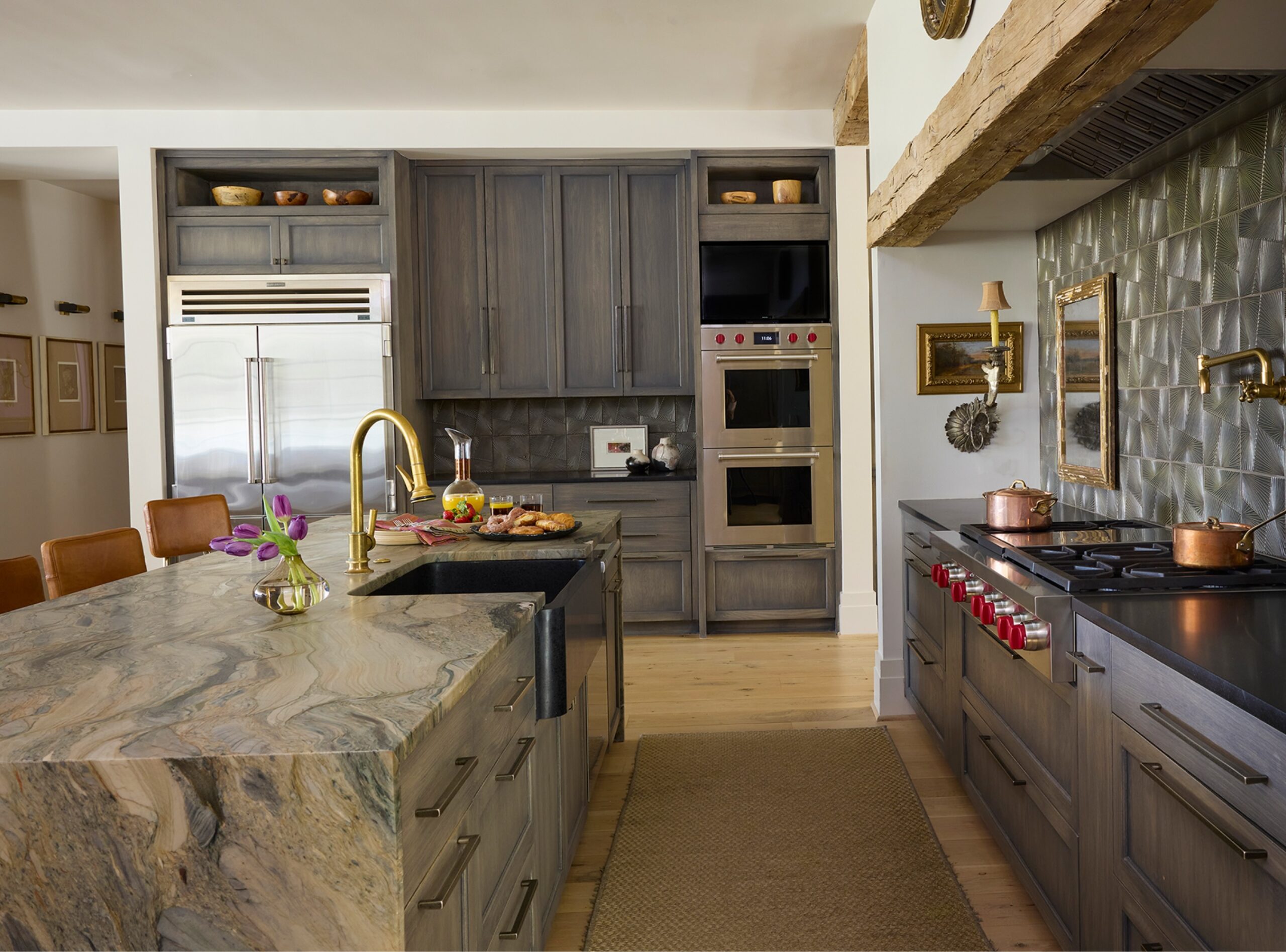
The materials gave the kitchen warmth and character, but it’s the overall design plan—developed alongside R. Cherri Pitts of Studio C Architecture & Interiors—that makes everything feel so naturally connected. Rather than treating it as a standalone room, the layout allows the space to sit seamlessly between the living room and adjoining salon.

The range wall acts as an anchor for the kitchen, while storage and tucked-away niches keep the space streamlined and open—especially without the presence of upper cabinetry. The refrigerator and ovens are intentionally positioned to allow for easy movement throughout the room. // Photography by: Jean Allsopp

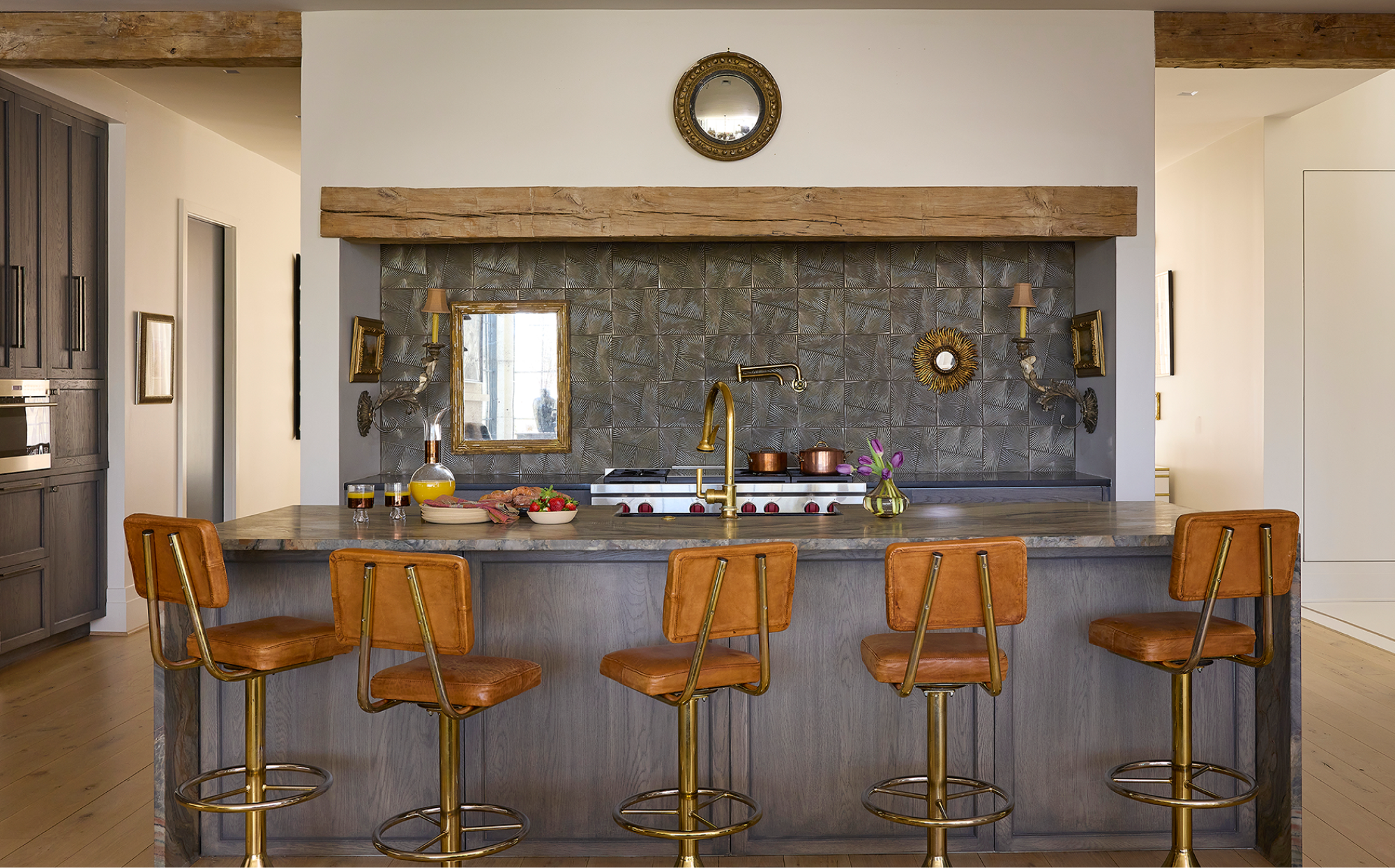
The expansive island creates a central place to gather. Underneath the oval opening to the salon, a dedicated bar creates an easy in-between moment. “I feel like my design style always has a little twist somewhere,” Home owner and designer Rebecca Hawkins says. “This kitchen feels really different, and I love that about it. It’s where we spend most of our time, and it just feels comfortable.”

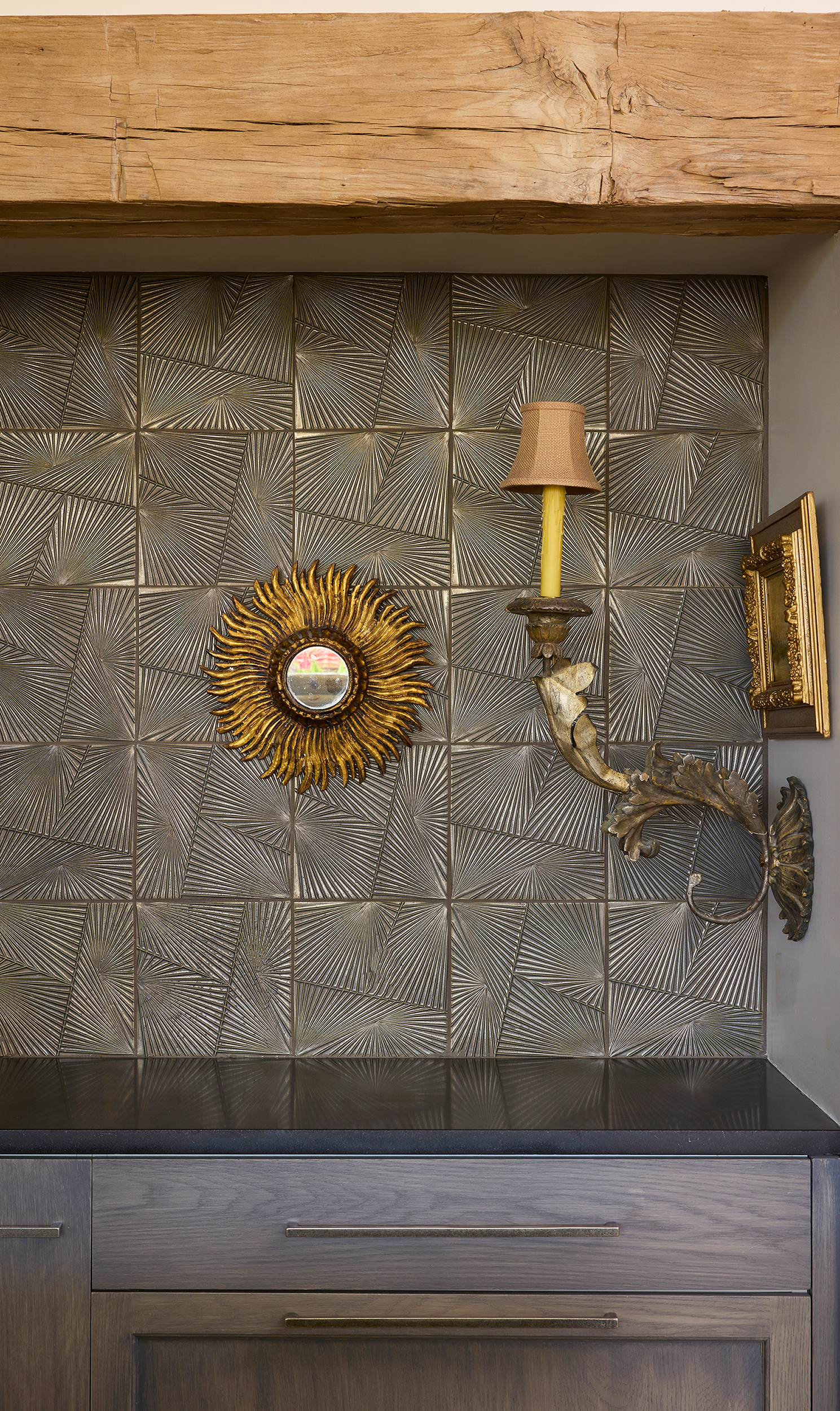
The range wall is layered with antiques—a gilt mirror, silver-leaf sconce, and framed oil painting—that sit directly against the Kelly Wearstler backsplash tile. A wood beam conceals the vent hood above the Wolf range.
At the bar, lived-in finishes continue the kitchen’s earthy palette. Hardware from Brandino Brass in a soft gray patina offers a continuum with cabinetry, while a soapstone sink and faucet from Fixtures & Finishes introduce a moodier contrast along with the stone countertops.

“We wanted the kitchen to feel like the heart of the home rather than something isolated, and it functions beautifully—there’s something really effortless and gracious about the way it all flows together.”

— Cherri Pitts, Studio C Architecture & Interiors

Cherri Pitts

Why We Love It | What Makes This Kitchen Work

A Collected, Not Constructed, Feel

Nothing in the kitchen feels overly designed—it feels assembled over time, even though it’s brand new. The mix of old-world antiques and modern elements gives the kitchen lived-in character.

Natural Materials that Age Beautifully

A palette grounded in quartzite, granite, wood, and unlacquered brass gives the space an immediate sense of permanence, but also something that patinas beautifully over time.

Entertaining Without Effort

The space easily accommodates a full house without ever feeling formal. Whether it’s drinks at the bar, family gathered at the island, or guests drifting between rooms, the kitchen supports entertaining in a way that’s easy and unforced.

Also from This Home

Inside Rebecca Hawkins’s Moodier, Earthier Mountain Brook Kitchen

Resources

Co-designers: Rebecca Hawkins and Cherri Pitts, Studio C Architecture Countertops (Island & Perimeter): Cottage Supply Company Custom cabinetry: MDM Design Studio Appliances: AllSouth Appliance Backsplash tile design: Kelly Wearstler Dining table & bongo stools: Circa Interiors & Antiques Island stools: Lolo French Antiques

- Sponsors -

How Rebecca Hawkins and Cherri Pitts Designed Birmingham’s Favorite Kitchen

Rebecca Hawkins' Kitchen
Just off the kitchen, a painted table and bongo stools from Circa Interiors & Antiques create a separate dining area.
Rebecca Hawkins' Kitchen
Rebecca Hawkins

The Anti-White Kitchen

When Rebecca and Allen Hawkins began designing their new-build in Mountain Brook, Rebecca knew it was a prime opportunity to do something different. Though she loved the bright white kitchen in her previous abode, this time around she was ready to take a different approach—one that felt bolder, warmer, and more connected to the natural surroundings just outside her windows.

“I felt the pull to go with earthy tones,” she explains. “The more I looked and gathered inspiration, the clearer it became that this was the direction I wanted to take—it just felt like the natural choice for how the space should come together.”

Rebecca Hawkins' Kitchen
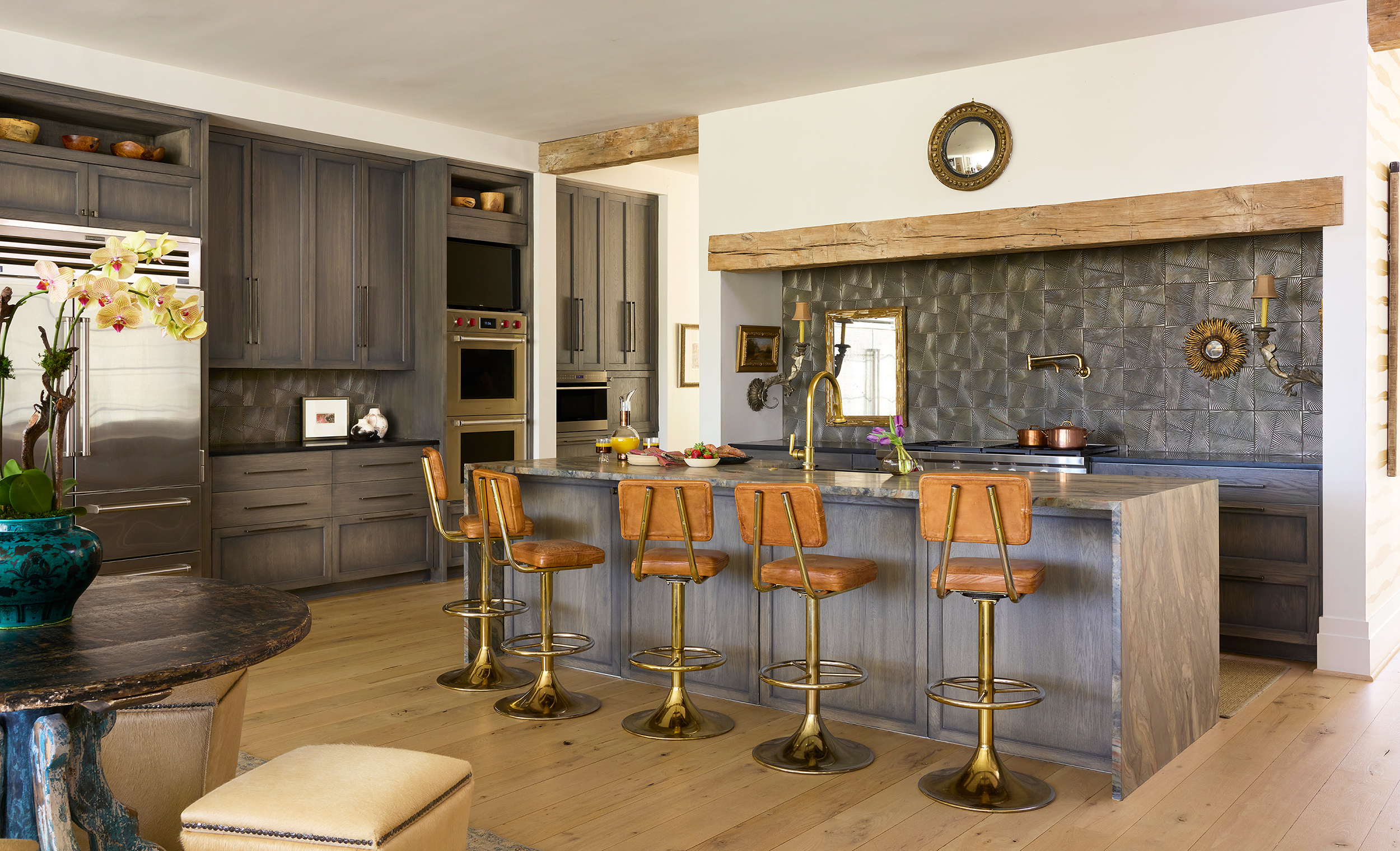
Low-profile stools from Lolo French Antiques keep sight lines open. The decision to skip pendants above the island preserves the kitchen’s unfussy feel. 

Effortless Layers

Rebecca knew it was meant to be when the pieces started falling into place almost effortlessly, beginning with quartzite from Cottage Supply for the waterfall-edged island. From there, she layered in finishes that naturally built on that design and added more depth and movement, including a textured Kelly Wearstler backsplash tile, black granite countertops (also from Cottage Supply) for the perimeter countertops, and a wooden beam in place of a vent hood.

Rebecca Hawkins' Kitchen
The textured Kelly Wearstler backsplash tile anchors the range wall. Antique mirrors and silver-leaf sconces lean directly against the field tile, giving the wall its collected, assembled-over-time character.

A Soft Approach

With those elements working in sync, the custom cabinetry from MDM Design Studio followed, which Rebecca had stained a soft gray with a hint of green. “It felt right to let the cabinetry blend with the backsplash,” she says. “It keeps the look natural and really grounds the space.”

Rebecca Hawkins' Kitchen
Sub-Zero and Wolf appliances from AllSouth Appliance blend seamlessly into the kitchen’s soft gray cabinetry and natural materials. The range hood is concealed beneath a wood beam, while touches like the waterfall-edge island and gooseneck faucet keep the space feeling modern.

Rebecca’s Top 3 Kitchen Essentials

01 Smart Drawer Storage

Storage isn’t just about capacity—it’s about ease. “I love having deep drawers to hold pots and pans and also bowls and plates, and it’s easier to get in and out of a drawer than a higher cabinet.” Rebecca also recommends smaller drawers for spices and cooking essentials near the stove.

02 Island Seating

Barstools at the island turn the kitchen into an easy gathering place, keeping family and friends right in the middle of the action.

03 Layered Task Lighting

Discreet under-cabinet lighting enhances everyday tasks while maintaining a clean, uninterrupted design, allowing the materials and finishes to stay front and center.

Presented by

Also from This Home


Discover how Cherri Pitts of Studio C Architecture & Interiors designed this space to flow seamlessly between the living room and salon.

Resources

Co-designers: Rebecca Hawkins and Cherri Pitts, Studio C Architecture Countertops (Island & Perimeter): Cottage Supply Company Custom cabinetry: MDM Design Studio Appliances: AllSouth Appliance Backsplash tile design: Kelly Wearstler Dining table & bongo stools: Circa Interiors & Antiques Island stools: Lolo French Antiques

- Sponsors -

How to Entertain Like a Southerner with Mary Catherine Folmar

The 1776 napkins, Cotton & Quill design, say everything that needs to be said about how Mary Nelle Clem entertains: with things that have a history, on a table that has seen a few hundred summers. // Photos by Jean Allsopp.

“This isn’t the house, I grew up in, but it is still very much home,” says Mary Catherine Folmar of her mama’s house, a 1929 redbrick Georgian just off the Athens, Alabama, downtown square where her grandparents used to live.

The exterior of the 1929 Georgian, recently updated, offers front porch, lawn, and backyard spaces for entertaining.

The house lends itself to outdoor entertaining on the front porch, lawn, and backyard — a recently landscaped addition by garden designer Troy Rhone. It’s certainly an easy house to come home to, and a festive venue for hosting both local get-togethers, book signings, and parties through Mary Catherine Folmar’s partnership with Lydia Menzies Supper Club.

The entertaining sensibility here traces back directly to Mary Catherine’s grandmother. Longtime dairy farmers, her grandparents relocated to Athens after they retired from farm life, but they brought their quietly elegant way of life with them — something that Mary Catherine and her mom, Mary Nelle Clem, continue to hone and enjoy.

A recently landscaped backyard by garden designer Troy Rhone with ‘Victory Garden’ connects the main house to the kitchen house, now converted into a guest suite.

“Growing up, my mom introduced me to beautiful table settings, the allure of historical design—and especially a love of Colonial Williamsburg, Virginia.”

– Mary Catherine Folmar

The world’s largest living history museum, Colonial Williamsburg, where Mary Catherine and her family would visit often on vacation offered her an immersive look at 18th-century decorative arts. This allure shines through in the way Mary Catherine’s table is set, the objects she chooses, and the ease with which the house welcomes people in.

The dining room houses Mary Catherine’s great- grandmother’s dining table and chairs. The mirror and chandelier belong to Mary Nelle. The lamps on the sideboard are an estate sale find. The floral arrangement was created by friend and floral designer Matthew Jimmerson with Athen’s Florist. Mary Nelle picked the Queen Anne’s Lace and Thistle for Matthew to integrate into the mix.

Mary Catherine Folmar | Cotton & Quill

For more about her workshops, events, or products, visit cottonquill.com.

Mary Catherine Folmar and Mary Nelle Clem enjoy a shared love of entertaining and design.

This story appears in the July/August 2026 issue of Birmingham Home & Garden. To see more inside the house subscribe here.

Resources

Interior Design: Mary Catherine Folmar Garden Design: Troy Rhone Florals: Matthew Jimmerson with Athen’s Florist

- Sponsors -

Luxury That Actually Improves Daily Living

The kitchen and bath features homeowners love long after the remodel is finished.

Luxury kitchen and bath design features

Luxury in today’s home is shifting. It’s no longer just about creating a beautiful space, it’s about creating a home that functions better for everyday life. The features homeowners end up appreciating the most are often the ones that make mornings smoother, entertaining easier, and daily routines more comfortable.

In kitchens and baths especially, thoughtful upgrades can completely change how a space feels and functions long after the excitement of the renovation is over.

Here are some of the luxury features homeowners say they use, and love, every single day.

Steam Showers That Create a Spa Experience at Home

Bathrooms are becoming more than functional spaces. More homeowners are transforming them into places to relax and recharge, and steam showers continue to grow in popularity for that reason.

Beyond the luxury feel, steam showers can help create a calming, spa-like experience right at home. Many homeowners incorporate features like multiple shower heads, handheld sprays, built-in benches, and digital controls to customize their experience and turn an ordinary shower into a true retreat.

Workstation Sinks That Make Kitchens More Functional

One of the most practical luxury upgrades in today’s kitchen is the workstation sink. Designed with built-in accessories like cutting boards, drying racks, and prep bowls, these sinks maximize both efficiency and workspace.

For busy families or homeowners who love to cook and entertain, workstation sinks help simplify meal prep and cleanup while keeping countertops less cluttered. It’s one of those features homeowners often wish they had added sooner.

Pot Fillers That Add Everyday Convenience

Pot fillers have become one of the most requested kitchen upgrades in recent years, and for good reason. Mounted directly above the cooktop, they eliminate the need to carry heavy pots of water from the sink across the kitchen.

While they may seem like a small addition, homeowners quickly realize how convenient they become during everyday cooking, especially in larger kitchens.

Smart Faucets and Touch Technology

Hands-free and touch-activated faucets continue to gain popularity because they simply make life easier. Whether cooking with messy hands or multitasking during cleanup, touch technology adds convenience while also helping reduce the spread of germs in busy kitchens.

Many homeowners are also drawn to newer faucet designs that combine advanced functionality with beautiful finishes and timeless style.

Layered Shower Systems That Feel Like a Luxury Hotel

Today’s primary bathrooms often feature more than just a standard shower head. Homeowners are increasingly choosing layered shower systems that may include rain heads, body sprays, handheld showers, and thermostatic controls for a more customized experience.

These upgrades not only create a more luxurious daily routine, but they also add comfort and flexibility for homeowners of all ages.

Bidets and Washlets Becoming Mainstream

Once considered a niche luxury feature, bidets and washlets have quickly become one of the most appreciated bathroom upgrades. Homeowners who install them often say they would never go back.

With features like heated seats, warm water cleansing, night lights, and adjustable settings, today’s washlets offer comfort, hygiene, and convenience that many homeowners now consider essential.

Luxury That Lasts Beyond Trends

The best luxury upgrades are the ones that continue improving daily life long after the renovation is complete. While beautiful finishes and design trends will always evolve, features that add comfort, convenience, and functionality tend to have lasting value.

As homeowners continue investing in kitchens and baths that support the way they truly live, luxury is becoming less about excess, and more about thoughtful design that makes every day better.

Visit Kitchen & Bath Showroom

- Sponsors -

Why So Many Successful People Feel Overwhelmed at Home

The Secret Stress of the Successful Homeowner

Here is a particular irony many successful homeowners share, though few say it out loud. They manage complex careers, full family schedules and busy social lives with remarkable competence. Yet at home, behind beautifully designed façades, they feel quietly outmatched by their own spaces.

Closets that never quite reset. Kitchens that feel scattered by midweek. Rooms meant to restore energy that somehow do the opposite.

This experience is far more common than most people realize, and it has very little to do with discipline, taste or effort.

The Science of Clutter: What It Does to Your Brain

Environmental psychology has long shown that our surroundings shape how we think and feel. A well-known UCLA study found that individuals who described their homes as cluttered experienced higher levels of cortisol, the body’s primary stress hormone. Neuroscientists at Princeton discovered that visual clutter competes for attention, making it harder to focus and process information.

Simply put, when a home feels chaotic, the mind rarely feels calm.

Still, the instinctive response for many high-achieving adults is self-blame.

“If I just had a free weekend.”

“If I were more organized.”

“If I finally dealt with that closet.”

But here is the truth most people are relieved to hear: the problem is rarely personal.

Why Modern Houses Fail Modern Families

Modern life has evolved faster than the homes we live in. Many houses were designed decades ago, when wardrobes were smaller, work stayed at the office and storage needs were far simpler.

Today’s homes must accommodate:

  • Hybrid work
  • Athletic gear
  • Seasonal décor
  • Expanding families
  • The emotional complexity of objects that represent memory, identity and aspiration.

Decision Fatigue and the Cost of Lost Time

Then there is decision fatigue, an often-overlooked contributor to household stress. Disorganized spaces quietly demand choices all day long. What to wear. Where something lives. Whether to keep, donate or “decide later.” Those small decisions accumulate, draining mental energy before the day has truly begun.

The National Association of Professional Organizers estimates that people can spend up to an hour each day searching for misplaced items. That time loss is not about inefficiency. It is about friction built into the environment.

Clutter also carries emotional weight. Belongings are rarely neutral. They represent milestones, relationships, guilt, optimism and sometimes unresolved chapters. Organizing them is not simply a physical task. It is a psychological one. Without clear systems, it can feel overwhelming enough to postpone indefinitely.

Why Quick Fixes Fail (And What Actually Works)

This is why quick fixes so often fail. A weekend purge may offer temporary relief, but without thoughtful structure, disorder quietly returns. Organization that lasts is not powered by willpower. It is powered by design.

True organization is less about labels and more about flow. It reduces decisions instead of creating them. It supports routines rather than interrupting them. It adapts as life changes, instead of demanding constant catch-up.

The True Value of an Organized Home

When a home is properly organized, the shift is subtle but unmistakable. Mornings feel calmer. Evenings feel more restorative. Closets stop negotiating. Kitchens regain their rhythm. The mental background noise softens.

Importantly, an organized home does not mean a sterile or perfect one. It means a space that understands how you live. One that anticipates your habits, respects your time and quietly works in the background. Like good design, it should feel almost invisible when done well.

For many homeowners, the greatest relief comes not from achieving order once, but from knowing it can be maintained without constant effort. Systems that are thoughtfully designed and gently supported over time allow people to focus less on managing their homes and more on living in them.

Redefining Order: It’s About Ease, Not Control

Feeling overwhelmed by your home is not a personal failure. It is a very human response to living fully in spaces that were never designed to keep up with modern life.

Order, when done with intention, is not about control.

It is about ease. It is about clarity. And ultimately, it is about creating a home that gives back as much as it takes.


Sponsored by Space Cadets. Discover Orbit 365, a yearlong approach to home organization that addresses 12 spaces over 12 months for a complete home transformation. Learn more at https://www.spacecadetsorg.com/orbit365

- Sponsors -

Sumner Starling Designs the Rooms She’d Always Wanted

Ashley’s dream list included a private reading room off the primary bedroom painted in a cheerful green (Farrow & Ball ‘Yeabridge Green’) with a fretwork Thibaut wallpaper on the ceiling. // Photography by Jean Allsopp, Styling by Morgan Stephenson

Designing Out of the Comfort Zone

With the plans secured, Ashley (still in Houston) started talking shop with Sumner and revealed her love of jewel tones. While Sumner is known for quieter palettes with punches of color, neither client nor designer saw that as a problem. “It was so fun to get out of my comfort zone a bit, and we both pushed each other,” says Sumner. “We had a great rapport. You will see jewel shades throughout and especially Ashley’s favorite amethyst.” Adds her client, “She was able to listen to me and take my love of color and really present it in an elegant refined manner.”

The butler’s pantry provides a moody moment painted blue with a high-gloss finish. The space connects to the living areas beyond.

Starting with a Blank Slate

When choosing finishes, fabrics, and décor, Sumner was given a desirable blank slate — “a dream scenario!” she says. Ashley explains, “I wanted to start fresh. We did not have plans to sell our Houston home at the time, so I think I only brought one thing — a mirror.”

Sumner never saw the Bordens’ Texas home, and that was intentional as her client didn’t want the designer to think that she desired a repeat. The decorator’s playbook included dramatic eye-catching light fixtures, great art (including two pieces by Arthur Price), a butler’s pantry in a high-gloss blue, and dining chairs dressed in amethyst mohair fabric with the backs covered in a muted Fortuny print. Framed chinoiserie wallpaper panels bring additional color to the dining room. “I was looking for something new — something different from Texas,” says Ashley. “I got my wish and couldn’t be happier.”

Instead of strict tradition, Starling mixes clean modern furniture with unique vintage finds. Bright natural light fills the space, showcasing textured fabrics, low-profile seating, and contemporary art that brings a contemporary voice to the space.
For the living room, Ashley and Sumner commissioned a painting by Arthur Price that speaks to the mood of the exteriors. A collection of finds graces the chest beneath.
The large square kitchen island needed a light fixture with some gravitas, so the designer went bold with a brass lantern from Visual Comfort set off by a coffered ceiling.

“We wanted a sense of casual elegance with luxurious fabrics like Fortuny, but performance ones as well,”

-designer Sumner Starling

This formal dining space asserts itself through a highly curated mix of pattern and saturation. Deep purple velvet chairs, with their charming patterned backs, stand beautifully around the expansive polished wood table, all lit by a spectacular gilt chandelier.

Jewel Tones and Tailored Spaces

The dining room may be the most formal in the home, but it’s ready to welcome with jewel tones. Framed chinoiserie panels are from Paul Montgomery.
Ashley’s love for collecting amethyst started on a trip to Highlands, North Carolina. A favorite piece, an amethyst lamp, resides in the dining room atop an antique chest.

Bringing the Landscape Indoors

For the office, Sumner chose a handsome green (Sherwin-Williams ‘Rosemary’) to wrap the library, while Scott added a round window for a surprising accent.
The dark green grasscloth powder room with the brass sink and geometric mirror.
Sumner introduced quiet cheer to a guest room with a block-print wallpaper by Schumacher and matching fabric for accents that blend in rather than compete with the lush setting.

“I prefer small, cozy spaces versus wide open with lots of tall ceilings, and I like a separate dining room, so the house has both open and more closed spaces.”

-Ashley Borden

A brass bar with antiqued mirror, colored glasses, sculptural figures. Unexpected, dramatic, high-design.

Point of View

The House & The Story

Resources

Interior design: Sumner Starling and Anne Hurley, Starling Interiors Architect: T. Scott Carlisle, Carlisle Moore Architects Builder: Davis Construction Services LLC Landscape: Dave Eyrich, RLA, Dave Eyrich & Associates, LLC Hardware: Brandino Brass Plumbing and tile: Fixtures & Finishes Countertops: Triton Stone Group Appliances: AllSouth Appliance Group, Inc. Cabinets: Hamm Cabinet Furniture on covered patio: LEE Industries through Circa Interiors & Antiques Pavers: FireRock Fabrics: Schumacher, ROMO, Kravet, Fortuny Olive jar: Architectural Heritage Chandelier and sconces: Visual Comfort Rug: Billy Brown Flooring Chest: Circa Interiors & Antiques Paint: ‘White Dove,’ Benjamin Moore Office paint: Sherwin-Williams ‘Rosemary’ Office ceiling fixture: Visual Comfort Reading room paint: Farrow & Ball ‘Yeabridge Green’ Ceiling wallpaper: Thibaut Chinoiserie panels: Paul Montgomery

- Sponsors -