Move-in Ready

Set to Sell received a Gold Award from the National Association of Home Builder’s National Sales and Marketing Council for their work on a model at Franklin Lofts. Photo by Graham Yelton
Franklin Loft Before

You offer both staging and interior design services. How do you approach each side of the business?
In everything we do, we always have the same goal—to make spaces beautiful. For staging, we focus on presentation and design that looks most appealing to potential buyers. We want to make sure we highlight the home’s best features and make the most of any undesirable factors. We ask ourselves the same questions they would ask as they walk through a potential new home. Does the furniture layout make the room feel spacious and demonstrate the functionality of the room? Is it clear where they could place their TV? Can they envision how to use a smaller space? We also ask these questions through the lens of photography, looking at which pieces will show well for listing photos.

For interior design, we consider function and beauty at the same time. We always talk to the client about their vision for their spaces and how they will be used, ensuring our selections serve all of their purposes. Interior design is much more personal than staging. The pieces selected for interior design are curated for the individuals who will be living in and using the space.

For your project at Franklin Lofts, what were some things you did to soften the industrial edges?
The loft in its original form felt very dark. We lightened the space by painting the walls and floors in Incredible White by Sherwin-Williams. Adding white linen curtain panels along the windows helped soften the walls. We incorporated different textures in our furnishings, such as the beautiful velvet swivel chairs by Atelier, the antique chest, and the wood-and-stone coffee table in the living room. The large mirrored panels by Aidan Gray brought a lot of drama into the space and helped divert attention away from the industrial feel of the space. The use of beautiful Gabby and Regina Andrew light fixtures gave the loft more of an elegant, transitional feel.

Does anyone ever walk in and say, “I want it all!”?
Yes, it happens all of the time. We do offer an option to purchase furniture for those interested in our staging items, but we order the items new rather than selling our inventory. Because we get this question so often, we created Turnkey Luxury Furniture Packages, which are pre-selected groupings of furniture, rugs, artwork, and lighting for the main rooms in your home or apartment. There are six design styles per package, ranging from bohemian to transitional to modern. Each furniture package is custom-fit and priced to match your space. If someone is interested in learning more about these Turnkey Packages, we schedule a complimentary design consultation and go from there.

Why is it a good idea to stage a house before selling? What’s my ROI?
The numbers don’t lie. 96% of realtors confirm that buyers react more positively to staged homes than they do empty ones, and 94% of realtors state that staged homes sell more quickly than vacant ones. It’s rare for one of our stages to sit for longer than a month, and it’s not uncommon for them to sell within a few days. Staged homes sell more quickly and at a higher value, so the cost associated with staging is more than offset by the benefits. Everything is online-based now, which makes having desirable listing photos more important than ever. We often post “before-and-after” images on our social media channels so people can fully grasp how much of an impact staging makes. You definitely do not need to stage every room in your home to make an impact. If the home is completely empty, we suggest staging the main rooms: living room, kitchen (with breakfast nook), dining room, and master suite. One thing we always recommend is staging any room that has an ambiguous purpose. We see this a lot with small nooks or rooms with confusing structure. Staging helps a buyer realize that nothing is wasted space.

Do I hire you or does my realtor hire you?
Either! We work with a lot of real estate agents on a consistent basis, but we are also contacted directly by homeowners.

Where do you get the furniture and accessories?
We work with about 250 brands to select furniture, lighting, artwork, and accessories for our staging. While we never want any of our designs to be bold enough to detract from the home itself, we do like to keep abreast of current trends and rotate our inventory out. We also find new ways to mix and match our inventory to align with the home’s target market and what trends they’re looking for in the moment. We have a large warehouse in West Homewood, and we host two warehouse sales per year where we sell our staging inventory at great prices.

5 Must-Haves for Any Space

1. Artwork
We look for creative ways to display artwork. Sometimes we mix and match complementary pieces or create a vignette by layering multiple prints.

2. A chair in the bedroom
The corner of your bedroom is so much more luxurious when you have a little nook to enjoy.

3. Fresh & faux greenery
We use faux greenery in our staging, of course, but will often visit a local florist to grab various flowers and succulents for that extra layer of lifestyle.

4. Beautiful throw pillows
Pillows bring accent colors and textures to a space. They have the potential to change the look and feel of an entire room.

5. Unique Mirrors
In particular, we love antique mirrors for their rich texture and depth.

FROM LEFT TO RIGHT: Sarrah Weston, Office Administrator; Hayden Williams, Warehouse Manager; Merilyn Scivley, Home Stager; Britney Bradford, Owner, President; Bee Little, Founder; Caroline Harding, Director of Marketing + Home Stager; Carson Bee, Warehouse Team Member; Crawford Bumgarner, Home Stager

Set to Sell has been serving the Greater Birmingham area and beyond for more than 12 years. The design professionals work with homeowners and real estate agents, as well as residential and commercial builders and developers. Working with Ingram Homes and Farris Properties on the Franklin Lofts, Set to Sell was recently honored with a Gold Award in the Best Interior Merchandising of a Model Priced $300,000 to $500,000 category.

Set to Sell • settosell.com • 205.277.0326

- Sponsors -

My Favorite Gardening Months

Asiatic Lilies

May is perhaps one of our most enjoyable gardening months, and June is when we really start to enjoy the rewards of spring-planted vegetables. One of the biggest assets of gardening during this time is that the soil is warm, which creates perfect growing conditions for many of our favorite plants. It’s not too late to plant almost anything in the garden, so continue planting summer-flowering annuals and perennials, as well as summer vegetables.

This is the time of year that your oriental and Asiatic lilies are growing or are about to come into bloom. The lilies are so beautiful, but sometimes the flower cluster outweighs the stem to stand upright. I like to stake these plants before they come into bloom, if possible. Thin bamboo stakes work well for this. Simply slide them as close to the stem as possible and tie them firmly, but not tight, at several spots below the blooms so as not to distract from the sensational flowers. I leave these stakes up until the stalks die and then remove them at the same time I cut down the stalks.

May and June are also the perfect months to plant dahlias for fall bloom. Remember that these are tuberous roots and should be planted as such. For best results, good fertile soil and a sunny location are important. After I dig a deep hole that is about one-and-a-half times the width of the tuber, I add rich organic soil or compost mixed with the native soil. Then I add ¼ cup of a low-nitrogen fertilizer (like 5-5-10) and mix this well in the planting spot. Once this is done, I plant the tubers in the hole about a foot deep. Be sure not to cover the tuber with the soil more than an inch until the growth on the tubers is visible. Over a period of the next few weeks, I slowly add soil until the tuber reaches the original soil line.

Roses are another favorite in my summer garden and can be planted now with no problems. Many rose varieties tend to be high-maintenance, so I like to look for roses that will not involve as much work but will still bloom all summer and into fall. I have had a lot of luck with the flower carpet roses. With only water and fertilizer, they will continue to bloom until the fall nights get below 50 degrees. I do suggest two things that really help with the flower production of these bushes. Before the roses begin to flower, treat them with Bayer All-In-One Rose and Flower Care. Then, after every flowering, remove the spent blossoms and lightly fertilize the plants.

I look forward to seeing three trees bloom this time of the year: dove tree, loblolly bay, and southern catalpa. These trees are not common landscape trees and may be more difficult to find, but they are worth tracking down as they offer sensational white flowers that bloom in very different ways.

Southern Catalpa Tree

Dove trees and loblolly bays (more often called by the genus Gordonia) are small trees that showcase their flowers in late spring until it gets hot in our area. They like good soil, I also make sure to plant them where they get some late afternoon shade. The flowers of dove trees look like tiny white handkerchiefs waving in the breeze. The tree is a member of the blackgum family, so it is okay to plant in damp locations. The same is true of loblolly bay, as its native habitat is swampy pinelands. To me, its flowers resemble a single anemone.

One of the best large trees you see in bloom around Birmingham this time of the year is the southern catalpa. It was one of the earliest street trees planted here but fell out of favor as new trees became available. If you see this large tree covered with its clusters of white blooms in early May, rest assured it is a showstopper. If you need a large tree in your home landscape, this one would be beautiful. In fact, the great thing about all of these trees is that once established, they are curiosities for your garden.

Crepe Myrtles

Floyd’s To-do List: May/June

Continue planting flowering annuals and perennials. Lantana, Angelonia, marigold, and all of the salvias do better when planted once the soil has warmed up rather than in early spring. The keys to successful summer flowers are water and fertilization. Be sure to water before your plants look like they are beginning to wilt. Liquid feeding every other week throughout the hot days of late June and July is recommended. After that, monthly fertilization should be sufficient.

Remove all of the suckers at the base of crepe myrtles, as well as any awkward shoots that seem out of place in the plants. Cut the suckers as close as possible to the central trunk. If they are tender enough to pull off, that is an even better way to remove them.

Mulch now if you haven’t already done so. My favorite mulch is pine straw. It makes no difference whether it is longleaf pine that usually comes in the round bales or the regular straw that comes in square bales. Remember that the main purpose of mulch is to help protect plants from dry conditions, so place it as thick as possible around plants without covering them up. I like to water the mulch to stabilize it, especially if it’s windy. An added benefit of mulch is that it helps the landscape look more manicured.

Prune and shape azaleas that have finished blooming. Remove tall shoots, crossed branches, and spent blooms that are still present. Then reduce the size of the plants if needed. Using a hand pruner is best. Once the pruning is complete, fertilize with a formulation like 15-0-15 to promote new growth and good plant color.

Support the Gardens

Now is a great time to support the Birmingham Botanical Gardens by becoming a Friend of the Gardens. Membership dollars benefit the ongoing stewardship and enhancement of the Gardens, as well as educational programs and outreach activities. As a member, you’ll receive benefits such as access to members-only classes and events, free general admission to Antiques at the Gardens, and discounts on certain workshops, as well as many other perks. Visit bbbgardens.org to learn more and sign up to become a member.

John Floyd has been gardening in the Birmingham area for more than 30 years. In addition to his day-to-day experience, John has degrees in horticulture from Auburn and Clemson Universities and was editor-in-chief of Southern Living. For daily tips and more garden information, visit birminghamgardeningtoday.com.

- Sponsors -

In the Garden with Becky Satterfield

Becky’s garden includes a variety of plants that attract butterflies, birds, and honeybees. In fact, the hummingbirds that frequent her garden are the inspiration for El ZunZún, the traditional Mexican restaurant she opened in Cahaba Heights. Zunzún is the Spanish word for hummingbird. Photos by Jean Allsopp

Garlic is not an unusual scent to encounter in a chef’s kitchen, but in Becky Satterfield’s garden, the minced cloves aren’t going into a salsa or marinade. Scads of them are steeping in hot water to make garlic tea that Becky will use to organically combat the Japanese beetles trying to lay waste to her beloved roses.

Becky is a stickler for how her garden is maintained, keeping it free of pesticides and chemicals. She is equally passionate about pollinators and makes a point to plant species that butterflies, honeybees, and birds are naturally attracted to—a giant towering trumpet vine, butterfly bushes, milkweed, zinnias, fennel, and sunflowers. Part ornamental and part filled with produce, her backyard seems to literally hum with activity.

In the vegetable garden, Becky starts almost everything from seed (heirloom varieties, if possible) in the most fantastic setup in her garage, with grow lights on timers and calibrated ventilation and fans to build strong stems. Early growth specimens are transplanted to an outdoor sheltered spot with good light so they may acclimate before going into the ground.

A smaller chef’s garden filled with fresh herbs offers the perfect garnishes for a piece of grilled fish or skewered kabobs. This is a garden that has grown over time as new plants are installed and others are culled. Here and there, Becky has let some varieties go to seed to replenish themselves while allowing others to be nibbled on by visiting creatures (rabbits more likely than beetles).

No matter what is in season, it’s all fodder for her restaurants, Satterfield’s and El ZunZún. Working with two very different types of menus, Becky finds plenty of reasons to plant, grow, pick, and experiment for fabulous dining (in-house or takeout).

Sunset in Tulum

Try your hand at re-creating this favorite cocktail from El ZunZún. Serves one but is easily doubled.

1.5 ounces Mezcal
1.5 ounces freshly squeezed blood orange juice
½ ounce Ancho Chile Reyes
½ ounce fresh lime juice
½ ounce agave
2 dashes orange bitters

Combine all ingredients in a cocktail shaker with a scoop of ice. Shake and strain into the colorful tumbler of your choice over a large cube of ice. Garnish with a wedge of fresh orange.

Satterfield’s, 205.969.9690, satterfieldsrestaurant.com
El ZunZún, 205.791.7711, el-zunzun.com

- Sponsors -

20 Incredible Kitchen Designs

Photo by Jean Allsopp

Location: Crestline

RESOURCES
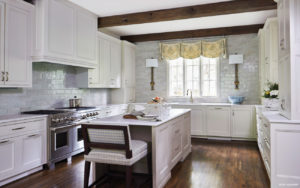
Interior designer: Cyndy Cantley, Cantley & Company, cantleyandcompany.com Cabinetry and hardware: Cantley & Company Appliances: AllSouth, allsouthappliance.net Countertops: Triton Stone, tritonstone.com Sconces: Village Firefly, villagefirefly.com Plumbing fixtures and sink: Fixtures & Finishes, fixturesandfinishes.com Kitchen table: Henhouse Aniques, henhouseantiques.com Chairs: Patina, shoppatina.com Kitchen paint color: White Dove, Benjamin Moore, benjaminmoore.com

Photo by Jean Allsopp

Location: Mountain Brook

RESOURCES
Designer: Danielle Balanis Design Architect: Chad Bryant, C.M. Bryant Architecture Builder and interior wood finishing: Francis Bryant Construction, francisbryant.com Cabinets: Cotton Woodworks, cottonwoodworks.com Hardware and lighting: Fixtures & Finishes Countertops: Montclair Danby Marble from Surface One, surface1.com; walnut Countertops from Cotton Woodworks Tile/backsplash: Floor & Decor, flooranddecor.com Sink: Surface One Faucet: VW Gallerie, vwplumbingsupply.com Lighting: Fixtures & Finishes Hardwood floors: Alabama Hardwood Floors

Photo by Jean Allsopp

Location: Homewood

RESOURCES
Plan designer:
Crystal Tucker, Twin Construction, twincompanies.com Builder: Twin Construction Interior designer: Laurie Fulkerson, Twin Interiors Cabinet Hardware: Brandino Brass, brandinobrass.com Countertops: Surface One, surface1.com, Triton Stone, tritonstone.com Backsplash: Triton Stone Cabinets: Parsons Cabinetry

Photo by Jean Allsopp

Location: Hollywood

RESOURCES
Kitchen renovation: Shea Bryars Design, sheabryarsdesign.com Builder and kitchen cabinets: Daniel Logan, Blackstone Restoration Hardware: Brandino Brass, brandinobrass.com Countertops and backsplash: Surface One, Matt Webster, surface1.com

Photo by Jean Allsopp

Location: Highlands, North Carolina

RESOURCES
Interior Design: Jan Ware, Jan Ware Designs, janwaredesigns.com Architect: Jeremy Corkern, Jeremy Corkern Studio, jeremycorkernstudio.com Builder: Jim Robinson, Design South Builders, LLC, designsouthbuilders.com

Photo by Jean Allsopp

Location: Mountain Brook

RESOURCES
Architecture: Standard Creative, standardcreative.com Kitchen design: Cyndy Cantley, Cantley & Company, cantleyandcompany.com Interior design: Aimee Belden, Belden Designs, LLC. Construction: Hufham Farris Construction hufhamfarris.com Countertops: Stone Concepts Hardware: Architectural Hardware Supply ahardwareman.com. 

Photo by Jean Allsopp

RESOURCES
Designer: Katie Morrow, [email protected] Architect: Taylor Davis, tpdarchitect.com Builder, custom cabinets, banquette: Daniel Miller Hardware: Lew’s Hardware lewisdolin.com Appliances: Ferguson ferguson.com Countertops: Surface One, surface1.com Tile/backsplash: Robert F. Henry Tile Co. henrytile.com Lanterns: Neiman Marcus neimanmarcus.com Tape lights: Mayer Lighting mayerlighting.com Sound system: Sonos sonos.com Hardwoods: Precision Flooring precisionflooringinc.com Details: hood: Venetian plaster: Daniel Whitsett Paintworks Design Studio LLC Wicker chairs: Serena & Lily serenaandlily.com Paint colors: Benjamin Moore Hale Navy and White Cloud benjaminmoore.com

Photo by Jean Allsopp

Location: Mountain Brook

RESOURCES
Interior Design: Aimee Belden, Belden Designs, LLC Architect: Lissy Frese, CCR Architecture & Interiors, ccrarchitecture.com Hardware: Avondale Specialty Hardware, avondalespecialtyhardware.com

Photo by Holland Williams

Location: Montgomery

RESOURCES
Interior designer: Marianne Strong Interiors, 205.222.8876, mariannestronginteriors.com

Photo by Jean Allsopp

Location: Anniston

RESOURCES
Interiors: Lucy Smith, Lucy Smith Designs, lucysmithdesigns.com; Lisa Flake, Caldwell Flake Interiors, caldwellflake.com Contractor: David White Construction Kitchen Cabinet Color: Repose Grey, Sherwin-Williams, sherwin-williams.com

Photo by Jean Allsopp

Location: Mountain Brook

RESOURCES
Interior designer: Megan Houston, meganhoustondesign.com Builder: Chris Farren, Benchmark Specialties Cabinets: Cotton Woodworks, cottonwoodworks.com Hardware: Brandino Brass, brandinobrass.com Appliances: Ferguson Bath, Kitchen & Lighting Gallery, ferguson.com Countertops: Triton Stone Group, tritonstone.com

Photo by Laurey Glenn

Location: Tuscaloosa

RESOURCES
Designer: Jenny Edwards, J. Edwards Interiors, jedwardsinteriors.com Builder: William Blakeney, William Blakeney Building Company Cabinets: Livingston Cabinets, Coker, Alabama Hardware including custom kitchen shelving: Brandino Brass, brandinobrass.com Porcelain Stone Countertops and Backsplash: Triton Stone, tritonstone.com

Photo by Jean Allsopp

RESOURCES
Designer:
 Katrina Porter, Katrina Porter Designs, katrinaporterdesigns.com Builder: Slate Bargainier Building, slatebargainier.com Cabinets and touch latches: Matt Parsons, Parsons Cabinetry, mattparsonscabinetry.com Appliances: AllSouth Appliance Group, Inc. Countertops: Will Casey, Cottage Supply Company, cottagesupplycompany.com; Synergy Stone, synergystoneinc.com Backsplash: Triton Stone Group

Photo by Jean Allsopp

Location: Vestavia Hills

RESOURCES
Interior design: Katrina Porter, Katrina Porter Designs, LLC, katrinaporterdesigns.com Construction: Slate Barganier Building, Inc., slatebarganier.com Barstools, dining room sofa: Argent Antiques, argentantiques.com Kitchen runner: Eighteenth Street Orientals, 18thstreetorientals.com Custom cabinets: Katrina Porter, Crafted by Village Woodworks Fabrication of steel cabinets and hood: Bradford and Hines, bradfordandhines.com Alabama white marble slabs: Triton Stone, tritonstone.com Cabinet hardware: Brandino Brass, brandinobrass.com

Photo by Jean Allsopp

Location: Homewood

RESOURCES
Designer: Tammy Connor Interior Design, tammyconnorid.com Cabinetry: Lane Woodworking, lanewoodworking.com Plumbing and tile: Fixtures and Finishes, fixturesandfinishes.com Appliances: Ferguson, ferguson.com Countertops: Pacific Shore Stones, pacificshorestones.com Hardware: Brandino Brass, brandinobrass.com Pendant lights: The Urban Electric Company urbanelectricco.com Stools: Tammy Connor Interior Design Fouta towels: Suite Dreams Dinnerware: Table Matters, table-matters.com

Photo by Jean Allsopp

Location: Lake Martin

RESOURCES
Interior Design: Jenny Edwards, J. Edwards Interiors, jedwardsinteriors.com Architect: Jeffrey Dungan, Jeffrey Dungan Architects, jeffreydungan.com Builder: Kevin Shubird, WSC Distinctive Builders, LLC, wscdistinctivebuilders.com

Photo by Jean Allsopp

Location: Mountain Brook

RESOURCES
Interior design: Melanie Pounds, Patina Builder: Chris Franks, Franks Building Co., franksbuildingcompany.com Backsplash & tilework: Triton Stone, tritonstone.com Hardware: Brandino Brass, brandinobrass.com

Photo by Jean Allsopp

Location: Mountain Brook

RESOURCES
Interior designer: Sarah Jernigan Designs, Inc., sarahjernigandesigns.com Builder and Interior wood details and finishing: Bill Meadows, Meadows Homes, Inc. Cabinets: Allen Deal, Deal’s Cabinetry Co. Cabinet color: White Dove, Benjamin Moore, benjaminmoore.com Appliances: AllSouth, allsouthappliance.net Countertops: Cottage Supply Co., cottagesupplycompany.com Tile/backsplash: Ann Sacks, annsacks.com Cabinet finishing: Coverwalls, coverwallsal.com, 205.368.3066 Dining bench: Lee Industries, leeindustries.com

Photo by Art Meripol

Location: Southside

RESOURCES
Architect: James F. Carter Architect, jamesfcarter.com Contractor: Slate Barganier Building, slatebarganier.com

Photo by Jean Allsopp

Location: Mountain Brook

RESOURCES
Interiors: Kate Hartman, Chickadee, chickadeeinteriors.com Architect: Scott Torode, Pfeffer Torode, pfeffertorode.com Kitchen cabinets: custom hardware: Emtek emtek.com Appliances: Wolf subzero-wolf.com Countertops, tile, backsplash: Synergy Stone, synergystoneinc.com

- Sponsors -

California Cool

This house was like nothing we had seen before in Birmingham—it had great bones and lots of custom accents, and we knew we could put our touch on it to make it work us,” says Melissa Colvin, who along with her husband, Whit, fell head-over-heels for the modern Brookwood Forest home from the first moment they saw it. Designed by Israel & Associates and inspired by the High Museum of Art in Atlanta, the house offered lots of open space, lofty ceilings, a private lot, and too-many-to-count windows letting in an abundance of natural light. However, the 7,800-square-foot home also came with a lengthy list of updates needed to modernize its original 1988 design and create the sleek California look Melissa wanted.
To make it happen, the Colvins brought in two tried-and-true professionals-turned-friends—architect Brian Jernigan and interior designer Lisa Flake. Brian fashioned a better floor plan by moving around some doors. He also reconfigured the bathroom to create the ultimate master retreat. Lisa refreshed every room, opting for sleek white cabinets and a waterfall-edge island in the kitchen. For the décor, she chose varying shades of white, black, and earth tones to create continuity. Then she added interest with various fabrics and textures. “We achieved exactly what we wanted: a modern space that’s also welcoming and relaxing,” says Lisa. “It’s truly a showpiece.”

The main entrance opens to the great room and staircase. To make the staircase more of a statement piece, the Colvins removed its original and extremely outdated wood paneling and replaced it with a thick wall of glass anchored by discreet steel brackets in keeping with the sleek, minimal aesthetic.

“When buying art for a specific room, I want it to be the last layer that defines the room,” Lisa says. A black sculpture from one of Lisa’s go-to Atlanta shops, Pieces, anchors a corner of the dining room. Other standouts include the illuminated sculpture from Gallery 1930 above the sideboard and the trio of framed works by Jane Timberlake Cooper that Lisa found at Maison by Pam Evans. A collage of Japanese prints by Frances Mayhall in the sitting room is from Circa Interiors & Antiques. The wire Vibia chandelier makes a serious statement above the white lacquered table and black, gray, and white ombré chairs from 1st Dibs.
“We absolutely love the modern feel of this house and all of the natural light. It’s the California style we really wanted.” –Melissa Colvin

Mad for Modern

Want to create your own modern masterpiece? Designer Lisa Flake shares her style tips.

1) Choose furniture and accessories with simple lines and sculptural appeal. In the den, sling-back camel-colored cowhide chairs play off the chunky, custom cocktail table by Ben Bludsworth.

2) To keep a space from feeling cold, opt for warm undertones. Think honey-hued neutrals and warm grays in fabrics and finishes. Add in well-edited, personally meaningful art and accessories, such as the figure by local artist Catie Radney.

3) Maintain a consistent color scheme. White, black, and earth tones create drama and allow the black furniture and accessories to pop.

4) Consider scale. Because of the home’s soaring ceilings, abundance of windows, and open layout, we opted for heavy furniture to ground the rooms and then added interesting fixtures and bold artwork to draw the eye upward. The fireplace makeover in the great room helps delineate spaces thanks to its strong, architectural lines and black marble.

5) Add depth with texture and contrasts. In the den, an Italian 3D-surfaced tile creates interest above the fireplace. In the master bedroom, an antique desk chair and starburst mirror add just enough of a playful mix of styles.

In the master bedroom, Lisa paired a desk from CB2 with a lamp from Circa Interiors & Antiques. Above the desk is one of Melissa’s favorites pieces: custom artwork by McKenzie Dove.
Before With its pink tile and jetted tub, the master bathroom design was as dysfunctional as it was outdated. After Reconfiguring the space allowed for the addition of a see-through shower that overlooks the pool. Marble walls from Triton Stone, fluted wood cabinets, and a freestanding tub keep the room simple so as not to compete with the view.

RESOURCES
Interior Design: Lisa Flake, Caldwell Flake Interiors, caldwellflake.com Remodel architect: Brian Jernigan, wmbrianjernigan.com Fireplace design: Gary Justiss, garyjustiss.com Fireplace insert: Southern Fireplaces, southernfireplaces.com Kitchen backsplash: Crossville Studios, crossvillestudios.com Kitchen barstools: Details, 205.870.8005. Rugs: Hiltz Lauber, hiltzlauber.com Wall color throughout house: Decorator’s White by Benjamin Moore, benjaminmoore.com Glass stair railing in entrance and mirrors in master: Birmingham Glass Works, birminghamglassworks.com Pool: Swimrite Pool Services, swimritenow.com, GreenGo Aquatics, greengoaquatics.net

- Sponsors -

Lake Escape

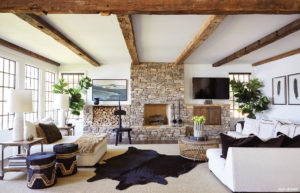
The playroom’s living area is an addition to the original home’s footprint. The ceiling in this space drops to a cozy 12 feet from the game area’s lofty 20+ feet. As a counterweight to the large game room, Jenny added ceiling beams and a “big wall of stone to help balance the weight of everything on the other side without overcrowding it,” she says. Furniture from Patina sits on a sisal rug from Design Materials. A black cowhide rug from Southeaster Salvage completes the space. Photos by Jean Allsopp

When we bought our lake house more than 10 years ago, our kids were still in junior high,” says designer Jenny Edwards of their home at Willow Point, a Russell Lands On Lake Martin neighborhood. “We knew we would renovate one day, but we were not in a hurry.” While her family of four settled in to enjoy weekends away from their full-time home, Jenny observed “how life was then, how it evolved, and how it might look moving forward.” Over the years, one thing remained a constant: “My kids always wanted a lot of people at the lake,” she says. “They still do. They are just bigger people now!”

Today, her children are college-age young adults. “They aren’t able to come to the lake as much,” Jenny says. “Since my husband, Lee, and I are there alone a lot, we wanted to have a master suite, kitchen, living, and outside spaces where we could spend time without being in most of the house. We envisioned living in a quadrant when we were the only ones there but also having lots of bedrooms and baths for the kids and their friends, as well as for grandkids one day.”

The playroom, which is several steps down from the main level, includes a pool table, a bespoke leather-and-iron ping-pong table, and a custom-made, antique-pine bar by Van Nostrand Cabinets. A lantern by Mr. Brown through J. Edwards Interiors, makes a statement above the bar, while sconces by Visual Comfort through Mayer Electric offer additional lighting.The Ms. Pac-Man arcade game is Jenny’s personal favorite. “I went to the mall with my friends every Friday night in 6th grade, and all we did was play Ms. Pac-Man,” she says. “My kids try to beat me all the time, but I always win!”

With her “space for us and space for them” theory in mind, Jenny upgraded and updated finishes and furnishings in existing spaces and bumped out the footprint here and there. “We added space off the playroom and added to the porches off the master suite and kitchen,” she says. What was originally a three-bedroom, two-bath home now has eight bedrooms and six-and-a-half baths, thanks to some careful rearranging and the use of the home’s previously unfinished attic space.

Since the house sees a lot of activity, Jenny focused on making it beautiful yet durable. For example, the floors throughout the home are Coretec Plus luxury vinyl tile installed in long runs of wide planks. “The tiles give the appearance of real hardwood, but they are indestructible,” she says. “I didn’t want to worry about wet swimsuits or drinks being spilled.” Other durable choices that help the hosts relax include slipcovered furnishings and outdoor-rated upholstery.

In the kitchen, Jenny splurged on the things that matter most to her. High-end touches include a waterfall soapstone counter on the island and Alabama white marble counters on the perimeter cabinets, all from Triton Stone. Kitchen cabinet hardware from Brandino Brass adds a finishing touch. Budget-friendly, side-by-side ovens from AllSouth Appliance sit beneath a cooktop. “Since I don’t cook, I didn’t want to spend a lot on appliances,” she says. Nearby, a tall cabinet with a pivoting pocket door serves as an appliance garage for those non-chef must-haves: microwave, toaster, and panini grill. Pantry storage hides behind wood cabinet doors built by Van Nostrand Cabinets. The butler’s pantry houses an icemaker, coffee maker, and two more fridges filled with drinks “because in the summer at the lake, that’s what people want,” Jenny says.

“Even though the interiors of the house are white, I wanted to create a cabin feel. The design elements have an outdoorsy, rough, natural aesthetic. There’s not a lot of fluff.” —Jenny Edwards

To keep a cabin feel, Jenny added shiplap siding and natural wood ceilings throughout the house. She painted everything in Benjamin Moore’s Sea Pearl. Textile mill beams in the keeping room and hand-hewn barn beams in the playroom, all from Evolutia, add rustic touches. Jenny also chose a muted white-beige-gray color palette for the fabrics, art, and accessories to bring the surrounding landscape inside. “The lack of pattern is purposeful so that it looks different from what I have at home,” she says. “That’s what makes it feel like a true getaway.”

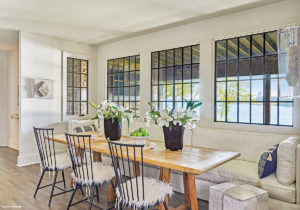
Just beyond the kitchen, a 16-foot-long banquette, custom-made through Jenny’s design firm, hosts a dining table and more chairs. “It’s an eating sofa,” Jenny says, “so folks will linger there after a meal.”
People also hang out in the adjoining keeping room, where white slipcovered seating surrounds a massive tree-trunk coffee table from Design Supply. Slipcovered furniture pieces, along with a sisal rug by Design Materials, offer beauty yet durability. A “bird’s nest” light fixture from Patina connects the interiors to the outdoors.
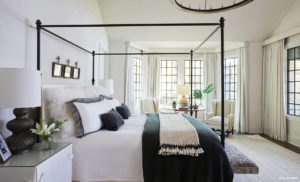
For the master bedroom, the designer chose a Pottery Barn bed. Restoration Hardware shams and lumbar pillows pair with a matelassé bedspread from Target. A rug from Fibreworks anchors the space.
In the master bath, Jenny used square marble tiles from Triton Stone, rather than an expensive slab, to create a shapely backsplash behind the tub.
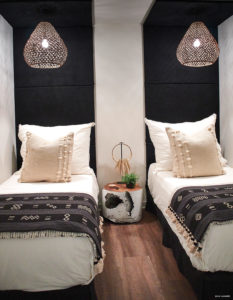
When it came to bedrooms and sleeping spaces, Jenny got creative to accommodate as many people as possible. “When the children were younger, we could sleep a lot of kids in bunks or full beds,” she says. “But now that they’re older, they want their own space.” To create more private sleeping areas, Jenny turned a large, unused closet into a cozy twin bedroom (above). Instead of using headboards, she topped the twin mattresses with painter’s canvases painted black and covered in black burlap. The white teak side table is from Patina.

Jenny Edwards

“I’m a spend-and-save kind of girl. That’s what keeps a house from looking like you went out and bought it all together,” designer Jenny Edwards says. “Everything doesn’t have to be super expensive for it to look good. I shop everywhere. I mix old stuff with Target and everything in between. If you put it all together well, you can have a plethora of items that will look good and flow together.”

RESOURCES
Interior Design: Jenny Edwards, J. Edwards Interiors, 205.870.5100, jedwardsinteriors.com Architect: Jeffrey Dungan, Jeffrey Dungan Architects, 205.322.2057, jeffreydungan.com Builder: Kevin Shubird, WSC Distinctive Builders, LLC, 334.567.4715, wscdistinctivebuilders.com

- Sponsors -

Outward Bound

Although the property’s irregular pie shape and setbacks limited the scope of the expansion, the goal was always to maximize views and get as close as possible to the water. “Our initial thinking revolved around the fact that no design, no matter how well thought out, would be able to compete with the natural beauty of the scrub, the dunes, and the breathtaking Gulf,” says Paul. The expanded covered porch accommodates a generous conversation area. Furniture was selected for practicality and positioned for flexibility and views. Two daybeds are low and can easily be moved to take advantage of sun or shade without obstructing sight lines. Photos by Jean Allsopp

No strangers to the 30A scene, this Birmingham couple had previously owned houses in Rosemary Beach, WaterColor, and WaterSound. But none of these homes had been located right on the Gulf.  As soon as they saw this oceanfront home in Old Florida Beach, they knew they had discovered a hidden gem. The location was ideal, and the floor plan lent itself to expansion. The owners knew exactly what they wanted in the renovation and wasted no time getting to work. “Within six hours of walking the property, we had drawn up a plan,” says the wife. Next, they met with 30A architect Paul Geary of T. S. Adams Studio. “We know there’s nothing worse than a client showing up at the first design meeting with plans they’ve already drawn,” the wife laughs. “Luckily, Paul didn’t kick us out of his office.”

The first order of business was taking the original house down to the foundation and two walls. Then Paul set out to integrate livable, gracious rooms within a new footprint, while instilling exteriors and interiors with a fresh take on the traditional Florida Cracker aesthetic.

Rip Thompson of Rip’s Professional Lawn Care designed a landscape plan with mature oaks, palms, and a myriad of native plantings, allowing the renovated house to fit into the established neighborhood.

The original house had main living spaces and a master bedroom on the upper level, resulting in a series of small cut-up rooms. “We quickly realized that if we relocated the master bedroom to the first floor, it would vastly open up the view in the second-level living areas, which is where it really counts,” says Paul. The owners also decided that the original two-car garage could be better utilized as finished space for guest bedrooms. These two concessions created a world of opportunity and served as the game-changers in terms of enhancing and increasing the liveable square footage.

To connect the interiors to the outdoors, five sets of French doors swing out to welcome in sunlight and ocean breezes. In keeping with the classic Old Florida feel, reclaimed cypress in natural tones enlivens the ceiling and pairs with random-width, tongue-and-groove wood on the walls. The generous kitchen anchors a corner of the main space without being front and center. “I like to be part of the action, but I’d rather not feel like I am cooking in the living room,” says the wife. It’s just one more aspect of the home that the couple loves. Adds the husband, “We’ve come full circle along 30A, but this is where we were supposed to end up.”

With an eye towards the Gulf for inspiration, the architect crafted a vacation retreat to meet the needs of family gatherings and modern-day living. Interior furnishings and finishes offer a neutral palette, allowing the emerald greens and blues of the water to be the main source of color. A textured fireplace crafted of antique bricks anchors the gracious sitting area.
Relocating the interior staircase away from the center of the house allowed the architects to maintain an open-concept kitchen while creating a greater, uninterrupted flow between the living and dining areas. This seamless connection brings water views into focus in every space. The new kitchen offers counter seating for casual dining—a must for grab-and-go lunches at the beach.
As a bonus, the relocated stair made room for a breakfast nook with built-in banquette seating tucked behind the stair railing.
Rearranging and adding space on the upper level carved out a sunny spot nicknamed “The Mom Cave.” When the husband and two sons are engrossed in football, the wife has her own escape. “It was imperative that this room not be relegated to the street side away from the view,” says Paul. “We carved it out at the end of the great room overlooking the porch.” Two sets of French doors allow privacy when closed or a welcoming flow when open. With its layers of implied age, the space feels like an old porch that was “taken in” for more interior space.
Relocating the master suite downstairs was necessary to devote more square footage to living areas, but the new space needed something wonderful to make up for the asset it lost. “We had only a sliver of land left at our disposal,“ says Paul. “While the owners initially didn’t want a pool, the more we refined the floor plan, the more we felt the pool would create an unanticipated private outdoor space and something to overlook.”
French doors swing open from the bedroom to a new shady enclave and terrace. The pool level was built up, allowing the porch edges to became the pool’s coping. Scrub oak along the outside of the porch creates a sense of privacy.
Facing the street, a front screened porch runs the length of the house. Flowing curtains offer privacy for an oversized, swinging daybed.
The new “sunset porch” allows ample space for family and friends to take in panoramic vistas.

Before & After: A Little Bigger, A Lot Better

The original floor plan was basically a box of a house with wrap-around porches. The goal was to follow the setbacks and bump out the structure, adding outdoor rooms as close as possible to the water. Accommodating the pool was a major concern. After exploring various options, the owners and architect came up with a garden arbor trellis that angles out and over the pool. Large screen panels fill in the void areas to maintain the Florida vernacular theme of the architecture. Two guest bedrooms with private baths on the first floor now occupy the prime space previously devoted to the garage. The rest of the first floor accommodates the master suite with sweeping views of the Gulf. A third guest bedroom, conveniently located on the second floor, allows even more space for overnight visitors.

RESOURCES
Architect Paul Geary, T.S. Adams Studio Architects, 404.262.3499, tsadamsstudio.com Landscape Designer Rip’s Professional Lawn Care, 850.233.6396

- Sponsors -

Field of Dreams

Natasha McCrary is passionate about sharing her family’s mission of education and preservation on their north Alabama farm. Photos by Jean Allsopp

The town of Mooresville, Alabama, can trace its origins back to 1818—a full year before Alabama even became a state. However, it was 2011 when the farm named in tribute to that year began in earnest. On a family vacation, Natasha and Laurence McCrary’s then-8-year-old son, Gamble, became enamored with English Southdown Babydoll sheep while visitng a petting farm. Afterward, the sheep were all he could talk about. “He wanted to have one, he wanted to sell the wool, he wanted to sell the manure—he has always had an entrepreneur’s mindset,” says Natasha. It seems that the apple doesn’t fall far from the family tree in North Alabama, and soon Natasha was researching the sheep herself and thinking about how she could raise them at their farm just outside of Huntsville. “It became a family project,” she says. But the Babydoll sheep were just the beginning of the pastoral adventure. “We started with the sheep and then added raised beds and backyard chickens,” says Natasha. “The produce took off, and soon we had restaurants asking to buy from us. It just grew organically from there.”

Through a lot of trial and error, paired with the family’s keen business sense, farm life evolved. “We now focus our gardening efforts solely on flowers, with over 11,000 flowers growing on the farm,” says Natasha. “But we realized that a small business cannot rely on just one revenue stream, especially with a farm. When a frost hits the garden, you still have to bring in some income to feed the animals. So that is how the whole 1818 Farms bath line was born.”

At the 1818 Farms production facility in Huntsville, a line of Kitchen-Aid stand mixers aerates batches of skin saver while workers make cuticle balms, place labels on linen sprays, and package up the coveted beard oil. Natasha shows off some dried flower wreaths she is producing. Her zero-waste policy is clearly in place as she points to craft-paper cones filled with dried petals, or “wedding confetti” as she likes to call it.

“Education and preservation are at the heart of everything we do here at 1818 Farms. We are so lucky to get to share this love with our customers all over the world!” —Natasha McCrary

Just last fall, Natasha was honored to receive the Woman-Owned Small Business of the Year award as part of Amazon’s first Small Business Spotlight Awards program, besting more than 1,300 other nominees. Not only does this additional outlet expose her products to more consumers, but also, as part of her award, Natasha will have her own designated Amazon marketing representative for a full six months. At the rate that her business is growing, it won’t be long before everyone has fallen in love with those Southdown Babydoll sheep, just as much as Gamble did. Just don’t ask Natasha to part with one of them. They are permanent 1818 Farms residents—and reminders of where it all began.

About those Precious Sheep

Southdown Babydoll sheep originated in Southdown, England, but were brought over to this country in the 1700’s for their prized wool and meat. (The McCrarys do not eat their sheep, whom they care for like pets.) In the centuries that followed, cross-breeding produced less-desirable results, and the breed was almost lost. By the 1990’s, there were fewer than 500 sheep left. Committed to preserving the breed, the McCrarys are vigilant with their sheep, who are now glorified lawnmowers. They still get sheared once a year, and visitors are invited to come for the event (see website for details). Natasha has future plans for turning the wool into an affordable item that customers will love.

Events

The McCrarys host visitors at the farm each spring for sheep-shearing day. (Try saying that 10 times fast!) Other events on the farm include calligraphy workshops, wreath-making classes, and bloom-strolls through the garden. Details can be found online or by following the farm on Instagram: @1818Farms.

Beauty

Everyone loves to be pampered with products from 1818 Farms. Ladies especially like the scented signature shea cream and linen spray, while the men go for the beard oil and cuticle treatment. Products and gift boxes are available on the 1818 Farms website (1818farms.com), as well as on Amazon’s “Handmade” website: amazon.com/handmade/1818-Farms

Blooms

Ceasing produce production was a business decision for Natasha. As she says, “Flowers are a luxury item. Very rarely will you have someone dispute the price of a flower, whereas you can go to market with a beautiful heirloom tomato and customers will haggle over the price. It is a very strange concept, but it’s true!” Now the farm boasts more than 11,000 blooms. Varieties include Lisianthus, Ranunculus, Anemones, Zinnias, Gomphrena, Celosia, Amaranthus, Strawflowers, Snapdragons, Sweet William, and Rudbekia.

- Sponsors -

Spotlight: Kristie Stewart of LillieKat Rugs

Photos by Jett Walker

From Instagram to Storefront
Ten years ago, I wouldn’t have taken the risk of opening a shop. I started on Instagram because I saw other people selling art and antiques. I thought it would be an easy way to have a “store” without having the overhead of a physical space. It worked beautifully for two years, but my Instagram exploded this past year. I ship rugs all over the United States yet I was lacking the space to show rugs to local clients. It just seemed like the next step. I truly believe that to be successful as a business 2020, you need to have all three mediums—a website, a strong social media presence, and a brick-and-mortar store.

From Lawyer to Design
My real love for interiors started when I was in law school in Jackson, Mississippi, and clerking with a local law firm. On weekends, I would often house-sit for one of the partners and his wife. I remember being amazed at their home. The interiors, the art, and the rugs—it was all perfect. I spent lots of time studying how they had mixed antiques and modern pieces. I enjoyed doing that a million times more than working at the law firm!

The Path to Rugs
My initial goal was to buy a few rugs for our new house, but it was a struggle to find quality, one-of-a-kind rugs that I could afford. Eventually, I connected with an amazing rug source through a friend, and I found a couple of great rugs that fit my budget. A few weeks later, it hit me that others were likely in the same predicament when shopping for rugs. My business started with me handpicking five rugs for resale, and it just snowballed from there. I love digging through hundreds of rugs to find the perfect ones for my clients. 

Around Town
Birmingham is lucky to have so many great designers and shops! I can’t even begin to list all the local designers that I stalk on Instagram. For interiors, accessories, and art, I love Patina, Circa Interiors & Antiques, Maison by Pam Evans, Details by Liz Hand Woods, Defining Home, and Alkmy, just to name a few. And my storefront at Pepper Place is neighbors with Design Supply, Richard Tubbs, FarmStand, Yellow Hammer Creative, and Billy Reid! For all of my personal necessities, I shop Tulipano, Stella Blu, Milla, Etc., and Beaute Therapie. The majority of these local businesses are owned and run by some of my favorite females!

Best Advice
I was a lawyer for 15 years and felt like because I had earned a law degree, I had to use it in some capacity. To completely take a left turn at the age of 44 was terrifying. Thank goodness I have a husband, two daughters, parents, and friends who encouraged me to keep moving forward. I like that we live in a time where anyone can have a second chapter in life. It’s about growing, changing, and improving. I’ve enjoyed showing my girls that you can shift gears and reinvent yourself at any age.

LillieKat Rugs • 2821 2nd Avenue, South, Suite A1, Birmingham, AL 35233
205.535.3090 • lilliekatrugs.com • IG: @lilliekatrugs • FB: LillieKat Rugs
Call for appointment

- Sponsors -

Let the Planting Begin

Angelonia

March means the start of spring for Birmingham. Warmer days paired with cold nights delight many of our early blooming plants. And when April rolls in with even more warmth, our city bursts into full bloom. While daffodils, deciduous magnolias, quinces, and forsythia give us a taste of spring color in March, the real riot of color appears in April.

Daffodils

I do love gardening in March because I can bundle up for the cool mornings and then shed some layers mid-day as the temperatures rise. Throughout this month, I enjoy adding shrubs and trees to fill in my garden where needed. However, I always wait until mid-April or later to plant any tender summer annuals or perennials. Of all the bulbs we grow in our gardens around Birmingham, I think daffodils are the easiest and most critter-proof. Once planted, you can basically leave them alone until they are so crowded that bloom count is reduced. This signals the need for thinning and separating. Many people think that since you plant daffodils in the fall, you should wait until then to separate the clumps that are not blooming. I prefer not to wait. Once the foliage starts to yellow and die on the overcrowded clumps, I dig the bulbs, separate them either singly or in clusters, and then replant. It is certainly okay to separate and dry them for later planting as well, but I have found that this is not necessary. Before planting the separated bulbs, you need to prepare the soil for replanting. The better the soil is prepared, the better they will bloom next spring. When I plant at this time of year, I make sure the bulb tips are covered with soil and marked so that I won’t disturb them when doing additional planting in the area.

The two things that we all want to do in early spring are prune plants that need shaping and cut back hard shrubs that have gotten out of hand. My general rule is that plants that have not put out leaves can be pruned as desired, with the exception of florist/mophead-type hydrangeas that flower on last year’s growth. Of course if you want to prune spring flowering shrubs, I would wait until the flowering is finished. Also remember that if you cut back evergreens that fruit, you can expect a reduced number of berries produced.

With the warmer weather in early April, our inclination is to go buy summer annuals and perennials that are in the garden centers now. However, I like to wait until April 15th or later to plant these, as we will often still have frost a night or two before then. If you decide to risk it and plant earlier, be prepared to cover them to keep the tender plants from being killed by the frost. Also keep in mind that until the soil warms, these tender plants won’t grow much.

While marigolds, petunias, vinca, and other common annuals are great for this time of year, it’s also fun to try a few of the new things that are exceptional in our gardens like angelonia, portulaca, superbells, blue salvias, and all the new colors and looks of coleus for your sunny spaces. If your garden is shady, opt for some of the new colors of tried-and-true favorites like impatiens, begonias, and browallia. Or choose salvias, which are sometimes annuals and sometimes perennials. They grow very well in Birmingham gardens. Mexican sage is a must-have salvia for my garden and is a vital part of my fall flowering border. Other great bloomers include black-and-blue salvia, Victoria blue salvia, cirrus salvia (gray-white flowers), mystic spires blue salvia, and coral nymph salvia. Many garden centers carry a good selection of these plants, but don’t be afraid to use mail-order nurseries to secure unique ones.

While March and April are showstoppers when it comes to color in our gardens, these months are also the time to plan and plant your summer and fall garden annuals. After the danger of frost has passed in April, go ahead and make your choices while there are still good selections of plants available.

Floyd’s To-Do List: March/April

When cutting flowering branches to arrange indoors, cut the stems deep into the plant instead of just cutting the size you need. This will keep the plants attractive and will, in effect, prune them. Cut the branches that are partially open and showing color, place in tepid water, and bring indoors. When arranging them, be sure to recut the branches and remove any foliage or flowers that would be covered with water in the vase.

All gardens need a soil test, as it’s the best way to tell what you need in order to amend your soil for maximum plant growth. It’s easy to do, and the results are invaluable for plant health. Secure the soil test boxes and instructions at the Hanna Center at the Birmingham Botanical Gardens. Once you collect the sample, mail it to the soil-testing lab at Auburn University. You can get your online results quickly.

Overgrown flowering shrubs that need to be cut back hard after flowering should be done now. Forsythia, quince, spring flowering spirea, deutzia, and kerria can be cut to within a foot of the ground and will essentially generate new shrubs. Evergreen hollies, boxwoods, camellias, and barberry should be stage-pruned over a series of years for best results. This means you should reduce their size no more than a third of the plant each year. Make sure you remove foliage and branches that will allow light in the middle of the plant to encourage new growth.

Quince

The last seeding of lettuce, spinach, and other spring greens can be made in March. In late April, green beans, squash, cucumbers, and other summer vegetables can be planted. It’s okay to wait on planting tomatoes in order to have fruit throughout July and August. The soil is still too cold to seed okra, so I wait until May for best germination of my seeds.

One of my favorite things to do in the spring is to share wandering plants in my beds with my friends. I survey my garden and remove out-of-place plants. Once I dig them up, I divide them and repot into small pots. I like to see the dug-out plants growing in the pots before I give them away. Many well-established perennials can also benefit from removing a section of the clump before they put out their foliage.

Don’t forget about the great selection of summer “bulbs” that can be planted now. Asiatic and oriental lilies, dahlias, callas, crocosmias, gingers, and pineapple lilies are exceptional additions to my garden and can all be planted now. All of these have specific planting requirements, so be sure to follow the planting directions that come with them. One tip on planting lilies in our area is to dig a hole much deeper than the bulb. Then I add a 2- or 3-inch layer of compost followed by a fourth- to a half-inch layer of pea gravel. Place the base of the bulb on the gravel and cover with fertile soil. This will allow the lilies to grow in your garden for many years.

John Floyd has been gardening in the Birmingham area for more than 30 years. In addition to his day-to-day experience, John has degrees in horticulture from Auburn and Clemson Universities and was editor-in-chief of Southern Living. For daily tips and more garden information, visit birminghamgardeningtoday.com.

- Sponsors -